

The pp2pp Experiment at RHIC Elastic Scattering of Polarized Protons PowerPoint PPT Presentation
1 / 19
Title: The pp2pp Experiment at RHIC Elastic Scattering of Polarized Protons
1
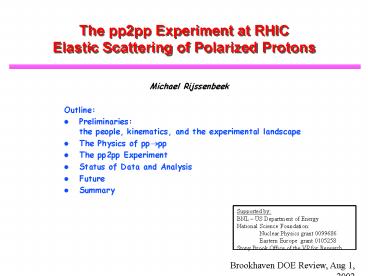
The pp2pp Experiment at RHICElastic Scattering
of Polarized Protons
- Michael Rijssenbeek
- Outline
- Preliminaries the people, kinematics, and the
experimental landscape - The Physics of pp?pp
- The pp2pp Experiment
- Status of Data and Analysis
- Future
- Summary
Supported by BNL US Department of
Energy National Science Foundation
Nuclear Physics grant 0099686
Eastern Europe grant 0105258 Stony Brook Office
of the VP for Research.
Brookhaven DOE Review, Aug 1, 2002
2
The People pp2pp Collaboration
- Total and Differential Cross Sections, and
Polarization Effects in pp Elastic Scattering at
RHIC
S. Bueltmann, B. Chrien, A. Drees, R. Gill, W.
Guryn, I. H. Chiang, D. Lynn, P. Pile, A. Rusek,
M. Sakitt, S. Tepikian Brookhaven National
Laboratory, USA J. Chwastowski, B.
Pawlik Institute of Nuclear Physics, Cracow,
Poland M. Haguenauer Ecole Polytechnique/IN2P3-CN
RS, Palaiseau, France A. A. Bogdanov, S.B.
Nurushev, M.F Runtzo Moscow Engineering Physics
Institute (MEPHI), Moscow, Russia I. G.
Alekseev, V. P. Kanavets, B. V. Morozov, D. N.
Svirida ITEP, Moscow, Russia M. Rijssenbeek, C.
Tang, P. Yaron, S. Yeung SUNY Stony Brook,
USA K. De, N. Guler, J. Li University of Texas
at Arlington, USA A. Sandacz Institute for
Nuclear Studies, Warsaw, Poland
3
Descriptive pp?pp
- Kinematics
- Dynamics
- s-Channel Helicity amplitudes fi (hi is helicity
of proton i) - Observables
- cross sections ?tot, ?elastic, ? ?
Re(A)/Im(A)t0 - s difference DsT ? stot?? stot ??, DsL
- Differential cross sections ds/dt
- Transverse spin asymmetries (N(t) ? dN/dt)
- Analyzing Power
- Double-Spin Correlation parameter
4
The Experimental Landscape
- Small t tlt10-3 GeV2
- Coulomb region
- Absolute prediction (direct measurement of L )
- Coulomb-Nuclear Interference (CNI) region,
t110?3 GeV2 ? ? Re(A)/Im(A)t0 ?
?(s)? - Medium t 10-3lttlt1 GeV2
- Nuclear region
- nuclear slope parameter b(s) and stot(s)
- Diffraction dip at t ? 1 GeV
- destructive interference between different
exchange amplitudes - Large t tgt3-6 GeV2
- Perturbative QCD elastic cross section is small
drops ? t-8 !
PP2PP reach2002
Pomeron Physicsnon-perturbative QCD
5
pp?pp Physics
- Elastic scattering (and diffraction) is still
poorly understood - Phenomenologically and historically all
scattering involves exchanges in the s-channel or
the t-channel - All non-elastic scattering involves exchanges of
known (virtual) particles with m2t lt0 - for 0ltlttltlts such scattering is well described
by Reggeon exchange exchange of families of
mesons lying on straight trajectories in a
J(spin) vs m2t plot - Regge the scattering amplitude A(s,t) goes as
where ?(t) is the Regge trajectory. Thus
- for meson trajectories a0 ? 0.0-0.5
- for Elastic scattering a0 ? 1.0 such a
physical object is unknown the
phenomenological Pomeron - Pomeron is unlike any other particle !
stot ? s1.01
stot
?s GeV
6
pp?pp Physics (contd)
- Elastic and diffractive scattering mediated by
the Pomeron - QCD mediator is a system of gluons with q.n. of
vacuum (JPC0) - At t?5 GeV2 calculations are
non-perturbativeElastic scattering probes the
soft, long-distance behavior of QCD - QCD is starting to make non-perturbative
predictions (Lipatov, et al.) predicts
existence of Odderon (C ?1, a0?1?e) gluonium
exchange, in addition to Pomeron (C 1, a0?1e)
exchange. - Sensitivity to Odderon in CNI (r) and dip
regions compare to ?pp ! - AN, which is sensitive to the hadronic spin-flip
in the CNI region, constrains models of nucleon
structure (e.g. quark-diquark models) - ANN and AN provide spin amplitude information,
and will constrain the different exchange
contributions Odderon/Pomeron. - Important to verify the t?8 drop at large t
(perturbative prediction). - Recent HERA (small x) and TeVatron (RapGap
events) results A soft vs hard Pomeron? - Low ?s Spin results (e.g. from AGS) dont fit QCD
expectations
7
Physics Range of pp2pp
TeVatron data are inconsistent!
- RHIC unexplored region in pp energy
- Highest pp energy so far?s 63 GeV (ISR)
- Next highest ?s 14 TeV (LHC)
- Compare to?pp at ?s 62.8, 540, 630, 1800 GeV
- Odderon contribution has opposite sign in?pp !
- Spin measurements are available only at low ?s ?
24 GeV - pp2pp s-range
- 50 ? ?s ? 500 GeV
- pp2pp t-range from Coulomb to beyond Dip
- 4104?t?1.5 GeV2
8
Physics of pp2pp
- RHIC has the UNIQUE capability for colliding
POLARIZED proton beams, further elucidating the
exchange dynamics - Beam energy between 25 and 250 GeV
- Transverse, Longitudinal polarization
- Polarization up to 70
- Polarization can be chosen on a bunch-by-bunch
basis (eliminates detection systematics!)
9
Physics of pp2pp (contd)
- Single Transverse Spin Asymmetry (Analyzing
Power) AN - Interference of hadronic non-flip amplitude with
electromagnetic spin-flip amplitude produces
calculable asymmetry (maximum 4 at t 0.003
GeV2) - Option for RHIC polarimetry
FNAL E704 data (1993)
pp2pp simulation (2003)(C. Tang, Thesis
SUSB,2001)
Projectedpp2pp 2002
N.H. Buttimore, B.Z. Kopeliovich, E. Leader, J.
Soffer, T.L. Trueman, The Spin Dependence of
High-Energy Proton Scattering, PR D59 114010
(1999)
- Measure the Pomeron spin-flip amplitude
- hadronic spin-flip amplitude accounts for
schannel helicity non-conservation at high
energy helicity-flip term of Pomeron can
indicate - isoscalar anomalous magnetic moment of nucleon
- helicity non-conservation in constituent
quarkgluon vertex - diquarkquark structure of nucleon
10
Physics of pp2pp (contd)
- Double Transverse Spin Asymmetry ANN
- Search for the Odderon
- Different (??/2) phases of Pomeron and Odderon
at t0 Enhanced Odderon contribution to ANN due
to interference with one-photon
exchangeCharacteristic peak near t 0.002
GeV2
E. Leader, T.L. Trueman, The Odderon and Spin
Dependence of High-Energy Proton-Proton
Scattering, PR D61 077504 (2000)
11
Physics of pp2pp (contd)
- dip region several dominant exchange amplitudes
- Study dynamics of diffractive pp scattering P,
PP, ggg - Single spin asymmetry AN especially interesting
in dip regionprevious measurements - appearance of negative AN asymmetry near t 1
GeV2 at Ös ?10 GeV - slow variation in 10 ? Ös ? 24 GeV range
- Compare pp with?pp, e.g.
Model from A. Donnachie, P.V. Landshoff , NP
B231 (1984) 189. (see C.
Tang, Thesis SUSB 2001)
12
The pp2pp Detectors
24 Scintillation Counter planes 2.5???5.5
z
x
Roman PotStation 1
LinearSlide
Station 2 (uninstrumented)
Vacuum
Bellows
UHVChamber
13
Roman Pot Si Detector Package
- 4 planes of 400 µm Silicon microstrip detectors
(BNL Instrum. Div.) - 2 X- and 2 Y-detectors 4.5 x 7.5 cm2
- Closest proximity to the beam 1.4 mm
- 8 mm trigger scintillator, 2 PMT readout
Al strips 512 (Y), 768 (X), 70µm wide100 µm
pitch
implanted resistors
Trigger Scintillator
1st strip?edge 490 µm
guard ring
bias ring
SVX2E (DØ)(and DØ Readout Controller)
Silicon Sensor (backside)
Tooling Balls
Si Detector Package
14
January 2002 Run
- Engineering run January 2002
- pbeam 100 GeV/c
- 1 Roman pot station in per arm, inelastic
detector around Interaction Point (IP) - Pots at 57 m from IP, Leff,y 23 m
- Kinematics range 0.005 lt t lt 0.02 GeV2
- Run
- 4 hours commissioning on 1/19/02
- 14 hours of data on 1/24/02
- excellent beam quality emittance 10p?mm?mrad
after scraping - Estimated Polarization 25
- 100 efficient data taking
- Collected 974k events (30 elastic triggers)
- Data will primarily be used to study detector
performance and to prepare for data run in 2003 - High quality of data will yield publishable
physics !
15
Data Analysis
- We are analyzing the 2002 data
- Calibration
- Precision survey of detector
- Calibration of Si channels (pedestals/gain) to
optimize hit recognition - Determine trigger efficiency
- Determine Si efficiency in x and y planes using
elastics - Acceptance calculation
- Data detector fiducial regions with high
acceptance - Simulations analytical, Geant using measured
transport matrix - Background determination
- Select events using cuts in corrected
collinearity distribution - Calculate beam halo, diffractive, and random
backgrounds - Determine differential dN/dt as a function of t
and extract nuclear slope b and possibly AN
16
Hit Patterns
- Raw Detector X-Y hit positions (no alignment
applied)100k triggerstight elastics (1 hit
in each plane)
17
Hit Correlations
- Arm-Arm Correlations
18
Plans
- 2003
- 2 More stations
- ?s 200 GeV
- Extend to smaller t 10?3 ? t ? 0.02 GeV2
- stot, selastic, b, AN, ANN
- More statistics!
- 2004-2005
- ?s 500 GeV
- Small t 410?4 ? t ? 0.13 GeV2
- stot , selastic, r, b, AN, ANN, and absolute L !
- Large t 0.1 ? t ? 1.3 GeV2
- Dip region and its spin dependence
19
Summary
- pp2pp will measure spin-dependent elastic
proton-proton scattering in a new kinematic
region RHIC Spin is UNIQUE Facility for
this! - pp2pp probes the Pomeron (Odderon)
- Large distance QCD
- Transition to pQCD
- First engineering run successful
- Working on 2002 physics results nuclear slope,
AN(N) - Next (2003-2005) finish building experiment and
complete physics program - UNIQUE opportunities at RHIC for pp?pp over the
next few years
Recommended

