

Top stop by charm channel analysis using D0 runI data PowerPoint PPT Presentation
Title: Top stop by charm channel analysis using D0 runI data
1
- Top stop by charm channel analysis
using D0 runI data - OUTLINE
- physics process of top to stop
- Monte Carlo simulation for signal
- data sample
- events selection
- QCD background estimate
- signal significance optimization
- conclusion
- Physics process
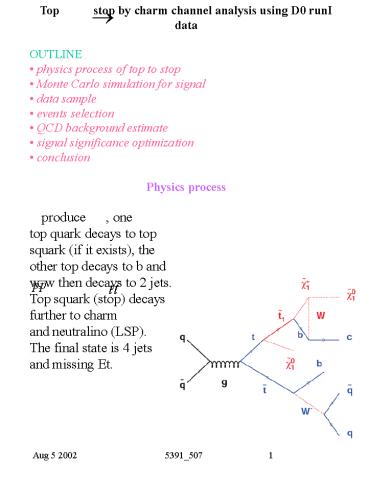
- produce , one
- top quark decays to top
- squark (if it exists), the
- other top decays to b and
- w, w then decays to 2 jets.
- Top squark (stop) decays
2
If the branching ratio from top to stop is b, the
standard model decay is 1-b, considering the
symmetry of and , the total cross
section is 2b(1-b) , here is
production cross section. Stop search status
3
(No Transcript)
4
5
- Data sample
- Using missing_et trigger data collected in
1993-1995 (RunI B) - at D0. The data was reconstructed by RECO version
12 with - jet-finding algorithm of cone size 0.5. It
includes run number - 72250-93115 and total 1,556,505 events. The
integrated - luminosity 81.23 (all bad run and
duplicated run are - removed).
- Event selection
- CLEAN CUT
- total scalar transverse energy is between 0 and
1800 GeV - primary vertex is (-60,60)cm
- veto MainRing events
- scalar transverse energy at MainRing region gt
-10GeV - JETS CUT
- at least 4 jets gt 15GeV
6
Ht CUT QCD ELIMINATION
7
(No Transcript)
8
VETO (top group loose
cut) PrezapOnly central toroid muon is
considered, fot posrzap both central and end
toroid magnets muons are considered. Muons are
required to have gt15GeV and not A-stub.
If Hfracgt0.6 Efracgt0 or Hfrac1, that muon is
good but will be vetoed only when it is isolated
(with closest jet gt 0.5 in distance) For Monte
Carlo sample, the muon will be rejected by rate
9
HOT CELL If one of the cells are removed by AIDA
and this cell is within DR0.5 of the axis of the
jet in space, this event will
be removed if this jets has and
10
MissingEt TRIGGER EFFICIENCY
11
VERTEX CONFIRMATION The misidentified vertex may
give rise mismeasured large , these events
are likely collected by our cuts as candidates of
our new physics. To eliminate these events, we
must confirm if the vertex is the true
interaction point. An event is a good candidate
of our signal if the following criteria
applies (1) At least one of the four jets is
central (2) There are good tracks in the event
corresponding to the central jet and their
distance is less than 0.4 (3) More than half of
these good tracks emanate from (-60,60) (4) There
are more tracks coming from primary vertex
than coming from 2nd/3rd vertices. Using jet_85
and jet_max data (STA/DST) to get
jetpointing efficiency. All jets are required
to have lt20GeV in order to avoid
misvertex. Two leading jets pass all the trigger
requirements and one jet also pass jetpointing
criteria, the ratio of the two jets give the
efficiencies.
12
Wjets decay modes selection
Use ISAJET lepton ID
and then
require invariant mass (78,82)
Use ID and also require the invariant
mass of the two objects be within (78,82)
and
hadronically decay Require the final product
have two leptons and both have the same ID11
leptonically
decay Exclude all the above three kinds of decay
modes, the remaining is this decay mode. QCD
estimate QCD Use jet_85jet_max
data to make spectra at low
region (20,40) but high region(110,130). Use
spectra func h
13
We can change the least square problem to a
2-d linea r regression to get the best fitting
of the spectra. The error is greatly reduced.
14
Signal significance optimization Let
60,70,80,90,100,110,120,130,140 GeV
40,50,60,70,80,90,100,110,120 GeV
70GeV arc10.5, arc20 Apply all the
cuts to background sample and data,
calculate merit function signal/sqrt(phy bkgQCD)
to get the best significance. Preliminary
results
15
(No Transcript)
16
- Next
- double check all the code and cuts
- improve acceptance and reduce errors
- Use equal-probabilities test to set limit at
95CL
Recommended

