

CATEGORY MANAGEMENT: The Merchandising Tool of the Future PowerPoint PPT Presentation
1 / 19
Title: CATEGORY MANAGEMENT: The Merchandising Tool of the Future
1
Retailing MKTG 6211
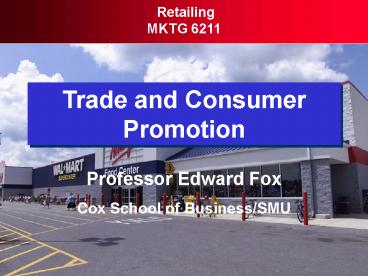
Trade and Consumer Promotion
Professor Edward Fox Cox School of Business/SMU
2
Types of Manufacturer Sales Promotions
- Consumer Promotions
- Objective is to influence consumer to purchase
product/service - Trade Promotions
- Objective is to influence retailer/wholesaler to
purchase product, and to promote it to the
consumer in turn - Business Promotions
- Manufacturer to business buyer
3
Growth of Sales Promotions
- Trade Promotion grows with roughly with
manufacturers dollar sales
Source A.C. Nielsen
4
How Important Are Promotions?
- Total Advertising and Promotion Budget
- by Spending type -2000
Trade promotion is 12 of gross dollar sales for
packaged goods manufacturers
Source A.C. Nielsen
5
Why the Prominence of Sales Promotions?
- Product managers face pressure to increase
current sales - Companies face competition in mature markets
- Advertising efficiency has declined
- Consumers have become more deal-oriented
6
Consumer Promotions
- Short-term incentives by the manufacturer to
encourage purchase of a product or service
Consumer-Promotion Tools
Consumer-Promotion Objectives
Advertising Specialties
Samples
Entice Consumers to Try a New Product
Coupons
Lure Customers Away From Competitors Products
Patronage Rewards
Patronage Rewards
Cash Refunds
Get Consumers to Load Up on a Mature Product
Contests
Price Packs
Sweepstakes
Hold Reward Loyal Customers
Premiums
Games
Consumer Relationship Building
Point-of-Purchase Displays
Source Adapted from Prentice Hall
7
Trade Promotions
- Short-term incentives by the manufacturer that
are directed to retailers and wholesalers
Trade-Promotion Objectives
Trade-Promotion Tools
Premiums
Price-Offs
Persuade Retailers or Wholesalers to Carry a
Brand
Allowances
Give a Brand Shelf Space
Displays Allowances
Patronage Rewards
Buy-Back Guarantees
Promote a Brand in Advertising
Discounts
Push Money
Push a Brand to Consumers
Free Goods
Specialty Advertising Items
Contests
Source Adapted from Prentice Hall
8
Effects of Consumer and Trade Promotions on
Consumer Behavior
- Expand category volume
- Cause brand switching
- Cannibalization
- Change purchase timing
- Cause stockpiling
9
Considerations in Executing a Trade Promotion
Source Adapted from Prentice Hall
10
Issues in Trade Promotion
- Accountability
- Profitability
- Long-term effects of promotions
These issues boil down to whether or not trade
promotion represents a good investment
11
Trade PromotionAccountability
- Dollars for buying or selling?
- Off-invoice allowances
- Scan-backs or bill-backs
- Forward buying
- Diverting / grey markets
12
Trade PromotionProfitability
- What proportion of trade promotion dollars are
passed through to consumers? - What proportion end up in the retailers pocket?
- Do the additional sales from a trade promotion
offset the reduced margins and the allowances
paid out?
13
Trade PromotionProfitability Example
- Consider the following trade promotion example
- Sales for Starkist light meat in-water tuna 6.5
ounces average one case (48 units) per store in a
retailer having 100 stores - The regular shelf price is .79 the retailer
pays the manufacturers price of .70 per unit
(gross profit is .09 per unit) Starkists
production and transportation cost is .42 per
unit (unit contribution is .28) - The retailers gross profit during a normal week
is 48 x 100 x .09 432 - The retailer can sell an average of five cases
per store during a promoted week if the
discounted retail price is .59 and the product
is advertised and displayed
14
Trade PromotionProfitability Example
- Starkist offers the following trade deal
- Price-off - 20 off the manufacturers regular
price for all product sold during the week
(scan-back) yields a case price of 26.88 or a
discount of 6.72 off the regular case price - Display allowance - 2.00 per case
- Advertising allowance - 1,500
15
Trade PromotionProfitability Example
- Retailer profitability
- Sales for the promoted week are 5 x 100 500
cases or 24,000 units - Revenues for the promoted week are .59 x 24,000
14,160 - Costs for the promoted week
- With the price-off, the cost of goods is 500 x
26.88 13,440 - Allowances are 500 x 2.00 1000 for display
and 1,500 for advertising - The promoted items weekly contribution is
therefore 14,160 - 13.440 1000 1,500
3,220, much more than the normal weekly
contribution of 432
16
Trade PromotionProfitability Example
- Starkists profitability
- For a normal week
- Revenues are .70 x 100 x 48 3,360
- Costs are .42 x 100 x 48 2,016
- Contribution is 3,360 - 2,016 1,344
- For the promoted week
- With the 20 price-off, revenues are 500 x 26.88
13,440 - Costs
- Production and distribution is 500 x 48 x .42
10,080 - Allowances are 500 x 2.00 1000 for display
1,500 for advertising - Contribution of the promoted item is therefore
13,440 - 10,080 - 1,000 - 1,500 860 less
than the normal weekly contribution of 1,200
17
Trade PromotionProfitability Example
- So assessing the profitability of a trade
promotion requires determining what would have
been sold had the promotion not occurred - But what about the effect on other brands (e.g.,
Chicken of the Sea) and types (e.g., white meat
tuna)? - But what about stockpiling borrowing from
future tuna purchases?
18
Trade PromotionLong-Term Effects
- Detrimental to brand health?
- Builds the habit of switching
- Teaches shoppers to buy on price
- Takes resources away from media advertising
- Builds brands?
- Encourages trial
Though there is little evidence of promotion
enhancing brand equity, results are inconclusive
about harming brand equity
19
Why Not Reduce Trade Promotions?
- If a manufacturer reduced trade promotions
- What would competitors do?
- Reduce, maintain or increase promotional levels
- What would retailers do?
- Punish or not punish the manufacturer
Example - Procter Gamble adopted value pricing
and lost roughly 5 market share
Recommended

