

SECONDARY DATA: Data collected for purpose other than research at hand' PowerPoint PPT Presentation
1 / 25
Title: SECONDARY DATA: Data collected for purpose other than research at hand'
1
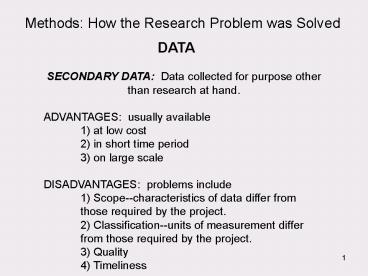
Methods How the Research Problem was Solved
DATA
SECONDARY DATA Data collected for purpose other
than research at hand. ADVANTAGES usually
available 1) at low cost 2) in short time
period 3) on large scale DISADVANTAGES
problems include 1) Scope--characteristics of
data differ from those required by the
project. 2) Classification--units of measurement
differ from those required by the project. 3)
Quality 4) Timeliness
2
DATA
SECONDARY DATA Data collected for purpose other
than research at hand.
TYPES 1) Cross sectional-data gather on
different sampling units at a particular point in
time. 2) Time series-data accumulated over a
sequence of equally spaced time
periods. SOURCES 1) internet 2) library 3)
internal documents 4) cd
3
DATA
PRIMARY DATA Data collected for the research at
hand. ADVANTAGE Designed to specifically fit
current project's needs. DISADVANTAGES 1)
expensive to collect 2) time consuming to
collect 3) low response rates SOURCE Primary
data are often collected in a survey.
4
RUDIMENTS OF SURVEY RESEARCH KEY TERMS
TARGET POPULATION Group under study. POPULATION
PARAMETER Characteristic (attribute, feature,
property, quality, trait, aspect) of target
population that is being studied. NB Population
parameters are VARIABLES A quantity capable of
assuming any of a set of values. SAMPLE
Selected segment of target population studied to
gain knowledge of the whole. SAMPLE STATISTIC
Estimate for the population parameter calculated
from the sample. NB Sample statistics are
variables too!
5
RUDIMENTS OF SURVEY RESEARCH KEY TERMS
SAMPLING PROCEDURE Method used to select the
sample. Depending upon the method, the sample is
either a RANDOM (PROBABILITY) SAMPLE All
target population members have a known, non-zero
probability of being in the sample. NON-RANDOM
(NON-PROBABILITY) SAMPLE Some target population
members have zero chance of being in the
sample. SAMPLING FRAME List from which a random
sample is drawn.
6
RUDIMENTS OF SURVEY RESEARCH KEY TERMS
SAMPLE SIZE The number of cases in the sample.
1) The most important determinant of sample size
is
VARIANCE.
2) As the sample size is increased, the error in
the sample statistic decreases, but at a
decreasing rate.
3) The optimal sample size is the one that
balances the benefit of reducing the error with
the cost of obtaining more responses.
7
(No Transcript)
8
(No Transcript)
9
- DRAFT-DAY GROUND RULES
- Exchange papers with the team across the aisle
from yours. Give Professor Sherony a copy of the
paper. - Individually read the paper. As you read,
evaluate the paper using the DRAFT
DAY--PRELIMINARY REPORT 1 EVALUATION CHECKLIST
WHITE FORM. - Members of the same team discuss the paper they
read and synthesize their comments by completing
DRAFT DAY--PRELIMINARY REPORT 1 EVALUATION
CHECKLIST COLORED FORM. - Both teams meet and take turns exchanging
comments and discussing the paper's strengths and
weaknesses. - Give the EVALUATION CHECKLIST COLORED FORM to
the other team when discussion has ended. Bring
this EVALUATION CHECKLISTS to small section this
week. - Turn in the EVALUATION CHECKLIST WHITE FORM. It
is worth 5 individual points and is a record of
your attendance at this session. - Turn in a copy of your PRELIMINARY REPORT 1.
10
Data Collection Methods
11
QUESTIONNAIRE DESIGN QUIZ Evaluate this
questionnaires design by identifying its
shortcomings. Base your critique on the
checklists for questionnaire design that is
posted on the website at Primary Data Collection
Techniques. Record your comments on the
questionnaire itself. Consider comments that
apply to the questionnaire overall, to a specific
part of the questionnaire or to specific
questions.
12
ERRORS BIASES IN SURVEY RESEARCH
SAMPLING ERROR The difference between a sample
statistic value and a population parameter value
that occurs because the sample does not include
the entire target population. WHAT YOU CAN
DO a) Increase the sample size. b) Use
statistical analysis to "gauge" the sampling
error
13
ERRORS BIASES IN SURVEY RESEARCH
NON-SAMPLING ERROR The difference between a
sample statistic value and a population parameter
value that occurs because mistakes are made
during sampling procedure. 1) NON-COVERAGE
Error resulting when sampling frame does not
include entire target population.
14
(No Transcript)
15
ERRORS BIASES IN SURVEY RESEARCH
NON-SAMPLING ERROR The difference between a
sample statistic value and a population parameter
value that occurs because mistakes are made
during sampling procedure. 1) NON-COVERAGE
Error resulting when sampling frame does not
include entire target population. WHAT YOU CAN
DO a) Know your target population. b) Carefully
construct a comprehensive sampling frame. c)
Define the target population based on the
available sampling frame. WHAT YOU MUST DO a)
Acknowledge the problem in the report. b)
Describe the suspected bias and its probable
effect on the research results. c) Provide
opinion about the significance of the problem.
16
ERRORS BIASES IN SURVEY RESEARCH
NON-SAMPLING ERROR
- 2) NON-RESPONSE Error resulting when respondents
fail to provide information. The sources are - non-response to the survey
- non-response to a question
- WHAT YOU CAN DO
- For non-response to the survey
- a) call back (telephone)
- b) over-sample (telephone)
- c) offer a bonus (in person, phone, electronic
or mail) - d) send an advance letter (pre-letter)
(electronic or mail) - e) send a follow-up reminder (mail)
- f) conduct a follow-up mailing (electronic or
mail) - g) use demographic data to estimate size of bias
self-selection bias
17
ERRORS BIASES IN SURVEY RESEARCH
NON-SAMPLING ERROR
2) NON-RESPONSE Error resulting when respondents
fail to provide information. WHAT YOU CAN
DO For non-response to a question a) Display
non-respondents as separate category. b) Prorate
the non-responses proportionally among other
answers. WHAT YOU MUST DO a) Acknowledge the
problem in the report. b) Describe the suspected
bias and its probable effect on the research
results. c) Provide opinion about the
significance of the problem.
18
ERRORS BIASES IN SURVEY RESEARCH
NON-SAMPLING ERROR
- 3) FIELD ERROR Mistakes made by interviewers
when recording information. - WHAT YOU MUST DO
- a) have a separate questionnaire for each
respondent. - b) conduct a field edit by checking for
- completeness -- all questions are answered fully.
- legibility -- handwriting, special notation,
abbreviations, etc. are legible. - c) deal with inappropriate answers.
19
ERRORS BIASES IN SURVEY RESEARCH
NON-SAMPLING ERROR
4) PROCESSING ERROR Mistakes made while coding
data and during data entry. WHAT YOU MUST
DO Enable correction by a) NUMBERING EACH
QUESTIONNAIRE!! b) recording the interviewer's
name and time of the interview on each
questionnaire. c) examining comparing hard
copies of the spreadsheet and statistics package
data files. d) generating a frequency plot of
each variable.
20
ERRORS BIASES IN SURVEY RESEARCH
Other Sources of Error The Investigator
Distortions that result from interpretations and
judgments made by the researcher. The
Respondent Distortions due to respondents
misrepresenting the truth. The Interviewer
Distortions due to the interviewer's presence
influencing responses. Distortions due to
interviewers faking responses. WHAT YOU MUST
DO a) Acknowledge the problem in the report. b)
Describe the suspected bias and its probable
effect on the research results. c) Provide
opinion about the significance of the bias.
21
SURVEY RESEARCH, ETHICS CONSENT
Research practitioners have the responsibility to
respect the rights of 1) respondents.
Respondents have rights to a) refuse to
participate. b) be informed. c) confidentiality
or anonymity.
22
INFORMED CONSENT PROTECTING THE RIGHTS AND
WELFARE OF RESEARCH SUBJECTS Obtaining the
informed consent of a potential human subject for
participation in any research (whether an
experiment, survey, interview, or demonstration)
is a federally mandated safeguard for protecting
the rights and welfare of all individual
subjects. Furthermore, the informed consent for
the subject or the subject's legally authorized
representative is necessary to the ethical
principles of voluntary participation. Informed
consent means investigators must give
subjects 1. information on the purpose(s) of the
research and a description of the procedure(s) to
be followed, 2. a description of any reasonably
foreseeable risks or discomforts to the
subject, 3. a description of any benefits to the
subject or to others as a result of the
information obtained from the research, 4. a
disclosure of appropriate alternative procedures
that may be advantageous to the subject in making
an informed decision whether or not to
participate in the research, 5. a description of
the measures to be taken to insure the
confidentiality of data and the anonymity of
individual subjects, 6. the name, address, and
phone number of a contact person who will be
available to answer any questions the subject or
his/her legally authorized representative may
have regarding the research (student
investigators must include the name, address, and
phone number of his/her faculty research
advisor), and 7. a clear explanation that
participation is voluntary and that neither the
refusal to participate nor the decision to
discontinue participation (at any time) will
involve no penalty or loss of benefits to which
the subject is otherwise entitled.
23
- ACQUIRING INFORMED CONSENT
- For research projects that interview subjects in
person, informed consent is obtained by providing
the potential subject/respondent a detailed
explanation of the purpose for and the protocol
of the research project in a consent form. The
subject's signature on the consent form shall
constitute informed consent. - For research projects that survey subjects by
telephone, informed consent is obtained in the
introductory message. The introductory message
provides the potential subject/respondent an
explanation of the purpose for and the protocol
of the research project, and asks the
subject/respondent if they are willing to
participate in the interview. The subject's
affirmative answer to "the question" shall
constitute informed consent. - For research projects that survey subjects by
mail or use some other self-administered form,
informed consent is obtained by providing the
potential subject/respondent an explanation of
the purpose for and the protocol of the research
project in a cover letter or introductory
message. Completion of the survey instrument by
the subject shall constitute informed consent.
24
SURVEY RESEARCH, ETHICS CONSENT
Research practitioners have the responsibility to
respect the rights of 2) clients. Clients
have rights to a) confidentiality. b) be kept
informed. c) results produced using appropriate
methodology. d) information concerning
limitations and biases of the study. 3)
authors. Authors have the right to
acknowledgment of their work.
25
SURVEY RESEARCH, ETHICS CONSENT
End-users of research have the responsibility
to 1) provide data that are unbiased. 2) use
data and results ethically. 3) accurately
represent the findings.
Recommended

