

Maine State Rail Plan Presented to: Technical Advisory Committee PowerPoint PPT Presentation
1 / 59
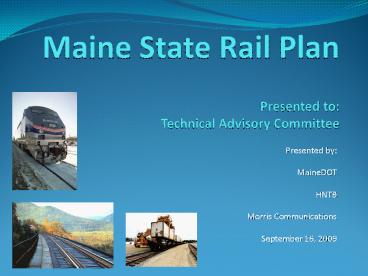
Title: Maine State Rail Plan Presented to: Technical Advisory Committee
1
Maine State Rail PlanPresented to Technical
Advisory Committee
- Presented by
- MaineDOT
- HNTB
- Morris Communications
- September 16, 2009
2
Agenda
- Introductions and Opening Comments
- Nathan Moulton, Project Manager, MaineDOT
- State Rail Plan Presentation
- The Role and Challenges of the TAC, Carol Morris,
Morris Communications - Project Overview, Ray Tomczak, HNTB
- Rail System Inventory, Dennis Coffey, HNTB
- Breakout Groups
3
Why Are You Here?
- Your input on the TAC is key to identifying
- Issues and trends that affect the quality of life
and business conditions in the state - Rail and multi-modal connection needs
- Better ways to collaborate
- Your opinion on statewide and regional rail
strategies - Assist MaineDOT in prioritizing rail investment
in Maine
4
MaineDOT and Rail
- Developed Rail and Port investment plan to start
needs identification/funding framework - Willing to put capital s into infrastructure
rehabilitation and maintaining rail ROWs - Willing to provide operations subsidy for
passenger rail - Not willing to subsidize freight rail operation
and maintenance - Actively support public-private partnerships such
as IRAP - Developing State Rail Plan to help shape future
and allow us to qualify for federal rail funding
5
What We Can Agree On
- Rail supports the States economy
- Provides mobility for people and goods
- Supports business/industry/jobs
- Rails knits communities together
- Rail can reduce highway congestion
- Rail is good for the environment
- Reduces energy use and harmful emissions
- Rail is a vital part of a States multimodal
transportation network
6
Our Challenges
- Rail is important to Maines future, but funding
for infrastructure and passenger operations is
scarce - Changes in Maines economy make it harder to
predict future needs - We need to support rail, but cant do everything
at once - Informed, long-term planning and prioritization
is key - The people in this room have the knowledge to
make a positive impact on the future of rail in
Maine
7
Public Outreach
- Carol Morris, Facilitator
8
Public Outreach Benefits
- Solicit feedback from key stakeholder groups
without which the study cannot be successful - Encourage the public to provide comment and
thereby improve the end result - Key is encouraging productive comment - time is
at a premium
9
Plan Outreach
- Public Meetings September/December
- Technical Advisory Committee Meetings
September/November - Individual Stakeholder Meetings/Surveys
- Press Releases
- Meeting Summaries to be emailed to TAC and
interested parties and posted on web site - Project Website is www.maine.gov/modot/railplan -
will be used for additional public input
10
TAC Meetings
- Two meetings scheduled
- September 16, 2009 to review findings to date
and - through discussion - identify needs and
priorities - Mid-November 2009 to review draft Plan
recommendations prior to the December Public
Meeting
11
Public Meetings
- Two rounds of meetings
- September 28 and 29 to talk with public on
challenges, issues and prioritization criteria - Early December 2009 to review and comment on
draft Plan recommendations - Two locations
- Bangor Motor Inn September 28
- University of Southern Maine/Glickman Library
September 29
12
Breakout Groups (150-350 pm)
- TAC members break out into three groups
- Each TAC member can choose two questions to
discuss - 150 - 230 Session 1 breakouts
- 235 - 250 Five-minute summaries to full group
on discussion outcomes - 250 - 330 Session 2 breakouts
- 335 - 350 Five-minute summaries to full group
on discussion outcomes
13
Project Overview
- Raymond Tomczak, Project Manager, HNTB
- Purpose of State Rail Plan
- Schedule
- Investment Criteria
- Economic, Employment and Transportation Trends
14
Why A State Rail Plan?
- Meet current and future system demands
- Establish a vision to guide future investment
- Provide a basis for Federal and State investment
in rail - Requirement of Passenger Rail Investment and
Improvement Act (PRIIA) of 2008 - Submission to USDOT every 5 years
- MaineDOT Critical Rail Program
- Ensure we prioritize investments to achieve
maximum public benefit
15
Study Purpose / Schedule
16
Draft Investment Criteria
- Enhance freight and passenger rail service that
provides dual transportation system benefit - Service key manufacturing industries
- Provide a net reduction in overall greenhouse gas
emissions from the transportation sector - Help facilitate the shift of rail-appropriate
freight from road to rail - Promote the leveraging of private or other funds
for every state dollar invested
17
Economic Trends
- Growth Rates in Key Maine Economic Indicators
Average Annual Growth Rates
Source Moodys/economy.com, August 2009
18
Employment Forecast
- Maine Employment Growth Rates
Source Moodys/economy.com, August 2009
19
Highest Growth Industries - ME
Mostly Service Related But Will Require
Goods Movement
Source Moodys/economy.com, August 2009
20
Rail-Dependent Industries - ME
Source Moodys/economy.com, August 2009
21
Peak-Period Congestion on National Highway
System 2035
Source USDOT, FHWA, Office of Freight Management
and Operations, Freight Analysis Framework,
version 2.2, 2007.
22
Train Volumes in 2035 Compared to Current
Capacity
23
Rail System Inventory
- Dennis Coffey, HNTB
- Historical Trends
- Current Conditions
- Future Needs
24
Rail Mileage History
Source Americans-Rail.com
25
Freight Rail
- 1,154 active route miles
- 100 public ownership
- 1054 private ownership
- No Class 1 Railroads
- 3 Class II Railroads
- 4 Class III Railroads
- Rail terminals and
- intermodal facilities
- Portland
- Auburn
- Waterville
- 90,700 carloads in 2007
26
Freight Rail Status
- 1,154 miles active
- 230 miles inactive with no service, but track
exist - 85 miles track removed, interim trail use
- 300 miles State owned railway
27
Maine Is Not So Unique With respect to freight
rail ownership!
- At least 20 other States own rail lines over
which freight service is largely operated by
private entities - Alaska ARC owner/operator 544 miles (unique
case) - Georgia approx. 486 miles
- New Hampshire largest owner of NH rail (201
miles) - North Carolina NCRR, privately run company
owned by NC leased 317 miles to NS - Oklahoma approx. 800 miles
- South Dakota approx. 301 miles
- Vermont approx. 305 miles
Maine approx. 100 miles
28
Variables for Shipping Via Rail
- Is it cost-effective for my business?
- What are the service levels?
- Is it a time critical commodity?
- Is service available and of interest to the
railroad? - What is the weight and distance being moved?
- Direct rail or intermodal?
- Can the destination accommodate rail?
- Where do I start?
29
Share of Total Freight Shipments by Mode and
Tonnage (2007) United States and Maine
Source FHWAs Freight Analysis Framework (FAF2)
30
Share of Total Freight Shipments by Mode and
Value (2007) United States and Maine
Source FHWAs Freight Analysis Framework (FAF2)
31
Maine Freight Shipments in Thousands of Tons by
Direction (2007) All Modes
Source FHWAs Freight Analysis Framework (FAF2)
32
Maine Rail Shipments by Direction in Thousands of
Tons (2007)
Source FHWAs Freight Analysis Framework (FAF2)
33
Top Ten Rail Commodities in Thousands of Tons
(2007)
60 Pulp Paper
Source FHWAs Freight Analysis Framework (FAF2)
34
Top Ten Rail Commodities in Millions of Dollars
(2007)
80 Pulp Paper
Source FHWAs Freight Analysis Framework (FAF2)
35
Maine Paper Industry
- 2006 Production Numbers
- Bucksport International Paper
- 4,700 tons per day (235 TPD)
- Skowhegan Sappi
- 4,000 tons per day (200 TPD)
- Rumford Mead Westvaco
- 2,800 tons per day (140 TPD)
- Jay International Wausau Paper
- 1,800 tons per day (90 TPD)
- Woodland Domtar
- 1,460 tons per day (73 TPD)
- Madawaska Fraser Papers Inc
- 1,300 tons of paper per day (65 TPD)
- Lincoln Lincoln Paper
- 760 tons per day (38 TPD)
- Madison Madison Paper
- 750 tons per day (38 TPD)
- Millinocket Katahdin Paper
- 500 tons of paper per day (25 TPD)
- Mill Locations
High-Volume Concentration
36
Economic Factors Affecting Maine Pulp and Paper
Industry
- Depends on US national growth and relative cost
of operating/production in Maine relative to
other US and international producers - US markets and demand are a function of
- Publishing industry output
- Advertising volumes and sales
- US personal consumption patterns
- Limited growth opportunities for domestic
pulp/paper demand - Most foreseeable growth in exports
- Ports are the key to participation in
export-oriented markets
37
Pulp and Paper Trends
- Short-term trends support continued operations of
specialty paper producers - Key specialty mills will produce at current
levels - Older tissue/print operations sold for tax
purposes may be phased out either temporarily or
permanently - Statewide forecasts for employment in pulp/paper
industry expected to continue to decline over
next 25 years (ME state forecast/economy.com) - Long-term output growth in pulp/paper industry
likely to remain near 2008 levels - Forecasts differ based on expected growth of
export markets
38
Why Should We Care?
- If rail service did not exist for the paper
industry in Maine this would amount to an
additional 866 outbound loaded trucks per day. - Since every load starts with an empty there
would need to be an additional 866 inbound trucks
per day to carry this freight. - Do these trucks exist?
- What would be the resulting highway impact?
- Who will absorb the additional maintenance costs?
39
What If No Action Is Taken?
- Negative effects on Maine could include
- Pulp and paper industry less competitive due to
increased transportation costs - Lower profits / loss of market options for rail
shippers - Lost economic development opportunities
- Loss of local tax base
- Potential increase in highway accidents,
congestion, air pollution and energy dependence
on oil - Once rail service is gone its difficult to
replace!
40
Freight Rail Issues
- Heavy reliance on paper pulp industry
- Insufficient rail cars service to accommodate
needs - System abandonments and state ownership
- Weight and vertical constraints
- Junction constraints (Danville / Northern Maine)
- Lack of private and public capital to maintain
and operate current system and future
improvements
41
Rail Industry Price Trends
Declining prices indicate carriers effort to
compete with falling truck prices and an effort
to increase market share in a declining economy
Source Logistics Mgt
42
Freight Rail Opportunities
- Rail-to-Port Triangle
- Port of Portland seaport
- Auburn Intermodal Facility
- Lewiston / Auburn port inland rail port
connections - Redeveloped Brunswick Naval Air Station
- Auburn I-95 Exit 75 Planning Study
- Searsport Bangor rail connection, Sears Island?
- Eastport rail connection
43
Freight Rail Opportunities
- Three Port Connections Initiative
- Eastport Bulk handling conveyor and upgrades to
the state-owned rail line between Calais and
Perry - Portland Improved freight operations and harbor
dredge spoil program - Searsport Port crane heavy lift capacity and
harbor-channel deepening - Mt. Division rehab and reactivation to Port of
Portland
44
Passenger Rail
- Amtrak Downeaster offers five daily roundtrips
between Portland and Boston - FY 2008, over 266,000 Amtrak passengers started
or ended their trips in Maine. - 170,100 in Portland
- 48,500 in Wells
- 35,300 in Saco-Biddeford
- 12,200 in Old Orchard Beach
- Ridership business travelers, tourist and college
students
45
Source FRA Vision for High Speed Rail in
America
46
NE High-Speed Rail Vision
- Downeaster
- Extend rail from Portland to Brunswick, stop in
Freeport - Reduce travel time between Boston-Portland to 2
hours - Increase capacity to support 7 daily roundtrips
- Connect Brunswick to Rockland, via Maine Eastern,
subsequent service to island communities via
Maine State Ferry Service
47
Passenger Rail Opportunities
48
Shared-Use Benefits
- Most rail networks are privately owned
- Freight and passenger networks have different
operational profiles - Addressing shared-use scenarios can have broad
benefits for multiple stakeholders
49
Passenger Rail Issues
- Intense competition for limited Federal funding
- State and local funding constraints
- Will there be enough ridership to adequately
support current and proposed services? - If not, then what level of support should the
State provide? - Are there other types of financial arrangements
that should be explored? - Private operations
- Public-private partnerships
50
Breakout Groups
- Carol Morris, Facilitator
- Raymond Tomczak, Facilitator
- Dennis Coffey, Facilitator
51
Todays Discussion Topics?
- Is the rail system adequate to meet current and
future needs of Maines industries? - What role can improved intercity and new commuter
rail have on mobility? What do you see as the
priority projects? - Maine has several good programs to encourage
freight rail. What other steps should Maine take? - What are the most pressing statewide and regional
rail issues currently and in the next five to ten
years? - What trends affect the State and its stakeholders
in addressing and meeting regional and statewide
rail needs? - What criteria should Maine use to prioritize rail
investments?
52
Next Steps
- Generate criteria
- Review criteria with TAC via conference
call/email - Public outreach September 28th and 29th
- Complete infrastructure conditions assessment and
commodity inventory - Complete economic and environmental trend
identification and benefits analysis - Refine issues and opportunities
- Get information to TAC for review
- Draft investments, policies and next steps
- Conduct next round of TAC and Public Meetings
53
(No Transcript)
54
- Removed Slides
55
What Could Be Done?
- If we invest in rail will it bolster the paper /
pulp industry? What if no investments were
made? - If we dont invest in rail what will be the
highway impact? - If we do invest in rail what other benefits may
accrue to the state? - What mix of passenger and freight investments can
and should be made? - What is the benefit-cost ratio of private sector
investment strategies?
56
Strategies for Moving Forward
- Sample discussion topics for today
- We are in a recession - once we recover, what
will the new normal be? How will things change? - Would existing and future freight rail support
this? What does it need? Where? Is it viable? - Would existing and future passenger rail support
this? What does it need? Where? Is it viable? - What role does/should rail play in economic
development and Maines ability to attract
industry and tourists?
57
Total Tonnage by Mode
2009 4,500?
Source FHWAs Freight Analysis Framework (FAF2)
58
Total Value by Mode
Source FHWAs Freight Analysis Framework (FAF2)
59
Top Ten Rail Trading Partners by Tonnage (2007)
Source FHWAs Freight Analysis Framework (FAF2)
Recommended

