

Parallelized%20Real-Time%20Dynamic%20Simulation%20of%20Long%20Hair%20over%20Arbitrary%20Meshes PowerPoint PPT Presentation
Title: Parallelized%20Real-Time%20Dynamic%20Simulation%20of%20Long%20Hair%20over%20Arbitrary%20Meshes
1
Parallelized Real-TimeDynamic Simulation of Long
Hair over Arbitrary Meshes
- Stuart Golodetz
2
What is hair simulation?
- Hair simulation is about physically modelling
hair and seeing what happens when it is perturbed
(by wind, for example). - It involves three distinct activities hair
shape modelling, hair rendering and hair
dynamics. - Hair shape modelling is concerned with how to
model hair so that it has the right shape (e.g.
short vs. long, straight vs. curly). The other
two are self-explanatory.
3
Why model hair?
- Two separate questions we want to model hair
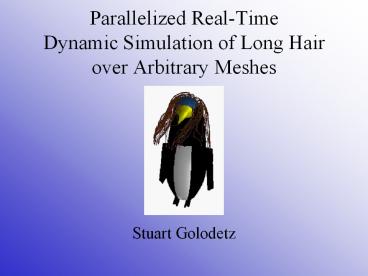
both because its inherently interesting and
because it has similarities to strings, ropes and
fibres. - We want to model hair because without an
appropriate underlying physical representation,
rendered hair looks good but cant do anything
interesting.
4
State Of The Art (1)
- Modelling (particularly rendering) of short hair
and fur is getting better all the time (see
right).
- Modelling of longer hair remains a research
problem.
5
State Of The Art (2)
- Current research tends to produce impressive
results in specific areas whilst avoiding dealing
with others. - There are documented approaches based on
level-of-detail (LOD) ideas, computational fluid
dynamics (CFD) and thin shell volumes (TSVs).
Each method has different strengths and
weaknesses.
6
Aims
- Blue-skies research! The aim is to simulate as
much hair as possible, with the greatest possible
accuracy and speed. - We want to see what happens when the hair is
perturbed (e.g. by wind). - We want to be able to specify properties of the
hair, e.g. length, number density, etc. - We want our implementation to be generic and
flexible.
7
Basic Design Physics
- We start with the physics kernel. Its purpose is
to simulate a number of objects by applying
type-specific numerical schemes to update their
properties (e.g. position, velocity) from one
time-step to the next. - The physics kernel does not (and should not)
worry about collision detection and response
(CDR), which is application-specific and must be
dealt with at a higher level.
8
Basic Design Physics
- Each object in our system has a number of key
points to which forces (which may vary with the
system state) can be applied. - The numerical schemes use these forces when
calculating how to update the objects. - In this design, springs are considered to be
force appliers, that is, things which add forces
to objects. (Disconnecting a spring would mean
removing forces in this context.)
9
Basic Design Hair Representation
- The hairs in our simulation are represented as
chains of point masses, connected using linear
and angular springs as shown. - Linear springs apply a force (along their line of
action) to each of the two objects they connect,
calculated using Hookes Law.
10
Basic Design Hair Representation
- Angular springs are used to prevent the hairs
bending too much. - They exert forces on points i-1 and i1 which
have a restoring effect on the angle at point i.
11
Basic Design Forces
- We model gravity, wind and (velocity-dependent)
air resistance in the obvious way, by applying
the relevant forces to each of the point masses
which make up the hairs. The air resistance
constant was determined empirically. - There are (at most) seven forces acting on any
one point mass gravity, wind, air resistance,
two linear spring forces and two angular spring
forces.
12
Basic Design Hair Bases
- We introduce the concept of a hair base, which
generalises heads, meshes, etc. - The roots of the hairs are represented as key
points on the hair base. A hair is connected to
the hair base by connecting the closest point
mass to the hair root with a linear spring.
13
In Detail The Head Hair BaseRepresentation and
Coordinate Systems (1)
- The head is represented as an ellipsoid.
- In turn, we represent an ellipsoid as an
orthogonal coordinate system, with its centre
being the origin of that system. - In the case of the head hair base, we call that
system the heads local coordinate system.
14
In Detail The Head Hair BaseRepresentation and
Coordinate Systems (2)
- We also define a polar coordinate system (f, ?)
for distributing hair roots. - This goes from f 0 at the top of the head, to f
p at the bottom, and from ? 0 at the right of
the head to ? p at the left. - The point (f, ?) in polar coordinates corresponds
to the local coordinate system point (cos ? sin
f, sin ? sin f, cos f).
15
In Detail The Head Hair BaseHair Root
Distribution
- To distribute the hair roots over the head, users
specify intervals flow, fhigh and ?low,
?high over which hair should be distributed
(this allows us to cover the back but not the
front of the head, for instance). - A uniform grid is generated and then random
points are chosen in each grid square according
to a user-specified number density function ?(f,
?).
16
In Detail The Head Hair BaseHair Properties
- Hair properties such as length, colour, etc. can
be specified as functions of the hair root
position (f, ?). - In practice, we tend to borrow an idea from the
literature and interpolate user-specified values
at the top, bottom, left, right, front and back
of the head.
17
In Detail The Head Hair BaseCollision Detection
- Since we have to simulate large numbers of hairs
in real-time, collision detection and response
needs to be cheap. - We can get acceptable results by simply testing
the individual point masses against a slightly
expanded head. By keeping the points outside of
this, we generally manage to avoid the hairs
penetrating the actual head. Using more points
provides better accuracy but carries a
computational cost.
18
In Detail The Head Hair BaseCollision Response
- When a collision is detected, we simply move the
point away from the centre of the head until its
outside the expanded head. - This is unsophisticated, but fast.
- Our CDR approach provides reasonable results for
a stationary head, but if the head can move then
a better scheme is required.
19
In Detail The Mesh Hair Base
- Many of our ideas generalise to arbitrary meshes.
- In particular, I have been simulating a
long-haired penguin as a proof-of-concept. - Collision detection and response requires
additional work, as will be described shortly.
20
In Detail The Mesh Hair BaseHair Root
Distribution and Properties
- The mesh for the penguin was constructed using
Blender. - The hair root distribution is specified by
applying a special material to parts of the mesh
which should have hair attached. - Hair properties are specified by varying which
material is applied.
21
In Detail The Mesh Hair BaseCollision Detection
- We expand the penguin mesh using Blender to form
a collision mesh (this can be less detailed). - This mesh is then used to construct a BSP tree
which we use for collision detection.
22
In Detail The Mesh Hair BaseCollision Detection
- BSP trees (binary space partitioning trees)
recursively divide space in two
23
In Detail The Mesh Hair BaseCollision Detection
- We do our collision detection by recursively
testing each hair point object against the BSP
tree. - Those objects that end up in a solid leaf of the
tree (and are therefore inside the penguin) are
then subjected to collision response.
24
In Detail The Mesh Hair BaseCollision Response
- There is a BSP raycasting algorithm that allows
us to find the point at which we first transition
from solid to empty space (or vice-versa). We use
this to move our penetrating point outside the
mesh again. - What ray direction to use is non-obvious. The
negation of the objects velocity doesnt work
well. In practice, we try several directions and
pick the one which induces the smallest change in
position.
25
In Detail The Mesh Hair BaseCollision Response
- We dont want our collision response to change
the length of the hair. - That would change the sizes of the spring forces
being applied and cause instability. - We thus apply length constraints to maintain the
hair length over collision response.
26
Rendering Details
- We render the hairs as cubic splines. To do this,
we have to interpolate the point objects at each
frame. The interpolation process involves a
matrix inversion, but we can cache the inverted
matrix for each hair to speed things up. - We use OpenGL Shading Language (GLSL) vertex and
fragment shaders to get our Phong lighting
effects.
27
HairPen BendCoding for the Cell BE
- IBM are running a student competition to write
code for the new Cell BE architecture, which is
finding use in Sonys PS3. - It has 1 primary and 8 secondary processors
running in parallel. This makes it good for
parallelizing simulation code. - I am currently in the process of porting the Java
code to C for my competition entry.
28
Future Work
- The collision detection and response could do
with more work. - Accommodating hair base movement remains a
challenge with this approach. - In practice, Im planning to spend the rest of my
DPhil on kidney cancer work, but hair modelling
has been really interesting.
Recommended

