

Peter J. Briggs, Alun Ashton, Charles Ballard, Martyn Winn and Pryank Patel PowerPoint PPT Presentation
1 / 1
Title: Peter J. Briggs, Alun Ashton, Charles Ballard, Martyn Winn and Pryank Patel
1
New Developments in the CCP4 Software Suite v5.0
and beyond
Peter J. Briggs, Alun Ashton, Charles Ballard,
Martyn Winn and Pryank Patel CCLRC Daresbury
Laboratory, Warrington, Cheshire WA4 4AD, UK
- Beyond CCP4 5.0 ...
- CCP4 version 5.0
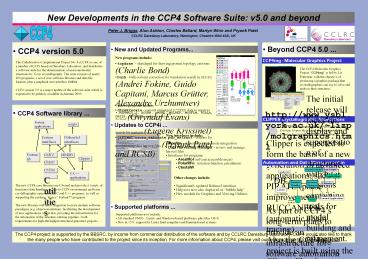
CCP4mg - Molecular Graphics Project
The Collaborative Computational Project No. 4
(CCP4) is one of a number of CCPs based at
Daresbury Laboratory, and distributes a software
suite for the determination of macromolecular
structures by X-ray crystallography. The suite
consists of nearly 200 programs, a set of core
software libraries and data file formats, plus a
graphical user interface CCP4i. CCP4 version 5.0
is a major update of the software suite which is
expected to be publicly available in Autumn 2003.
The CCP4 Molecular Graphics Project CCP4mg is
led by Liz Potterton, with the objective of
producing a graphics package that
crystallographers can use to solve and analyse
their structures
The initial release will focus on display and
superposition of structures, with later versions
containing tools for model building and
refinement.
http//www.ysbl.york.ac.uk/lizp/molgraphics.htm
l
- CCP4 Software library ...
CLIPPER Crystallographic Applications
CLIPPER is an independent project led by Kevin
Cowtan, to provide a set of object-oriented C
libraries for crystallographic computation.
Clipper is expected to form the basis of a new
generation of advanced applications, such as
PIRATE (phase improvement) and BUCCANEER
(automatic chain tracing). Also the CCP4mg
project is built using the Clipper
libraries http//www.ysbl.york.ac.uk/cowtan/
Automation and Data Management in CCP4
The new CCP4 core libraries are C-based and
provide a variety of functions (data handling,
access to CCP4 environment and basic
crystallographic operations) to C and C
programs, as well as supporting the existing
legacy Fortran77 programs. The new libraries
will allow migration to more modern software
paradigms (e.g. object-orientation), facilitating
the development of new applications whilst also
providing the infrastructure for the automation
of the structure solution pipeline - both
requirements for high-throughput structural
genomics projects.
As part of CCP4s long-term plans to provide an
infrastructure for software automation and
development of novel applications, migration
towards a modular system is envisaged. This open
architecture will provide modules for database
access as well as toolboxes of basic
crystallographic functions.
The CCP4 project is supported by the BBSRC, by
income from commercial distribution of the
software and by CCLRC Daresbury Laboratory. CCP4
would also like to thank the many people who have
contributed to the project since its inception.
For more information about CCP4, please visit our
web pages at http//www.ccp4.ac.uk
Recommended

