

City of Colorado Springs Street Division PowerPoint PPT Presentation
1 / 28
Title: City of Colorado Springs Street Division
1
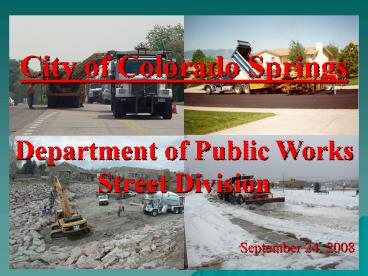
City of Colorado Springs Department of Public
Works Street Division
September 24, 2008
2
Street Division
District Maintenance
Road Resurfacing
Drainage Maintenance Concrete
Division Manager Operations Managers Program
Supervisors
Inspections
Severe Weather Response
Technical Support
Recycling
PPRTA Roadway Concrete Maintenance
3
2008 Budget
Street Division 9,416,183 / 16
- Additional Funding Sources
- CIP Funding for Pavement Resurfacing 4.5
million - PPRTA Roadway Maintenance Program 7.2 million
- PPRTA Curb Gutter/Sidewalk Concrete/ADA
Pedestrian Ramp Program
6.5 million
Public Works
4
Budget Distribution 2008
PPRTA 13,700,000
Salaries Plus Benefits 7,383,842
Operating 2,032,341
Capital Improvements 4,500,000
5
Street Division Programs
- Pavement Resurfacing
- District Maintenance
- Sweeping
- Milling/Leveling
- Digout Patch
- Pothole Patching
- Overlay (RTA/In-house)
- Alley Maintenance
- Grading
- Alternate Treatments
- Inspections
- Slurry Seal/Chip Seal
- Ordinance Code Compliance
- Crack Sealing
- Contractual Inspections
- Concrete Maintenance
- Technical Support
- Recycling Center
- AVL, PMA, RWIS
- PPRTA
- Resurfacing Concrete
6
Streets History
The number of street miles maintained has
increased while the number of Streets employees
has dropped. The number of centerline miles per
employee equates to 11.88 the number of lane
miles per employee equates to 55.98.
- Street Division employees are inclusive of all
functions - resurfacing,drainage,district maintenance,
snow/ice control, etc
7
Street Division Responsibilities
- 1,576 centerline or 7,423 lane miles of
- paved roads
- 125 miles of alleyways/gravel roads.
- 3000 miles of curb and gutter
- 326 miles of open drainage channels
- 637 miles of buried storm sewers
- Approx 19,700 stormwater features (inverted
siphons, bubblers and manholes) - Pavement Resurfacing
- PPRTA Roadway Maintenance Program
- PPRTA Annual Curb Gutter, Sidewalk Concrete
and ADA Pedestrian Ramp Program
8
Resurfacing
- Milling
- Digout Patchs
- Leveling
- Final Overlay
- Chip Seal
- Slurry Seal
9
Resurfacing Prioritization
- Candidate overlay streets are evaluated based on
the following criteria - Structural deficiency
- Ride quality
- Vehicle count/repetitive loading
- Age of street
- Coordination Effort between In-house and PPRTA
- Resurfacing list finalized
- The list is initialized right around September of
each year and is finalized by the end of the year
10
Drainage Maintenance
- The Division, with SWENT personnel, is
responsible for maintaining the Citys drainage
infrastructure consisting of - Open Drainage
- Closed Drainage
- Routine Drainage Maintenance
- Restoration
- Rehabilitation/Reconstruction
11
Open Drainage
Closed Drainage
Cleaning
Restoration
Rehabilitation/Reconstruction
Bank Stabilization
12
Concrete
Concrete Radius
- The Street Division maintains concrete at
intersections, alley entrances, common areas,
pedestrian ramps/radii and drainage crosspans
Pedestrian Ramp
13
District Maintenance
The City of Colorado Springs, Street Division
Maintenance Districts primary functions includes
the maintenance of between 600 to 750 centerline
miles. The main activities performed are as
follows
- Pothole Patching
- Dust Abatement
- Calcium Chloride
- Sweeping
- Minor Restoration
- Grading
14
INSPECTION STAFF
- Field inspections
- Specification compliance
- Resurfacing and Concrete
- Safety
- Stormwater Enterprise
- PPRTA
15
Storm Control
Sanding/Plowing
Summer Storm- flooding
16
Snow and Ice Control
- Level One Storms
- 69 employees per shift 63 route drivers, 4
Supervisors, 1 Operations Manager, 1
Communications Dispatcher - 5-6 hours to cover priority routes throughout the
city
- Level Two Storms
- Blizzard conditions
- A large defined loop through the
- city is cleared first to provide
- mobility for emergency vehicles.
17
Summer Storm Maintenance
- As soon as the winter storms subside, our efforts
are redirected towards summer storm control. - Every summer we remove hundreds of tons debris
caused by major rain storms common to the front
range.
18
Recycling Center
- Currently more than 80 of all materials recycled
come from sweeping, leaf removal, and anti-skid
from snow removal. These materials are processed
and returned as useful bi-products for bank
stabilization, and area/channel beautification.
19
Technical Support
- Automated Vehicle Location (AVL)
- Road Weather Information System (RWIS)
- Pavement Management Application (PMA)
- Work Management System
20
Automatic Vehicle Location
This system provides information on vehicle
location, and roadways being serviced by
snowplows or street sweepers. As a vehicle
passes over its route, position data is
communicated to a control center and serviced
areas are highlighted on an electronic map.
Actual streets swept
21
Automatic Vehicle Location
- System originally developed for Transit and CSFD
with Congestion Mitigation and Air Quality (CMAQ)
grant funding - System then adapted for the Public Works, Street
Division to assist with the management of fleet - Currently have or will have 91 units equipped
w/AVL (focus on Snow Ice and Sweeping
equipment) - Capabilities/Benefits
- Near real time vehicle location data
- Historical route tracing
- Operational picture for Supervisors
- Due to hilly nature of Colorado Springs, multiple
radio towers are needed to provide coverage to
the whole city (currently _at_ 37 towers) - Average cost per AVL unit - 2,000
- Budget concerns/issues
22
(No Transcript)
23
Road Weather Information System
The Road Weather Information System (RWIS) allows
real time monitoring of road and weather
conditions. The system consists of pavement
sensing equipment (pucks) placed in the road
surface. When potentially hazardous conditions
exists, the system provides notification via,
e-mail, cell phone or pagers.
24
Road Weather Information System
- The FP2000 sensor can measure
- Surface Temperature
- Wet/Dry Surface Status
- of Chemical
- of Ice
- Depth of Solution
- Type FP2000 surface sensors have three separate
circuits to record surface temperature, wet or
dry status and chemicals. - These circuits, along with air temperature,
relative humidity and precipitation, combine to
form a Status at the user display. - Performance Not degraded by climatic conditions,
traffic impacts, snow removal equipment or
deicing chemicals
25
Road Weather Information System
- Each weather station calculates, stores and
transmits current information from surface,
subsurface and atmospheric sensors. - Atmospheric sensors provide visibility, dew
point, relative humidity, wind speed and
direction, air temperature, amount and type of
precipitation (snow, rain, sleet, etc.) specific
to the location. This is useful in dispatching
crews to the areas of town where the worst
weather is occurring. - Road sensors detect the pavement temperature,
subsurface temperature, surface condition(dry,
wet, icy), amount of deicing chemical on the
roadway and freezing point of the pavement
surface. This information is pertinent to
summer and winter operations including
resurfacing and storm control. The pavement
conditions can vary significantly from the
atmospheric conditions generally provided in
weather forecasts.
26
(No Transcript)
27
Pavement Management Application
- Pavement Management Application is a systematic
and consistent method of evaluating and rating
streets. This system will also assist in
planning and coordinating our resurfacing
program.
28
Pavement Management Application
- The main goal of the Pavement Management
Application (PMA) is to provide a systematic
process to assist in the following areas - Justification of Capital Improvement Project
(CIP) budget requests - Selection of cost-effective strategies/actions to
improve efficiency and safety of the pavement
network - Comprehensive inventory data base of all
residential/arterial/collector streets - Objective evaluation/assessment of short/long
term condition of the network - Objectively determine maintenance/rehabilitation
programs - Models to assess/predict current and future
pavement performance - Protection of investments made in pavement
infrastructure
29
PMA Roadway Assessment Ratings
30
Pavement Management Application
- Concerns/Issues
- Annual funding to
- provide for contractual
- assessment of 1/3 of all
- roadways or
- Up front expenditure to purchase the necessary
vehicle and equipment to allow Street Division
staff (Inspectors) to conduct roadway assessments - Software upgrades/updates per vendor
31
Work Management System
- TRAKS Time Record Accounting
Keeper System - Daily Time Record Keeping
- Tracks labor, equipment and material
- Daily/weekly/activity reporting ability
- Auditing capabilities
- Work Maintenance Management System
- New System assessment being conducted
- User friendly/not manual intensive
- Very Audit friendly
- Audit Activities Past/Future
32
Street Division Point of Contacts
33
- QUESTIONS?
Recommended

