

Listeria Controls for Smoked Fish PowerPoint PPT Presentation
1 / 23
Title: Listeria Controls for Smoked Fish
1
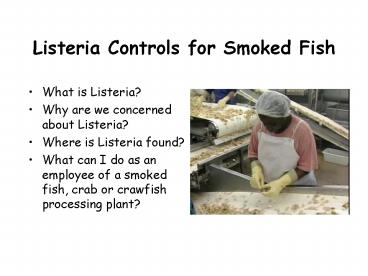
Listeria Controls for Smoked Fish
- What is Listeria?
- Why are we concerned about Listeria?
- Where is Listeria found?
- What can I do as an employee of a smoked fish,
crab or crawfish processing plant?
2
What is it?
- Listeria are invisible bacteria (germs) that can
cause illness. - When people eat foods that contain one type,
Listeria monocytogenes, it can cause - miscarriage in pregnant women
- brain infection and blood poisoning in babies,
elderly people, and people with a weakened immune
system.
3
Why do we have to worry about Listeria?
- Smoked Fish is a Ready-to- Eat Food
- that may NOT be cooked before it is eaten.
- Normally, when we cook foods before we eat them
any harmful bacteria like Listeria that might be
present are killed during cooking.
4
Why should I care about Listeria?
- Customers can get sick or even die.
- The government does not allow Listeria in
ANY ready-to-eat food products. - Companies can go out of business and people can
lose their jobs.
5
Company X
Company X
Comp X
Co X
6
Company Y declares bankruptcy because of
Listeria recall
Company Y
Co Y
Co Y
7
Dont let your company be next!
FOR IMMEDIATE RELEASE FOOD AND DRUG
ADMINISTRATION P00-1
Print Media 202-205-4144
January 10, 2000
Broadcast Media 301-827-3434
Consumer
Inquiries 888-INFO-FDA XXXXX
XXXXXX EXPANDS NATIONWIDE RECALL OF SMOKED
FISH PRODUCTS DUE TO POTENTIAL HEALTH RISK Xxxxx
Xxxxxxx., of Brooklyn, N.Y., is expanding its
December 23, 1999, recall of various smoked fish
products because they have the potential to be
contaminated with Listeria monocytogenes, an
organism that can cause serious and sometimes
fatal infections in young children, frail or
elderly people, and others with weakened immune
systems. Although healthy individuals may suffer
only short-term symptoms such as high fever,
severe headaches, stiffness, nausea, abdominal
pain and diarrhea, Listeria infection can cause
miscarriages and stillbirths among pregnant
women.
8
Where is it?
- Listeria can enter the plant on
- Employees shoes and clothing
- Carts, boxes, pallets
- Raw seafood
- In the plant Listeria can live on
- Floors and drains
- Scrap or trash barrels
- Equipment like hoppers, augers, or slicers
- Any surface that is not properly cleaned and
sanitized
9
Dont Carry Listeria from Raw to Finished Product
Areas !
- Areas where raw product is handled tend to be
dirtier because Listeria can come into these
areas on raw fish, equipment, people. - People and Equipment can carry Listeria when they
move to the cleaner areas where smoked
product is sliced, handled, and packaged.
10
- People can carry these bacteria on their hands,
gloves, aprons, clothing, and shoes or boots. - Listeria can also get onto equipment, racks or
carts and their wheels, totes, waste containers,
product bins, etc.
11
How can You help prevent Listeria contamination?
- Dont go from raw to finished product areas
without taking proper precautions. - Dont move equipment or product from raw to
finished product areas without taking proper
precautions. - Always use good Personal Hygiene and good Food
Handling practices.
12
Good Personal Hygiene Practices For ALL Employees
Include
- Good Personal Habits
- Proper Clothing
- Good Health
- Hand Washing
- Handling Products Properly
13
Keep Yourself Clean
- Bathe or shower daily
- Keep fingernails clean and trimmed at all times
14
- Keep your hands away from your mouth, nose, arms
or other body parts when working. - Do not eat, drink, or smoke in the food handling
areas.
15
- Never touch dirty objects and then touch food
products while working unless you properly wash
your hands or change your gloves.
16
Dress Properly for Work
- Wear clean, washable outer garments or uniforms.
- Wear hairnets, caps, or other suitable covering
to confine hair.
17
- Do not wear fingernail polish or jewelry when
preparing or handling food. - Keep shoes or boots clean.
18
ALL Employees Should Come to Work in Good Health
- Report any illness to your supervisor and avoid
contact with food, food contact surfaces and
utensils.
19
- Gloves shall be worn to touch food and food
contact surfaces when an employee has any cuts,
sores, rashes, casts, or wears nail polish,
artificial nails or jewelry.
20
How to Wash Your Hands
- Wet hands with warm water
- Use ample liquid soap from a dispenser
- Lather exposed arms and hands for 20 seconds by
vigorously rubbing - Thoroughly rinse hands in warm water
- Use foot operated faucets to prevent
re-contamination of hands - Dry hands thoroughly and properly dispose of
paper towels - Dip hands in sanitizing solution and
- Do not touch unsanitary objects.
21
When To Wash Your Hands
- After touching bare human body parts
- After coughing, sneezing, using a handkerchief,
or disposable tissue - After handling soiled equipment
- Immediately before handling food
- During food handling as often as necessary
and - After other activities that may require it.
22
Safe Food Depends on YouIf We All Work Together
We Can Provide Safe Food for Our Customers
23
Credits
This training program was developed as part of a
project entitled Control Strategies for Listeria
monocytogenes in Food Processing Environments
funded under the National Food Safety Initiative
in 2000 by the Cooperative State Research
Education and Extension Services of USDA Project
No. 00-51110-9768. Lots of hard work was
contributed by Cornell University New York Sea
Grant University of Delaware Sea Grant
College University of Maryland Sea Grant VPI Sea
Grant Extension LSU Cooperative
Extension National Food Processors
Association National Fisheries Institute
Recommended

