

Active Living Promoting a Healthier U'S' Through the Built Environment PowerPoint PPT Presentation
1 / 95
Title: Active Living Promoting a Healthier U'S' Through the Built Environment
1
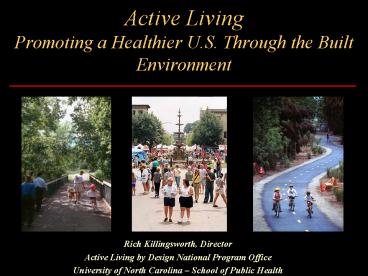
Active LivingPromoting a Healthier U.S. Through
the Built Environment
Rich Killingsworth, Director Active Living by
Design National Program Office University of
North Carolina School of Public Health
2
The Changing Face of Public Health 1950 - 2003
- Pre-1950 Improving Sanitation
- Change zoning, clean-up slums and industrial
pollution - 1950s Eradicating Infectious Diseases
- Polio, Typhoid, Malaria, etc.
- 1970s Removing Toxic Environments
- Improve Air/Land/Water Quality, Love Canal,
Asbestos - 1980s Preventing Risky Lifestyles
- Decrease Smoking, Drug Use, Drunk driving, etc.
- 21st Century Creating Healthy Environments
- Physical Activity and Healthy Eating
3
Focus of Todays Discussion on Active Living
- History
- Assumptions
- Terminology
- Public Health Burden of Physical Inactivity
- Research Needs
- Policy Needs
- Practice Opportunities
- Calls to Action
4
The individuals who will succeed and flourish
will also be masters of change adept at
reorienting their own and others activities in
untried directions to bring about higher levels
of achievement. Rosabeth Moss Kanter
5
(No Transcript)
6
(No Transcript)
7
(No Transcript)
8
(No Transcript)
9
The Emergence of a Sedentary Society
- Automobile
- Television
- Computers
- Convenience Engineering
- Built Environment
- Human Nature
10
Recommended Physical ActivityU.S. Adults,
1986-2000
Source Centers for Disease Control and
Prevention Behavioral Risk Factor Surveillance
System
11
The Burden of Physical Inactivity
- The Problem
- 27 of adults are sedentary
- 70 do not achieve recommended dose
- The Public Health Burden
- 64 overweight and 1 in 3 obese
- CVD, Cancer, Diabetes
- Physical inactivity is a primary factor in over
200,000 deaths annually. - The Economic Burden
- Medical costs associated with physical inactivity
may exceed 76 billion annually.
Data Sources 2000 BRFSS, 2000 NHANES, Powell
1994, Pratt et. al. 2000
12
Obesity Trends Among U.S. AdultsBRFSS, 1985
(BMI ? 30, or 30 lbs overweight for 54
person)
13
Obesity Trends Among U.S. AdultsBRFSS, 1991
(BMI ? 30, or 30 lbs overweight for 54
person)
14
Obesity Trends Among U.S. AdultsBRFSS, 1997
(BMI ? 30, or 30 lbs overweight for 54
person)
15
Obesity Trends Among U.S. AdultsBRFSS, 2001
(BMI ? 30, or 30 lbs overweight for 54
person)
16
Explaining the Epidemic
- Genetic
- Medical Care
- Behavioral Choices
- Social Circumstances
- Environmental Conditions
17
Syndemic
Two or more epidemics, interacting
synergistically, contributing to excess burden of
disease in a population.
http//www.cdc.gov/syndemics/index.htm
18
Consider the Possibility That...
- the pattern of growth has upset the balance of
human behavior - the social costs of development may be far more
reaching than traffic congestion - most new communities we have developed may not be
safe and healthy - there may be another way
19
Transportation, Land Use and Health in the News
- Taking Back the Street
- Suburbias Road to Weight Gain
- Link Between Sprawl and Obesity
- Pedestrians Pushing Back
- Land Use Discourages Walking
The Detroit News
20
The Burden of an Asphalt Nation
- 200 Million Per Day spent constructing new roads
- 22 Billion Per Year on routine maintenance of
roads - 7 Billion Per Year for interest and debt
retirement - Yet the dependency continues
- 73 minutes per day in our cars
- 25 of all trips within a mile, but 75 of these
trips are auto-based
Source Federal Highway Administration
Transportation Data 1995
21
Leveling Atlanta
Metro Atlanta loses 58 acres of forested land a
day to development, Source Georgia
Department of Natural Resources.
22
1973
1979
1987
1997
25 Years of Urban Growth in Atlanta
Source Scientific Visualization Studio, Goddard
Space Flight Center
23
Low Density
Big, Segregated Single-Use Zones
Sparse Street Network
Lack of Centers
24
(No Transcript)
25
(No Transcript)
26
(No Transcript)
27
Non-Motorized Trips 1977-1995Nationwide Personal
Transportation Survey - USDOT
28
Physical Inactivity and Overweight Trends Among
Youth
- 1 in 6 Youth ages 6-19 is Overweight
- 1 in 3 high school youth do not engage in
vigorous physical activity - Less than 30 attend daily physical education
- Children watch more t.v. in a year than attend
school
Data Sources 2000 YRBSS, 2000 NHANES, 2002
National TV Turnoff Week Data
29
The Disappearing Walk to School
- 1 in 4 trips made by 5-15 year olds are for the
journey to and from school. - Only 10 of these trips are made by walking and
bicycling. - Of school trips one mile or less, about 28 are
walk-based and less than 1 are bike-based.
Source Federal Highway Administration
Transportation Data 1995
30
Children Are Walking Less and Becoming
Increasingly Overweight
31
Transportation
Alternative Transportation
Healthy Environments and Active People
Physical Activity
Healthy Places and Spaces
Health
Environment
32
Barriers to Active Living in Low Income
Communities
- Crime
- Poorly maintained infrastructure
- Poor streetscapes
- Abandoned or unsafe parks
- Disconnected sidewalks
- Absence of service facilities
- Grocery, post office, library
- Neighborhoods divided by highways
- Limited access to destinations of interest
- Isolation from the larger community
33
Promoting Physical Activity in the Built
Environment
34
Advancing the Concept of Active Living
- Active Living is a way of life that integrates
physical activity into daily routines.
35
Theoretical Foundations
- City Planning
- Urban Design
- Environmental Psychology
Normative Theory describe, explain and predict
phenomena gtgtgt prescribes Explains how things
ought to be
36
Good City Form
- Kevin Lynch
- City form guides function
- Christopher Alexander
- The pattern of the city develops the language
(behavior) of how people communicate
(move/function)
37
The Life of Cities
- Jane Jacobs
- .the need of cities for a most intricate and
close-grained diversity of uses that give each
other constant mutual support, both economically
and socially.
38
The Life of Streets
- Donald Appleyard
- More traffic means smaller networks, less
neighboring, less interaction, and more isolation
39
The Life of Public Places
- William H. Whyte
- Intimate scale of public spaces invites
socializing, activity, and neighboring.
40
We Are Where We Live
- There is a dynamic interplay of social and
individual factors in a mutual and complex system - Behavior is guided by settings, socio-cultural
scripts, and cognitions of the environment
41
Potential vs. Effective Environments
- Physical Fallacy
- If you build it will they come?
- Function and Meaning
- Is it designed to be used the way it is
understood to be used? - Social and Cultural Norms
- Targeting the facility to the population who will
use it, but also to those who need it most.
42
The Influences on Behavior
Source Promoting Physical Activity A Guide for
Community Action, 1999. US DHHS, CDC
43
Personal Environmental Barriers to Physical
Activity
- PERSONAL BARRIERS
- Lack of motivation
- Perceived lack of time
- Weather
- Family obligations
- Fatigue
- ENVIRONMENTAL BARRIERS
- Lack of exercise facilities
- Lack of sidewalks, bike lanes, nearby public
parks, hiking/biking trails - Topography
- Perceived low levels of safety of ones
neighborhood
44
Social Ecological Model
Society/State
governor
legislators
state agency staff
Communities
countycommissioners
ministerial alliance
superintendent
mayor
planners
county/city agency staff
schoolboard
Organizations
principals
pastors
business ownersmanagers
cafeteriamanagers
teachers
CEOs
Family/Friends
parents
Individuals
45
Core Assumptions of the Social Ecological Model
- The health and the well being is influenced by
multiple facets of the physical and social
environments - Human environments are multidimensional and
complex - People and environment transactions are
characterized by cycles of mutual influence
(Reciprocal Determinism) - People and environments should be studies at
various levels of influence
46
(No Transcript)
47
(No Transcript)
48
Recreational and Utilitarian Walking/bicycling
49
Recreational/Utilitarian Matrix
50
Factors that Influence Active Transportation
- Land Use Mix
- Network Connectivity
- Street Design
- Site Design
- Density
- Beliefs
- Crime
- Safety
51
Impact of Community Design on Activity
Sources Cambridge Systematics 1994 UNC-Highway
Safety Research Center 1994 EPA/CDC Greenstyles
Survey 1999 Nebraska Social Indicators Survey
1999
52
The Influence of Location on Non-Motorized Travel
Behavior
Location
of Trips Walk/Bike
- Urban 17.7
- 2nd City 6.2
- Suburban 4.5
- Rural 3.9
Data Source 1995 NPTS - 40 metropolitan
statistical areas
53
Americans Want to Walk More
- 55 of Americans would like to walk more
throughout the day for exercise or to get to
specific places. - 40 would choose walking over driving.
- 63 would like to walk more to do errands.
- 54 say there are too few shops or restaurants
within walking distance.
Source Belden Russonello and Stewart Research
and Communications. Americans Attitudes Toward
Walking and Creating Better Walking Communities,
2003. (http//www.transact.org/report.asp?id205)
54
The Impact of Activity-Friendly Environments
- An average 150 pound person living in a
activity-friendly environment could prevent
weight gain of 0.85 to 1.75 pounds per year,
which approximates the average adult weight gain
in the U.S.
Source Jim Sallis Ph.D., San Diego State
University
55
(No Transcript)
56
Socio-Environmental Influences on Physical
Activity
- The physical activity literature has given little
attention to ecological determinants - There has been minimal empirical research on the
impact of facilities and environmental factors,
such as recreational facilities, PE programs, and
neighborhood crime
57
Core Findings Environmental and
Sociodemographic Determinants
- Sociodemographic factors have strongest impact on
physical activity - Physical education matters, but few participate
- Community facilities may offer a key intervention
- Presence of crime and unsafe pedestrian
environments gravely impacts physical activity - Need for greater exploration of
environmental/contextual determinants
Gordon-Larsen P, McMurray RG, Popkin BM. 2000.
Pediatrics 105e83.
58
Is There a Solution?
- Strategies to increase physical activity and
promote active living through transportation and
activity-friendly design must become a priority
for national, state and local governments,
leaders and citizens.
59
Active Living Strategies
- Preparation
- Promotion
- Programs
- Policies
- Physical Projects
60
Strategy 1 Preparation
- Build diverse partnerships
- Build a vision
- Assess policies and environments
- Build a plan of action
- Identify a champion
61
Strategy 2 Promotions
- Utilize mass media for awareness and public
education - Utilize mass media for policy advocacy
- Develop key messages for target groups and
settings
62
Strategy 3 Programs
- Safe Routes to School
- Commuter Choice Programs
- Incentive Campaigns Bicycle Friendly Communities
- Parks and Trails Events
- Walking / Bicycling Clubs
63
Strategy 4 Policies
- School Siting - provide pedestrian accessible
elementary school sites - Update codes to encourage density and mixed land
use - Reexamine parking policies and fees
- Develop health impact statements for new
development
64
Strategy 5 Physical Projects
- Build safe and well-connected pedestrian and
bicycle networks - Encourage mixed-use developments
- Adopt traffic calming measures to reduce speed,
noise volume - Create pleasant and beautiful pedestrian and
bicycling settings
65
Heritage Rail-Trail, York, PA
- The York County Heritage Rail-Trail, a 21-
- mile trail, was awarded 1million in TE
- funds. The trail runs adjacent to an active
- rail line, links multiple communities,
- connects
- to a 20-mile
- rail-trail in
- Maryland.
66
Douglas, GA Streetscape
- With 850,000 in TE funds, Douglas
- transformed six intersections. The new
- sidewalks,
- benches, and
- landscaping have
- contributed to a
- revitalization of
- Douglas
- downtown.
67
Rhode Island Bike/Ped Safety
- The Rhode Island Dept.
- of Health used 48,000
- in TE funds for a 3-year
- safety program. The
- money funds education
- and training in schools
- communities, and
- promotions such as t-shirts
- helmets.
68
Denver, CO Bike-n-Ride
- Denver added bike
- racks to 700 buses
- and installed 100
- bike parking racks
- with 301,500 in TE
- funds and a
- 100,000 match,
- greatly enabling
- and expanding
- bicycle commuting
- options.
69
Creating an Active Living Movement
- Foresight
- Picking the Right Target
- Having Strategic Acumen
- Building Synergy
- Framing the Issue and Delivering the Appropriate
Message - Looking for Pressure Points
- Discipline, Conviction, and Perseverance
Driving social change doesnt always have a plan
and its not linear. David Kessler, Former
Administrator Food and Drug Administration
70
The Robert Wood Johnson FoundationActive Living
National Programs
- Active Living Policy and Environmental Studies
- www.alpes.ws
- Active for Life
- www.activeforlife.info
- Active Living by Design
- www.activelivingbydesign.org
- Leadership for Active Living
- www.leadershipforactiveliving.org
71
RWJF Active-Living Projects
Creating Models And Increasing Capacity
Building the Evidence
Creating Demand
ALPES Community Indicators Urban Form/Public
Health Transit Use/Public Health Safe Routes to
School Policy Tracking
National Programs - Active Living by Design -
Active for Life Community
Projects Toolkit Development Bicycle-Friendly
Communities Walkable Communities
Micro-scale Projects Partnership
Building Clearinghouse Leadership for Active
Living Scholarships Media Series Reports /
Publications Incentives
72
Active Living by DesignNational Program OfficeA
National Initiative Supported byThe Robert Wood
Johnson Foundation
73
Active Living by Design - Mission
- To provide leadership in creating communities
that will support, encourage, and sustain active
living.
74
Active Living by DesignTarget Groups
- 25 geographic areas with readiness to implement
active living programs, policies, and
communication strategies - Special emphasis on low and mixed income
communities
75
Settings and Scale
- Buildings
- Public Spaces / Places
- Streets / Corridors
- Neighborhood /Community
- Town / City
- County / Region
- State / National
76
Populations
- Irregularly Active
- Youth
- Adults
- Older Adults
- Women
- Low Income
- People of Color
- People w/ Disabilities
77
Active Living by Design Goals
- Increase access to diverse and affordable
individual opportunities for physical activity. - Reduce built environment and policy barriers to
physical activity. - Develop effective communication and marketing
tactics. - Establish community models that can be replicated
nationally.
78
Active Living by DesignStrategic Domains Years
1 and 2
- Infrastructure Develop an effective,
collaborative, results oriented team and an
infrastructure that supports its work. - Marketing Communications Build awareness of
Active Living issues and opportunities and
identify ALbD as a key organization for
information and resources. - Education, Outreach and Partnerships Expand
awareness and knowledge base through education,
outreach, and partnerships. - Grant Making and Technical Assistance Develop
Call for Proposals and identify 25 diverse
communities as a vehicle for testing, evaluating
and replicating best practices
79
Active Living by DesignBrief Proposal Applicants
by Region
54
219
211
76
196
200
3
6
Representation from all 50 states, Washington, DC
and one (1) U.S. Territory (PR)
80
Active Living by DesignFull Proposal Applicants
by State
Seattle, WA (2)
Norwich, VT
Somerville, MA
Cambridge, MN
Paterson, NJ
Jackson, WY
Buffalo, NY
Bronx, NY
Lansing, MI
Winnebago, NE
Chicago, IL
Wilkes-Barre, PA
Sacramento
Cleveland, OH
Philadelphia, PA
Omaha, NE
Denver, CO
San Francisco
Baltimore, MD
Cincinnati, OH
Oakland
Washington, DC
Columbia, MO
Tustin, CA
Louisville, KY
Charlottesville, VA
Chapel Hill, NC
San Diego, CA
Nashville, TN
Albuquerque, NM
Charleston, SC
El Paso, TX
Orlando, FL
Rio Piedra, PR
Kodiak, AK
Honolulu, HI
Representation from 27 states, Washington, DC and
Puerto Rico
81
Summary
- Transportation and land use patterns strongly
influence Americans ability to be physically
active and healthier. - The tools and resources exist to realize the
potential of Active Living for improving the
health and quality of life of Americans. - We must be willing to take responsibility and
work together to make our communities more
supportive of healthy lifestyles.
82
Calls to Action
- Reach out to different partners and discover new
approaches to solving challenging problems. - Develop better practices and key policies to
build and support activity friendly environments. - Identify data that working in this area is
important and mutually beneficial. - Work to build synergy.
83
Come my friends, Tis not too late to seek a
newer world.
Alfred Lord Tennyson, Ulysses, 1842
84
(No Transcript)
85
(No Transcript)
86
(No Transcript)
87
(No Transcript)
88
(No Transcript)
89
(No Transcript)
90
(No Transcript)
91
(No Transcript)
92
(No Transcript)
93
(No Transcript)
94
We must become the change we seek. M. Ghandi
95
Active Living by DesignContact Information
- www.activelivingbydesign.org
- 919-843-ALbD (2523)
- rich_killingsworth_at_unc.edu
Recommended

