

Dark matter in spiral galaxies: a challenge for ?CDM PowerPoint PPT Presentation
1 / 1
Title: Dark matter in spiral galaxies: a challenge for ?CDM
1
Fitting rotation curves with a new
interpolation formula of MONDGianfranco
Gentile, Benoît Famaey, HongSheng
ZhaoUniversity of New Mexico (Albuquerque, USA,
e-mail ggentile_at_unm.edu), Université Libre de
Bruxelles (Belgium), University of St. Andrews
(Scotland)
1. Introduction MOND is a successful way to fit
rotation curves even though there are cases
where MOND fits are not successful in the
details, it predicts impressively well the
systematic kinematical properties of disk
galaxies. In MOND the gravitational acceleration
g and the Newtonian acceleration gN are related
through ggN/µ(g/a0) where µ(x) is an
interpolation function such that µ(x)?1 for
ggtgta0 µ(x)?g/a0 for gltlta0 Traditionally µ(x) is
given the following form µ(x)x/(1x2)1/2
(1) hereafter referred to
as "old µ(x)". Recently, Famaey Binney (2005,
MNRAS, 363, 603) suggested an alternative
functional form of µ(x) µ(x)x/(1x)
(2) hereafter referred
to as "new µ(x)". One of the main advantages of
this µ(x) over the old one is that, unlike the
latter, it is not in contrast with the
relativistic MOND theory (Bekenstein 2004, Phys.
Rev. D, 70, 083509), as Zhao Famaey (2006, ApJ
638, L9) have shown. Also, it manages to fit
simultaneously the rotation curves of the Milky
Way and of NGC 3198.
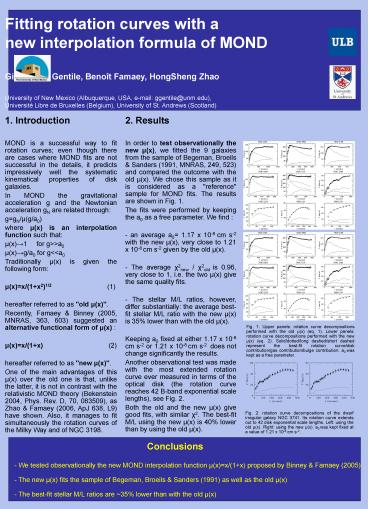
2. Results In order to test observationally the
new µ(x), we fitted the 9 galaxies from the
sample of Begeman, Broeils Sanders (1991,
MNRAS, 249, 523) and compared the outcome with
the old µ(x). We chose this sample as it is
considered as a "reference" sample for MOND fits.
The results are shown in Fig. 1. The fits were
performed by keeping the a0 as a free parameter.
We find - an average a0 1.17 x 10⁻⁸ cm s-2
with the new µ(x), very close to 1.21 x 10⁻⁸ cm
s-2 given by the old µ(x). - The average ?2new
/ ?2old is 0.96, very close to 1, i.e. the two
µ(x) give the same quality fits. - The stellar
M/L ratios, however, differ substantially the
average best-fit stellar M/L ratio with the new
µ(x) is 35 lower than with the old
µ(x). Keeping a0 fixed at either 1.17 x 10⁻⁸ cm
s-2 or 1.21 x 10⁻⁸ cm s-2 does not change
significantly the results. Another observational
test was made with the most extended rotation
curve ever measured in terms of the optical disk
(the rotation curve reaches 42 B-band
exponential scale lengths), see Fig. 2. Both the
old and the new µ(x) give good fits, with similar
?2. The best-fit M/L using the new µ(x) is 40
lower than by using the old µ(x).
Fig. 1 Upper panels rotation curve
decompositions performed with the old µ(x) (eq.
1). Lower panels rotation curve decompositions
performed with the new µ(x) (eq. 2).
Solid/dotted/long dashed/short dashed represent
the best-fit rotation curve/disk contribution/gas
contribution/bulge contribution. a0 was kept as a
free parameter.
Fig. 2 rotation curve decompositions of the
dwarf irregular galaxy NGC 3741. Its rotation
curve extends out to 42 disk exponential scale
lengths. Left using the old µ(x). Right using
the new µ(x). a0 was kept fixed at a value of
1.21 x 10⁻⁸ cm s-2 .
Conclusions- We tested observationally the new
MOND interpolation function µ(x)x/(1x) proposed
by Binney Famaey (2005)- The new µ(x) fits
the sample of Begeman, Broeils Sanders (1991)
as well as the old µ(x)- The best-fit stellar
M/L ratios are 35 lower than with the old µ(x)
Recommended

