

What is the cause of the problems Michael Jackson has had PowerPoint PPT Presentation
1 / 43
Title: What is the cause of the problems Michael Jackson has had
1
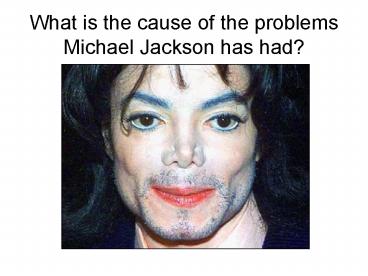
What is the cause of the problems Michael
Jackson has had?
2
Social Motivation-A cognitive approach
- Emphasizes that the way the social environment
influences our motivation - Basic Idea The presence of other people
influences our motivation
3
Social theories of Motivation
Attribution Theory (Heider, 1958) The
interpretation (attribution) of the cause of
others behavior influences our motivations toward
them. Attributions are the explanations we make
for behavior. An attribution can be either
internal or external. Internal or dispositional
attributions assign causality to factors within
the person, such as ability or personality.
External or situational attributions assign
causality to an outside factor, such as the
weather. These attributions create different
motivations for behavior.
4
- Examples
- external attributions.
- You get test results.
- You see, a 65.
- You realize you have a bad teacher and textbook
- And the test was unfair . . .
- Internal Attributions
- on the next test you get a 95.
- I am smart
- I prepared well
- I used good strategy
5
Attributions lead to behavioral choices
- External-Give-up..teacher doesnt like me.
- Or
- Internal- Work harder and with better strategy to
be better prepared.
6
Unfortunate Inaccuracies in Attribution
7
Reconsider MJ?
8
Attribution errors can occur in many ways
- Actor-observer bias
- Egocentric bias
- False consensus effect
- Fundamental attribution error
- Group attribution error
- Group-serving bias
- Hedonistic relevance
- Negativity effect
- Positivity effect
- Positive outcome bias
- Self-serving bias
- Trait ascription bias
9
(No Transcript)
10
Major Social Motivations Conformity
- is the most common and pervasive form of social
influence. - the tendency to act or think like other members
of a group.
11
Conformity probably essential for a community to
function.
- the Asch conformity experiments,
12
Imagine this Solomon Asch (1951) examined the
effect of peer pressure on one's perceptions.
- Social Pressure and Perception
- You sign up for a psychology experiment,
- you and seven others whom you think are also
subjects arrive - the others are actually confederates.
- The experimenter tells you that the study
concerns people's visual judgments. - two cards set before you.
- The card on the left contains one vertical line.
The card on the right displays three lines of
varying length.
13
- The experimenter asks one at a time which of
the three lines on the right card matches the
length of the line on the left card. - the real subject was always the next-to-the-last
person in each group - The task is repeated several times with different
cards. - On some occasions the other "subjects"
unanimously choose the wrong line. - What would you do?
14
- To Asch's surprise, 37 of the 50 subjects
conformed to the majority at least once, and 14
of them conformed on more than 6 of the 12
trials. - "The tendency to conformity is so strong that
reasonably intelligent and well-meaning people
are willing to call white, black. - Why did the subjects conform so readily?
15
- Major Factors and Motivations in Conformity
- Group Size
- Status
- normative influence, to gain social acceptance,
and avoid social conflict - informational influence, to obtain information
through conformity. - Minority influence -minority position on some
issue, (not ethnicity) - primarily informational and depends on consistent
adherence to a position, degree of defection from
the majority, and the status and self-confidence
of the minority members. - Reactance- doing the opposite of what is
expectedanticonformity appears more common in
men. - people high in need to control conform less
(Burger, 1987) - Self-esteem inverse relationship between
self-esteem and conformity (Martin, et al., 1983
Santee Maslach, 1982 Stang, 1972)
16
- ANOTHER POTENTIALLY MAJOR FACTOR IN CONFORMITY
17
Social ObedienceMilgrams study
- introduced to a stern looking experimenter in a
white coat and a pleasant and friendly
co-subject. - explains that the experiment will look into the
role of punishment in learning, - one will be the "teacher" and one will be the
"learner. - Lots are drawn to determine roles, and it is
decided that the individual who answered the ad
will become the "teacher."
18
- co-subject is taken to adjacent room
- strapped in a chair
- electrode is placed on his arm.
- "teacher" is taken to the teaching room which has
a generator. - The "teacher" is instructed to read a list of
word pairs and ask the "learner" to recall them. - If the answer is incorrect, the "teacher" is to
shock the "learner" starting at 15 volts.
19
- The generator has 30 switches in 15 volt
increments, each is labeled with a voltage
ranging from 15 up to 450 volts. - Each switch also has a rating, ranging from
"slight shock" to "danger severe shock". - The final two switches are labeled "XXX".
- The "teacher" is supposed to increase the shock
each time the "learner" misses a word in the
list. - the "learner" is actually a confederate actor
- (never harmed).
20
What would you predict happened?
21
- Ultimately 65 of all of the "teachers" punished
the "learners" to the maximum 450 volts. No
subject stopped before reaching 300 volts!
22
Why did Teachers shock student?
- To justify behavior, subject lays the blame onto
someone else (i.e. the experimenter) - E.g. Nuremberg trials after WWII
- Abu Graib?
23
Factors related to Obedience
- Authority figure - the prestige of the authority
figure and the physical presence of the figure
influence the degree of obedience. The higher the
perceived prestige, and the physical presence of
the authority figure increases the level of
obedience.
24
Factors related to Obedience
- Proximity of victim - more likely to obey an
order that may produce harm if that person is
physically separated from the potential victim. - Milgram observed a drop to 40 full obedience
when he placed both the participant and
confederate in the same room and had a drop to
30 full obedience when the participant had to
physically place the confederates hand on a metal
shock plate. - Personal responsibility
- in Milgram's study the experimenter assumed the
responsibility for harm. When a person has to
assume personal responsibility, the level of
obedience tends to drop. - Escalation of harm
- Milgram's study involved a gradual escalation of
potential harm to the confederate as the
"teacher" increased the levels of shock. - situations that lead to gradual escalation of
harm tend to produce more conformity, that is,
once a person starts the process it becomes more
difficult to not obey.
25
Examples of Other interesting studies of Obedience
- Bickman (1974) - had research assistants "order"
people passing by on the street to do something.
When they wore security guards uniforms, almost 9
out of 10 people obeyed. - Hofling, Brotzman, Dalrymple, Graves Pierce
(1966) studied how nurses would respond to a
phone request from a physician to administer an
uncommon drug at a high dosage with the potential
for harm to the patient. They found that 21 of 22
nurses were willing to complete these phone
orders (though the nurses were stopped from
actually administering the drug).
26
Conformity and Obedience gone astray?
27
- Another Major social influence on motivation
28
Social Learning (Modeling) -Albert Bandura
People can learn by observing the behavior of
others and the outcomes of those behaviors.
The Bobo Doll Experiments
29
The Bobo doll experiments
- The woman punched the clown, shouting
sockeroo! She kicked it, sat on it, hit with a
little hammer, and so on, shouting various
aggressive phrases. Bandura showed his film to
groups of kindergartners who, as you might
predict, liked it a lot. They then were let out
to play. In the play room, of course, were
several observers with pens and clipboards in
hand, a brand new bobo doll, and a few little
hammers. - And you might predict as well what the observers
recorded A lot of little kids beating the
daylights out of the bobo doll. They punched it
and shouted sockeroo, kicked it, sat on it, hit
it with the little hammers, and so on. In other
words, they imitated the young lady in the film,
and quite precisely at that. - Responding to criticism that bobo dolls were
supposed to be hit, he even did a film of the
young woman beating up a live clown. When the
children went into the other room, what should
they find there but -- the live clown! They
proceeded to punch him, kick him, hit him with
little hammers, and so on.
30
(No Transcript)
31
Models can be live or symbolic
- -The live model, an actual person demonstrating
behavior. - -The symbolic model, a person or action portrayed
in medium, , television, videotape, computer
programs.
32
Bandura- 4 Conditions for Social Modelling
- pay attention
- remember
- Motor reproduction the ability to replicate the
behavior - motivation, learners must want to demonstrate
what they have learned. - Reinforcement- Direct rewarding outcomes of the
behavior - group acceptance
33
Types of Behaviors demonstrated to be influenced
by Modeling
- mathematics
- Courage in a fearful situation.
- Aggression
- Much research indicate that children become more
aggressive when they observed aggressive or
violent models. - Moral thinking and moral behavior
- This includes moral judgments
34
Reciprocal determinism
- Modeling- behavior caused by the social
environment. - Bandura argued that your behavior in turn affects
the social environment
35
(No Transcript)
36
Other major areas of social influence research
- Social evaluation
- making a decision before becoming aware of the
relevant facts of a case or event. - Reputation/information transfer
- reputation as a socially transmitted (meta-)
belief (i.e., belief about belief) concerns
properties of agents, namely their attitudes
toward some socially desirable behaviour, be it
cooperation, reciprocity, or norm-compliance.
Reputation plays a crucial role in the evolution
of these behaviours reputation transmission
allows socially desirable behaviour to emerge and
persist even with low probability of repeated
interaction. - Empathy
- commonly defined as one's ability to recognize,
perceive and feel directly the emotions of
another. Since the states of mind, beliefs, and
desires of others are intertwined with their
emotions, one with empathy for another may often
be able to more effectively define another's mode
of thought and mood. Empathy is often
characterized as the ability to "put oneself into
another's shoes", or to in some way experience
the outlook or emotions of another being within
oneself, a sort of emotional resonance - Helping Behavior What are the psychological
conditions that determine whether we will help
someone in need? - Affiliation/ liking/ loving
- Romance and sex
- Authenticity and acting
37
- Competitiveness/ control
- Peer-pressure/ social bullying
- Inclusion/exclusion (ostracism)
38
- Social Deviance / eccentricity
- odd or unusual behaviour of an individual,
behaviour that departs from social norms or
normal ideals (Collins, 1990). - In his studies, Weeks has found at least 20
characteristics that contribute to an eccentrics
personality (Eby Shepard, 1986). Their principle
traits include - Nonconforming
- Creative
- Strongly motivated by curiosity
- Idealistic and
- An obsessive preoccupation with one or two
subjects (Weeks James, 1995).
39
- Social strategy
- (politics of social manipulation)
- Social movements
- are any broad social alliances of people who are
connected through their shared interest in
blocking or affecting social change. Social
movements do not have to be formally organized.
Multiple alliances may work separately for common
causes and still be considered a social movement.
40
- Self-perception theory - emphasizes that we
observe ourselves in the same manner that we
observe others, and draw conclusions about our
likes and dislikes. Extrinsic self perceptions
can lead to the overjustification effect. - Self-verification theory - focuses on peoples
desire to be known and understood by others. The
key assumption is that once people develop firmly
held beliefs about themselves, they come to
prefer that others see them as they see
themselves. - Social comparison theory - suggests that humans
gain information about themselves, and make
inferences that are relevant to self-esteem, by
comparison to relevant others. - Social exchange theory - is an economic social
theory that assumes human relationships are based
on rational choice and cost-benefit analyses. If
one partner's costs begin to outweigh his or her
benefits, that person may leave the relationship,
especially if there are good alternatives
available. - Social identity theory - was developed by Henri
Tajfel and examines how categorizing people
(including oneself) into ingroups or outgroups
affects perceptions, attitudes, and behavior. - Socioemotional Selectivity Theory - posits that
as people age and their perceived time left in
life decreases, they shift from focusing on
information seeking goals to focusing on
emotional goals. - Observational learning (social learning) -
suggests that behavior can be acquired by
observation and imitation of others, unlike
traditional learning theories which require
reinforcement or punishment for learning to
occur. - Triangular theory of love - by Sternberg,
characterizes love in an interpersonal
relationship on three different scales intimacy,
passion, and commitment. Different stages and
types of love can be categorized by different
combinations of these three elements. - Drive theory - posits that the presence of an
audience causes arousal which creates dominant or
typical responses in the context of the
situation.
41
And the Issues that are relevant to Social
Psychology are Sometimes Critical!
- -THE SOCIOLOGY AND PSYCHOLOGY OF TERRORISM WHO
BECOMES A TERRORIST AND WHY? Homepage
http//www.loc.gov/rr/frd/ - Susceptibility and Resistance to Social Defeat
Molecular Correlates mice are exposed to 10 bouts
of social defeat in which c57bl/6 test mice are
forced to intrude into space occupied by mice of
a larger and more aggressive strain, leading to
subordination of the test mice. Following this
repeated stress, a subset of mice develop
significant avoidance of social contact with mice
of the same strain and exhibit other signs that
are reminiscent of symptoms of human depression,
including weight loss and loss of hedonic
(pleasure) responses to sucrose.
42
(No Transcript)
43
(No Transcript)
Recommended

