

Bioremediation study with soils contaminated by explosives at Adazhi military polygon PowerPoint PPT Presentation
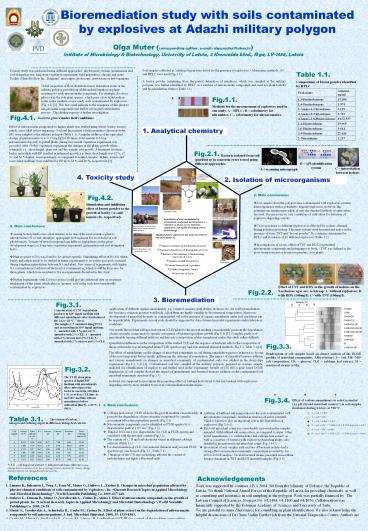
Title: Bioremediation study with soils contaminated by explosives at Adazhi military polygon
1
Bioremediation study with soils contaminated by
explosives at Adazhi military polygon
Olga Muter (corresponding author, e-mail
olga.muter_at_inbox.lv) Institute of Microbiology
Biotechnology, University of Latvia, 4 Kronvalda
blvd., Riga, LV-1586, Latvia
Soil samples collected at Adazhi polygon were
tested for the presence of explosives.
Colorimetric methods, GC and HPLC were used
(Fig.1.1).
Toxicity study was performed using different
approaches phytotoxicity testing (germination
and root elongation test, long-term vegetation
experiment, field inspection), chronic and acute
Toxkits (MicroBioTests Inc., Belgium)
microalgae, protozoans, crustaceans as
test-organisms.
Table 1.1.
A brown powder (remaining from the partial
detonation of munition), which was sampled at the
military polygon, was further identified by HPLC
as a mixture of nitroaromatic compounds and used
for plant toxicity and bioremediation studies
(Table 1.1).
Composition of brown powder identified by HPLC
Visual inspection of flora distribution near
detonation crater at the military polygon
provided an additional information on plants
resistance to toxic nitroaromatic compounds. For
example, Koeleria glauca was the sole plant
species, which grew close to detonation crater in
the medium coarse sandy soils contaminated by
explosives (Fig.4.1) 2. This fact could
indicate to the resistance of this plant to
nitroaromatic compounds and further use in
phytoremediation process. This finding requires
a further investigation.
Peak name Amount, µg/ml
1,3-Dinitrobenzene 17.384
1,4-Dinitrobenzene 3.974
2-Amino-6-Nitrotoluene 0.129
4-Amino-2-Nitrotoluene 2.719
4-Amino-2,6-Dinitrotoluene 8 672.557
2,4-Dinitrotoluene 29.965
2,6-Dinitrotoluene 9.614
3,4-Dinitrotoluene 22.636
2-Nitrotoluene 1.237
Fig.1.1.
A
B
Methods for the measurement of explosives used in
our study. A HPLC B colorimetry for
nitramines C colorimetry for nitroaromatics.
C
Fig.4.1.
Koeleria glauca under field conditions
Effect of nitroaromatic compounds to higher
plants was studied using wheat, barley, tomato,
radish, cress salad as test-organisms. Soil and
the mixture of nitroaromatics (brown powder, BP)
were sampled at the military polygon (Table 1.1).
A regular addition of an equivalent dosage of
nitroaromatics (i.e. 0.33 mg/kg for 26 times,
total amount 8.54 mg nitroaromatics/kg soil) to
potted plants during two-month vegetation
experiment was provided. After 58-day vegetation
experiment the changes in the plants growth where
estimated, i.e. shoot height, plant wet and dry
weight, root growth. A treatment of wheat, barley
and radish with BP resulted in enhanced growth,
i.e. their shoot height was 62 67 and 36
higher, correspondingly, as compared to control
samples. In turn, tomato and cress salad
seedlings were inhibited by BP up to 62 and 80
, respectively 2.
1. Analytical chemistry
Fig.2.1.
Bacteria isolated
from soil (purified or in consortia) were tested
using different approaches.
B API identification system
C interrelation between isolates
A
A scanning micrograph
4. Toxicity study
Sampling procedure at different sites of the
polygon
2. Isolation of microorganisms
B
- 2. Main conclusions
- Soil samples from the polygon sites contaminated
with explosives contain microorganisms with a
potential to degrade explosives, however, this
potential can remain unrevealed, if only the
standard methods of cultivation are used. It is
necessary to vary conditions of cultivation for
detection of explosive-degrading activity. - Cross-resistance to different explosives is
detected for isolates obtained during isolation
procedure. The same isolates were resistant and
active in the presence of toxic TNT and brown
powder. Its content is determined by HPLC and it
consists of 10 different explosives (Table 1.1). - In comparison of a toxic effect of TNT and RDX
(represented nitroaromatic compounds and
nitramines) to biota, - TNT was defined as the
most strong toxicant as to microorganisms, as to
plants.
Fig.4.2.
Stimulation and inhibition effect of brown powder
to the growth of barley (A) and tomato (B),
respectively.
Detonation crater
Samples sorting at the polygon
Remediation of soils contaminated by
nitroaromatic compounds and nitramines, i.e.
explosives, is known as very important,
complicated, and rapidly developing area of
biotechnology.
- 4. Main conclusions
- Among tested plants, cress salad remains to be
one of the most sensitive plant to nitroaromatics
(NA) and, therefore, appropriate test-organism
for assessment of soil phytotoxicity. Toxicity of
tested compound can differ in dependence on the
plant development stage (i.e. long-term
vegetation experiment, germination and root
elongation tests). - Plant response to NA was found to be
species-specific. Stimulating effect of NA for
wheat, barley and radish needs to be studied in
future experiments to reveal the processes
occurred during longterm interrelation between NA
and plant. New series of experiments with higher
NA concentrations could reveal the level of
contamination, which would be toxic also for
those plants, which were resistant to NA in
experiments described in this work. - Further experiments with Koeleria glauca could
provide additional data on resistance mechanism
of this plant, which plays a pioneer role in
the soils have been freshly contaminated by
explosives.
Representatives of Latvian state armed forces and
researchers at Adazhi polygon
- Multidisciplinary approach in this study was
achieved with participation of - Ministry of Defense of the Republic of Latvia
- National Armed Forces of the Republic of Latvia
- Institute of Microbiology Biotechnology,
University of Latvia - Institute of Solid State Physics
- Latvian University of Agriculture
- National Diagnostics Centre
- University of Tartu
Mobile laboratory at the polygon
Plant Koeleria glauca near detonation crater
Sample heterogenity
B
A
C
Effect of TNT and RDX to the growth of isolates
on the Saccharose agar acc. to Kirsop. A- without
explosives B- with RDX (100mg/l) C- with TNT
(100mg/l).
Fig.2.2.
3. Bioremediation
Fig.3.1.
Application of different organic amendments, e.g.
compost, manure, pulp sludge, molasses etc. for
soil bioremediation has become a common practice
worldwide. All of them are highly variable by
bio-chemical composition. Moreover, development
of microbial diversity in contaminated soil in
the presence of organic amendment under real
conditions can be unpredictable. Experiments on
real scale should be supported by data obtained
in model experiments under laboratory conditions.
Our results showed that cabbage leaf extract
(CLE) added to the growth medium can noticeably
promote the degradation of nitro aromatic
compounds by specific association of bacteria
upon their growth (Fig.3.1) 3. Complex, partly
not-reproducible (among different cultivars and
harvests) composition of this amendment makes
this study rather difficult. Quantitative
differences in the composition of the studied CLE
and the response of bacterial cells to the
composition of the growth media was investigated
using FT-IR spectroscopy and conventional
chemical methods (Fig.3.2, Table 3.1)4. The
effect of amendments on the change of microbial
community in soil during remediation process is
known to be one of the most important factors
finally influencing the outcome of remediation.
The impact of microbial biomass addition and
various amendments on changes in microbial
community of contaminated soils was studied in
the slurry-type experiment (Fig.3.3, 3.4) 1.
Contaminated soil was sampled at the military
polygon, prepared as average sample, analyzed for
identification of explosives and further used in
the experiment. Results of 16S rRNA gene based
DGGE fingerprints of soil samples showed the
impact of amendments and bacterial biomass
addition on the contaminated soil microbial
community structure (Fig.3.3). In future it is
supposed to investigate the promoting effect of
cabbage leaf extract to the soil bacteria with
explosives-degrading activity more detailed to
use it in soil remediation technologies.
Concentration of TNT degradation products in M8
liquid medium with different amendments after
incubation of the A43 (28 ?C, 7 days).
The samples 1-5 contained 40mgTNT/l and an
inoculum in M8 liquid medium 2 amended with
2 sucrose 3 amended with 2 CLE 4
amended with 2 sucrose and 2 CLE 5 - amended
with 1 sucrose and 1 CLE.
Fig.3.3.
Dendrogram of soil samples based on cluster
analysis of the DGGE profiles of microbial
communities. Abbreviations S soil, M8 M8
salt composition, Glc glucose, CLE cabbage
leaf extract, M mixture of strains A-Mix.
Fig.3.2.
The FT-IR absorption spectra of liquid M8 medium
with amendments after cultivation of the bacteria
consortia A43 (lines 1-3), as well as CLE (line
4) and M8 medium without amendments before
cultivation (line 5). (28 ?C, 6 days).
B
C
A
Fig.3.4.
Effect of various amendments to redox potential
(A), pH (B) and microbail count (C) in soil
samples incubated during 14 days at 28 ?C.
- 3. Main conclusions
- Cabbage leaf extract (CLE) added to the growth
medium can noticeably promote the degradation of
nitro aromatic compounds by specific association
of bacteria upon their growth (Fig.3.1). - Nitroaromatic compounds can be identified in
FT-IR spectra by a characteristic peak at 1527
cm-1 (Fig.3.2). - Band at 1602 cm-1 was characteristic for CLE in
FT-IR spectra and correlated with the nitrogen
content (Fig.3.2). - The content of C, N and carbohydrates varied in
different cabbage cultivars (Table 3.1). - For discrimination of CLE, conventional chemical
analyses and FT-IR spectroscopy can be used
(Fig.3.2 , Table 3.1). - Variations of the C/N ratio in medium affected
the content of carbohydrates and lipids of
bacterial cells.
- Addition of buffered salt composition to the
soils contaminated with nitroaromatic compounds,
resulted in decrease of redox potential, which is
known to play an important role in the
degradation of explosives (Fig.3.4-A). - The total microbial count was considerably
increased in the samples amended with buffered
salt composition, as compared to water. Other
tested amendments, i.e. carbohydrates and cabbage
leaf extract, as well as a mixture of bacteria
with explosives-degrading ability, also resulted
in an increased total microbial count
(Fog.3.4-C). - Inoculation of soil samples with mixture of
bacterial isolates had a strong effect on
microbial community composition revealed by 16s
rDNA-DGGE analysis. Several bacterial strains
presented in inoculum became dominant in TNT and
RDX amended samples (Fig.3.3). - .
1 soil water 2 soil M8 3 soil
water A-43 4 soil M8 1.25 CLE 0.25
sucrose A-43 5 soil M8 A-Mix 6 -
soil M8 1.25 CLE 0.25 sucrose A-Mix.
Table 3.1.
The content of carbon, nitrogen and reducing
sugars in different cabbage leaf extracts
CLE sample Carbon, vol. Total nitrogen, vol. N/C Sucrose, g/l Glucose, g/l Fructose, g/l Total reducing sugars, g/l
1 0.555 0.38 0.68 0.57 7.08 6.03 13.68
2 1.186 0.29 0.24 1.33 13.41 10.24 24.98
3 1.221 0.57 0.47 1.04 11.01 8.74 20.79
4 1.186 1.00 0.84 1.38 6.06 4.97 12.41
5 0.823 0.38 0.46 0.64 6.38 5.51 12.53
6 1.251 0.22 0.18 2.09 10.79 8.30 21.18
CLE cabbage leaf extract. 6 different cabbage
cultivars (white cabbage Brassica oleracea (1-3),
Savoy cabbage Brassica oleracea (4), Chinese
cabbage Brassica rapa (5), red cabbage Brassica
oleracea (6).
References
Acknowledgements
1. Limane B., Juhanson J., Truu J., Truu M.,
Muter O., Dubova L., Zarina D. Changes in
microbial population affected by physico-chemical
conditions of soils contaminated by explosives. .
In Current Research Topics in Applied
Microbiology and Microbial Biotechnology", World
Scientific Publishing Co. 2009, 637-640. 2.
Dubova L., Limane B., Muter O., Versilovskis A.,
Zarina D., Alsina I. Effect of nitroaromatic
compounds to the growth of potted plants. In
Current Research Topics in Applied Microbiology
and Microbial Biotechnology", World Scientific
Publishing Co. 2009, 24-28. 3. Muter O.,
Versilovskis A., Scherbaka R., Grube M. Zarina
Dz. Effect of plant extract on the degradation of
nitroaromatic compounds by soil microorganisms.
J. Ind. Microbiol. Biotechol. 2008, 35
1539-1543. 4. Grube M., Muter O., Strikauska S.,
Gavare M., Limane B. Application of FT-IR for
control of the medium composition during
biodegradation of nitro aromatic compounds. J.
Ind. Microbiol. Biotechol. 2008, 35 1545-1549.
Work was supported by contract AIVA 2004/288 from
the Ministry of Defense, the Republic of Latvia.
We thank National Armed Forces of the Republic of
Latvia for providing chemicals, as well as
consulting and assistance in soil sampling at the
polygon. Work was partially financed by The
Latvian Council of Sciences, Projects No.
05.1484, 04.1100 and 04.1076. Collaboration was
financially supported by the Estonian Academy of
Sciences and University of Tartu. We are grateful
to Anna Zheiviniece for consulting in plant
identification. We also acknowledge the helpful
discussions of Dr.Chem.Vadim Bartkevich from the
National Diagnostics Centre. Authors are
gratefull to Dr.Phys. Aloizijs Patmalnieks and
Lidija Saulite for SEM micrographies.
Recommended

