

Now Playing: PowerPoint PPT Presentation
Title: Now Playing:
1
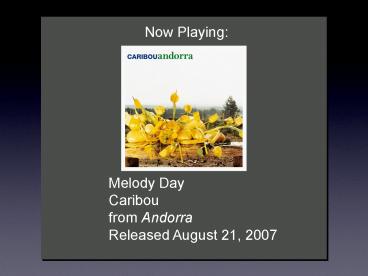
Now Playing
Melody Day Caribou from AndorraReleased August
21, 2007
2
MovieKnick Knack
- Pixar, 1989
3
Ray Casting
- Rick Skarbez, Instructor
- COMP 575
- October 25, 2007
4
Announcements
- Programming Assignment 2 (3D graphics in OpenGL)
is due TONIGHT by 1159pm - Programming Assignment 3 (Rasterization) is out
- Due NEXT Saturday, November 3 by 1159pm
- If you do hand in by Thursday midnight, 10 bonus
points
5
Last Time
- Reviewed light transport
- Lights
- Materials
- Cameras
- Talked about some features of real cameras
- Lens effects
- Film
6
Today
- Doing the math to cast rays
7
Ray-Tracing Algorithm
- for each pixel / subpixel shoot a ray into
the scene find nearest object the ray
intersects if surface is (nonreflecting OR
light) color the pixel else
calculate new ray direction recurse
8
Ray-Tracing Algorithm
- for each pixel / subpixel shoot a ray into
the scene find nearest object the ray
intersects if surface is (nonreflecting OR
light) color the pixel else
calculate new ray direction recurse
Ray Casting
9
Ray Casting
- This is what were going to discuss today
- As we saw on the last slide, ray casting is part
of ray tracing - Can also be used on its own
- Basically gives you OpenGL-like results
- No reflection/refraction
10
Generating an Image
- Generate the rays from the eye
- One (or more) for each pixel
- Figure out if those rays see anything
- Compute ray-object intersections
- Determine the color seen by the ray
- Compute object-light interactions
11
Rays
- Recall that a ray is just a vector with a
starting point - Ray (Point, Vector)
12
Rays
- Let a ray be defined by point S and vector V
- The parametric form of a ray expresses it as a
function as some scalar t, giving the set of all
points the ray passes through - r(t) S tV, 0 t 8
- This is the form we will use
13
Computing Ray-Object Intersections
- If a ray intersects an object, want to know the
value of t where the intersection occurs - t lt 0 Intersection is behind the ray, ignore it
- t 0 Undefined
- t gt 0 Good intersection
- If there are multiple intersections, we want the
one with the smallest t - This will be the closest surface
r(t) p td
14
The Sphere
- For todays lecture, were only going to consider
one type of shape - The sphere
- The implicit equation for a sphere is
- r2 (x - x0)2 (y - y0)2 (z - z0)2
- If we assume its centered at the origin
- r2 x2 y2 z2
15
Ray-Sphere Intersections
- So, we want to find out where (or if) a ray
intersects a sphere - Need to figure out what points on a ray represent
valid solutions for the sphere equation
16
(No Transcript)
17
(No Transcript)
18
(No Transcript)
19
Ray-Sphere Intersections
- There are three cases
- No intersection
- 1 intersection
- 2 intersections
- How do we detect them?
- Check the discriminant!
20
Ray-Sphere Intersections
- Using the discriminant
- D b2 - 4ac
- If D 0, there is one root
- If D gt 0, there are 2 real roots
- If D lt 0, there are 2 imaginary roots
D lt 0
D 0
D gt 0
D lt 0
21
Ray-Sphere Intersections
- So, for the 3 cases
- D lt 0 Ray does not intersect the object
- D 0 One intersection solve for t
- D gt 0 Two intersections
- But we know we only want the closest
- Can throw out the other solution
22
Ray-Object Intersections
- We derived the math for sphere objects in detail
- The process is similar for other objects
- Just need to work through the math
- Using implicit surface definitions makes it easy
23
Generating an Image
- Generate the rays from the eye
- One (or more) for each pixel
- Figure out if those rays see anything
- Compute ray-object intersections
- Determine the color seen by the ray
- Compute object-light interactions
24
Generating Rays
- Now, given a ray, we know how to test if it
intersects an object - But we dont yet know how to generate the rays
- We talked a bit about lenses last time, but an
ideal pinhole camera is still the simplest model - So lets assume that
25
Generating Rays
- Recall the pinhole camera model
- Every point p in the image is imaged through the
center of projection C onto the image plane - Note that this means every point in the scene
maps to a ray, originating at C - That is, r(t) C tV
- C is the same for every ray, so just need to
compute new Vs
26
Generating Rays
- Note that since this isnt a real camera, we can
put the virtual image plane in front of the
pinhole - This means we can solve for the ray directions
and not worry about flipping the scene
27
Generating Rays in 2D
This is referred to asa Pencil of Rays
Eye
28
2D Frustum
- Note that this is the same idea as the frusta
that we used in OpenGL
Far Plane
Near Plane
Image Plane
Eye
29
Building a Frustum
- So we need to know the same things that we did to
build an OpenGL view frustum - Field of View
- Aspect Ratio
- Do we need near and far planes?
- Except now we need to build the camera matrix
ourselves
30
(No Transcript)
31
(No Transcript)
32
(No Transcript)
33
Extending to 3D
- So, this is all we need to know for 2D
- Just generates a single row of rays
- For 3D, need to also know the vertical resolution
- In the form of the aspect ratio
34
Quick Aside about Aspect Ratios
- With our virtual cameras, we can use any aspect
ratio we want - In the real world, though, some are most commonly
used - 43 (standard video)
- 169 (widescreen video)
- 2.351 (many movies)
35
Aspect Ratios Example
36
(No Transcript)
37
(No Transcript)
38
(No Transcript)
39
Generating an Image
- Generate the rays from the eye
- One (or more) for each pixel
- Figure out if those rays see anything
- Compute ray-object intersections
- Determine the color seen by the ray
- Compute object-light interactions
40
Bonus MoviePortal Half-Life 2 Mod
Available onlinehttp//www.youtube.com/watch?vg
Kg3TUPQ8Sg
41
Determining Color
- Since were not yet talking about tracing rays
- Really just talking about OpenGL-style lighting
and shading - Since surfaces are implicitly defined, can solve
Phong lighting equation at every intersection
42
Review Phong Lighting
Ambient
Diffuse
- I Ia(Ra, La) Id(n, l, Rd, Ld, a, b, c, d)
Is(r, v, Rs, Ls, n, a, b, c,d)
Specular
- Rsomething represents how reflective the surface
is - Lsomething represents the intensity of the light
- In practice, these are each 3-vectors
- One each for R, G, and B
43
Phong Reflection ModelAmbient Term
- Assume that ambient light is the same everywhere
- Is this generally true?
- Ia(Ra, La) Ra La
- The contribution of ambient light at a point is
just the intensity of the light modulated by how
reflective the surface is (for that color)
44
Phong Reflection ModelDiffuse Term
- Id(n, l, Rd, Ld, a, b, c, d) (Rd / (a bd
cd2)) max(l n, 0) Ld - a, b, c user-defined constants
- d distance from the point to the light
- Lets consider these parts
45
Lamberts Cosine Law
- The incident angle of the incoming light affects
its apparent intensity - Does the sun seem brighter at noon or 6pm?
- Why?
Noon
Evening
46
Phong Reflection ModelDiffuse Term
- We already know how to get the cosine between the
light direction and the normal - n l
- What happens if the surface is facing away from
the light? - Thats why we use max(n l, 0)
- Why not just take n l?
47
Phong Reflection ModelDiffuse Term
- In the real world, lights seem to get dimmer as
they get further away - Intensity decreases with distance
- We can simulate that by adding an attenuation
term - (Rd / (a bd cd2))
- User can choose the a,b,c constants to achieve
the desired look
48
Phong Reflection ModelSpecular Term
- Is(r, v, Rs, Ls, n, a, b, c, d) (Rs / (a
bd cd2)) max(r v, 0)n Ls - Why r v?
- Reflection is strongest in the direction of the
reflection vector - r v is maximized when the viewpoint vector (or
really the vector to the viewpoint) is in the
same direction as r - What is n?
- Shininess coefficient
49
Generating an Image
- Generate the rays from the eye
- One (or more) for each pixel
- Figure out if those rays see anything
- Compute ray-object intersections
- Determine the color seen by the ray
- Compute object-light interactions
50
Review
- Reviewed the basic ray tracing algorithm
- Talked about how ray casting is used
- Derived the math for generating camera rays
- Derived the math for computing ray intersections
- For a sphere
51
Next Time
- Extending the camera matrix to be more general
- Covering some software engineering notes relating
to building a ray tracer
Recommended

