

Springtime in Winter: Phytoplankton Dynamics on the Middle Atlantic Bight PowerPoint PPT Presentation
1 / 1
Title: Springtime in Winter: Phytoplankton Dynamics on the Middle Atlantic Bight
1
Springtime in Winter Phytoplankton Dynamics on
the Middle Atlantic Bight
Yi Xu, Oscar Schofield, Robert Chant, and Scott
Glenn Coastal Ocean Observation Lab
Institute of Marine Coastal Sciences, Rutgers
University, New Brunswick, NJ USA
Introduction The shelf and slope waters of the
Middle Atlantic Bight (MAB) are some of the most
productive in the world with large seasonal
phytoplankton blooms (Riley, 1946, 1947 Ryther
and Yentsch, 1958). The dynamics in the
phytoplankton are complex and unraveling the
physical regulation is difficult. Past efforts
documented large blooms in the late winter-early
spring and late fall (Marshall et al., 1987,
Yoder et al. 2001). While stratification is a
documented factor driving the productivity, the
compounding factors influencing the inter-annual
variability remains in question. Therefore we
analyzed l A nine year time series of SST and
ocean color to study the physical factors
regulating the primary productivity of the
shelf. l Cross shelf transects conducted by a
Sloccum Webb glider.
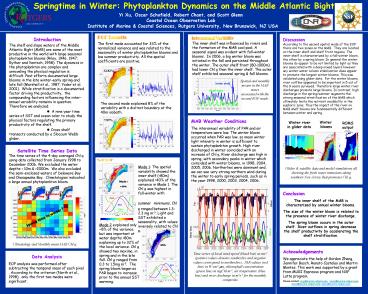
Discussion According to the second spatial mode
of the EOF there are two zones on the MAB. They
are located on the inner shelf and shelf front
regions. The inner shelf is characterized by a
fall-winter bloom, the other by a spring bloom.
In general the winter blooms do appear to be not
limited by light as they are associated with a
deep mixed layers however any winter water column
stabilization does appear to promote the largest
winter blooms. This was validated using glider
data. For the winter blooms, river outflow
appeared to be important in 5 out of the 9 years
surveyed. Therefore large winter river discharges
promote large blooms. In contrast, high discharge
in the spring/summer augments the strong seasonal
stratification of the MAB which ultimately limits
the nutrient availability in the euphoric zone.
Thus the impact of the river on MAB shelf blooms
are fundamentally different between winter and
spring.
.
EOF Resutls
Interannual Varibility
The inner shelf was influenced by rivers and the
formation of the MAB cool pool. A seasonal signal
was evident with fall-winter blooms. In 2006, a
big winter bloom was initiated in the fall and
persisted throughout the winter. The outer shelf
front (80-1000m) had lower Chl a than the inner
shelf. The outer shelf exhibited seasonal spring
fall blooms.
The first mode accounted for 33 of the
normalized variance and was related to the
seasonality of winter phytoplankton blooms and
low summer productivity. All the spatial
coefficients are positive.
Spatial and monthly means in the MAB zones
associated with the second EOF mode.
Innter shelf
Shelf front
The second mode explained 8 of the variability
with a distinct boundary at the 40m isobath.
MAB Weather Conditions The interannual
variability of PAR and air temperature were low.
The winter bloom occurred when PAR was low, so
mean winter light intensity in winter is
sufficient to sustain phytoplankton growth. High
river discharged in winter coincided with an
increase of Chl a. River discharge was high in
spring, with secondary peaks in winter which
coincided with winter blooms, in 1998, 2004,
2005, 2006. Northerlies were dominant and, we can
see very strong northern wind during the winter
to early spring periods, such as in the year
1998, 2000, 2003, 2004, 2006.
Winter blooms
Winter river in glider data
ROMS output
Satellite Time Series Data The time series of the
4-day averaged Chl a using data collected from
January 1998 to December 2006. We excluded the
water depths lt 10m gt2000m. We also excluded
the semi-enclosed waters of Delaware Bay and
Chesapeake Bay. Climatologies indicated a large
annual phytoplankton bloom.
EOF
Glider satellite data and model simulations all
showing the fresh water intrusions along southern
New Jersey that promotes Chl a.
Mode 1 The spatial variability showed the inner
shelf (lt80m) explained gt40 of the variance in
Mode 1. The Chl a was highest in fall-winter with
summer minimums. Chl a ranged between 1.3-2.3 mg
m-3. Light and SST exhibited a seasonality, with
values inversely related to Chl a.
Mode 1 gt40
Conclusion The inner shelf of the MAB is
characterized by annual winter blooms. The size
of the winter bloom is related to the presence of
winter river discharge. The spring bloom occurs
in the outer shelf. River outflows in spring
decrease the shelf productivity by accelerating
the shelf stratification.
PAR
SST
Chl-a
Spring time in winter ?
Mode 2 explained only 8 of the variance but was
important at water depths gt80m explaining up to
32 of the local variance. Chl a showed two
maxima, in spring and in the late fall. Chl a
ranged from 0.3 to 1.5mg m-3. The spring bloom
began as PAR began to increase prior to the
annual SST warming.
Climatology and Monthly mean MAB Chl a
Acknowledgements We appreciate the help of Gordon
Zhang, Jennifer Bosch, Renato Castelao and Martin
Montes. This work was supported by a grant from
MURI Espresso program and NSF Latte program.
Time series of local wind speed (black bar) as
ms-1 (positive values denotes southerlies and
negative values correspond to northerlies) , PAR
values (red line) in W/cm2/µm, chlorophyll
concentration (green line) in mgChl m-3, air
temperature (blue line) and river discharge in
m3s-1 for the monthly composite.
Data Analysis EOF analysis was performed after
subtracting the temporal mean of each pixel .
According to the criterion (North et al., 1998),
only the first two modes were significant.
SST
PAR
Chl-a
Please contact xuyi_at_marine.rutgers.edu,
oscar_at_marine.rutgers.edu, chant_at_marine.rutgers.edu
, glenn_at_marine.rutgers.edu
Recommended

