

Sand Motion over Vortex Ripples induced by Surface Waves PowerPoint PPT Presentation
1 / 33
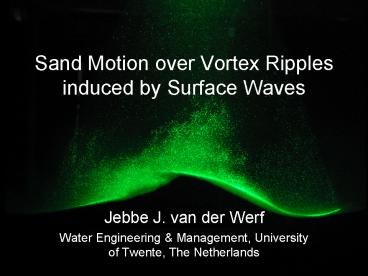
Title: Sand Motion over Vortex Ripples induced by Surface Waves
1
Sand Motion over Vortex Ripples induced by
Surface Waves
- Jebbe J. van der Werf
- Water Engineering Management, University of
Twente, The Netherlands
2
Outline
- Background
- Laboratory experiments
- Flow over ripples
- Sand dynamics over ripples
- Practical sand transport modelling
- Conclusions further research
3
Surface waves and oscillatory flow
4
Wave-generated ripples
- Cover large part shoreface bed
- ? 0.01-0.1 m and ? 0.1-1.0 m
- Vortex shedding if ?/? gt 0.1
5
Sand transport processes over vortex ripples
- Vortex ripples strongly influence wave boundary
layer structure, near-bed turbulence intensity
and sand transport mechanisms
6
Ph.D. research
- New full-scale laboratory experiments
- Improvement ripple predictors
- Improvement practical models to predict
time-averaged concentration profile - Development new practical sand transport model
- Improvement 1DV-RANS sand transport model
7
Experimental facilities
- Oscillatory flow tunnels
- Flow equivalent to near-bed horizontal flow
generated by full-scale surface waves
8
Measurements
- Bed elevation using laser displacement sensor
- Particle velocities using ultra-sonic velocity
profiler and PIV - Net sand transport rates by mass conservation
technique using measured masses in traps and
volume changes - Suspended sand concentrations
9
Suspended sand concentration measurement
- Transverse suction system
background
experiments
flow
sand dynamics
transport modelling
conclusions
10
Suspended sand concentration measurement
- Transverse suction system
- Optical concentration meter
background
experiments
flow
sand dynamics
transport modelling
conclusions
11
Suspended sand concentration measurement
- Transverse suction system
- Optical concentration meter
- Acoustic backscatter system
12
Experimental conditions
- Regular and irregular asymmetric flow with T
5.0-10.0 s and u 0.4-1.3 m/s - Uniform sand with D50 0.22-0.44 mm
13
Instantaneous flow field
D50 0.44 mm T 5.0 s ? 0.08 m ? 0.41 m
14
Instantaneous flow field
D50 0.44 mm T 5.0 s ? 0.08 m ? 0.41 m
15
Time-averaged flow field
16
Time- and ripple-averaged flow
17
Instantaneous suspended concentration field
D50 0.44 mm T 5.0 s ? 0.08 m ? 0.41 m
18
Instantaneous suspended concentration field
D50 0.44 mm T 5.0 s ? 0.08 m ? 0.41 m
19
Horizontal suspended sand fluxes
20
Horizontal suspended sand fluxes
21
Horizontal suspended sand fluxes
22
Horizontal suspended sand fluxes
23
Horizontal suspended sand fluxes
24
Horizontal suspended sand fluxes
25
Net horizontal suspended sand fluxes
D50 0.44 mm T 5.0 s ? 0.08 m ? 0.41 m
26
Bedload transport
- Near-bed (mms) transport where grain-grain
interactions are important - Net bedload in the onshore direction due to flow
asymmetry - Forcing mechanism for onshore ripple migration (?)
27
Net sand transport rate
28
Net sand transport rate
29
Practical sand transport modelling
- Implemented in larger morphological modelling
systems - Current practical sand transport models
- Quasi-steadiness qs(t) m un-1 u
- ltqsgt onshore (gt 0) for asymmetric oscillatory
flows with larger onshore velocities - Not valid in vortex ripple regime where net
transport is generally offshore (lt 0)
30
New practical sand transport model
- Phase-lag effects schematically included
- Four transport contributions F(?c,?t,P)
31
New practical sand transport model
32
Conclusions
- Flow and suspended sand dynamics controlled by
vortex generation and ejection - Net sand transport controlled by
offshore-directed suspended fluxes and
onshore-directed near-bed transport - New practical sand transport model
33
Future research
- Comparison detailed data with more sophisticated
models, 2DV-RANS models, ? - Development of a general practical model to
predict sand transport in coastal waters
(Dutch/UK SANTOSS project)
Recommended

