

Doerte Blume, K. Daily, D. Rakshit, Washington State University, Pullman. PowerPoint PPT Presentation
1 / 61
Title: Doerte Blume, K. Daily, D. Rakshit, Washington State University, Pullman.
1
Microscopic Treatment of Dilute Trapped Fermi
Gases
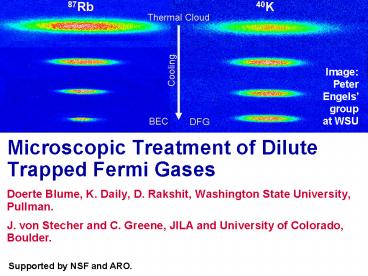
Image Peter Engels group at WSU
- Doerte Blume, K. Daily, D. Rakshit, Washington
State University, Pullman.
J. von Stecher and C. Greene, JILA and University
of Colorado, Boulder.
Supported by NSF and ARO.
2
Outline of This Talk
- Introduction
- BCS-BEC (Bardeen-Cooper-Schrieffer) crossover
(s-wave interacting up and down atoms with
equal masses and no population-imbalance). - Theoretical challenges.
- A few examples of our trapped few-fermion
studies - Universality throughout crossover and at
unitarity. - Natural orbitals, occupation numbers and momentum
distribution. - Not today Highly-polarized system, unequal
masses, trap-imbalanced, effectively
low-dimensional, p-wave. - Summary
3
BCS-BEC Crossover with Cold Two-Component Atomic
Fermi Gas
Normalized energy crossover curve ?N
BCS
Weakly-repulsive molecular Bose gas
1h?
Weakly-attractive atomic Fermi gas
BEC
aho/as
Strongly- interacting (unitarity)
STABLE GAS!!!
Images (experiment) Jin group, JILA.
4
Up - Down Interactions Two-Body s-Wave
Scattering Length
At low temperature, the details of the atom-atom
potential are irrelevant Positive s-wave
scattering length Effective repulsive
interaction. Negative s-wave scattering length
Effective attractive interaction.
weakly- interacting (attraction)
weakly- interacting (repulsion)
as
as
strongly- interacting
BEC- SIDE
BCS- SIDE
Dilute gas r0 ltlt aho, as or n(0)r03 ltlt 1.
as
Similarities with nuclear matter, condensed
matter/ Cooper pairs.
Ebind
external control parameter (B-field)
5
Our General Philosophy From Few to Many
- Microscopic to macroscopic
- Other examples
- Doped helium clusters Molecular rotations,
microscopic superfluidity,... - Metal clusters conductivity, designing
materials,... - What is special about dilute atomic Fermi
systems? - Controllable system (scattering length, trap
geometry,) - Universal behavior.
atomic/ molecular
condensed matter
?
mesoscopic
External confining potential
optical lattice
6
Microscopic Theoretical Description
- Three motivations
- Few-body physics is interesting and determines
some properties of the many-body system. - Commonalities of few- and many-body system.
- Benchmark of theoretical techniques.
- Challenge Naïve computational approaches scale
exponentially with number of degrees. - Possible solutions
- Introduce stochastic element (Monte Carlo)
- Use smart basis
r0
aho
r
7
Virial Expansion for Fermi Gas Based on Two- and
Three-Fermion Spectra
Complete N3 spectrum (calculated following
Kestner and Duan, PRA 76, 033611 (2007))
High-T thermodynamics in trap (virial
coefficients calculated from two- and three-body
energies)
L0
L1
Liu et al., PRL 102, 160401 (2009)
8
How Do We Solve Stationary Many-Body Schrödinger
Equation? CG.
H ?i (Ti Vtrap,i) ?Iltj Vtwobody,ij
- Up to N7 Basis set expansion (CG) approach.
- Use Gaussian two-body potential and correlated
Gaussian basis functions (plus generalized
spherical harmonic) - ? ?Np vL YLM(v) exp(-xTAx)
- x collectively denotes N-1 Jacobi coordinates.
- v u?x
- A denotes (N-1)x(N-1) dimensional parameter
matrix. - u denotes N-1 dimensional parameter vector.
- Hamiltonian matrix can be evaluated analytically.
- Rigorous upper bound (controlled accuracy).
- Computational effort increases with N
- Evaluation of Hamiltonian matrix elements
involves diagonalizing (N-1)x(N-1) matrix. - Permutations Np scale nonlinearly
(Np2,4,12,36,144 for N3,4,5,6,7).
?
For details see Suzuki and Varga von Stecher,
Greene, Blume, PRA 77, 043619 (2008).
9
How Do We Solve Stationary Many-Body Schrödinger
Equation? FN-DMC.
H ?i (Ti Vtrap,i) ?Iltj Vtwobody,ij
- Up to N30 Fixed-node diffusion Monte Carlo
(FN-DMC) approach. - Fermionic symmetry imposed by nodal structure of
so-called guiding function ?T (input) - Nodal surface coincides with that of
non-interacting Fermi gas - ?T ? det(?)det(?) (homogeneous system
normal). - Nodal surface determined by two-body solution
?(rii) - ?T ? A(?(1,1),, ?(N/2,N/2)) (homogeneous
system superfluid). - Rigorous upper bound for energy of state that has
the same symmetry as ?T. - Structural properties may suffer some bias
(hopefully negligible). - Stochastic method Observables have
(controllable) error bar. - Up to N7 Comparison between CG and FN-DMC
results.
For details see von Stecher, Greene, Blume, PRA
77, 043619 (2008).
10
Specifics for Small Equal-Mass Two-Component
Fermi Systems
- Absence of many-body bound state if no (s-wave
scattering length aslt0) / one (asgt0) two-body
bound state exists - 2 up and 2 down with zero-range interactions
Petrov et al. - Holds also for small systems with finite range
interactions (at least for the interactions we
looked at). - Technical implication State of interest true
ground state. - Physical implication Stability (Fermi pressure
counteracts attractive interactions). - In contrast, three- or many-body bound states
exist for unequal mass Fermi systems, for Bose
systems, and for three-component systems leads,
e.g., to Efimov physics. - Our goal
- Bottom-up study of 3D two-component Fermi system
with equal masses under spherically harmonic
confinement interacting through short-range
s-wave interactions.
11
Energy Crossover Curves for Large Few-Fermion
Systems
- Exact CG calculations for simple model
potentials. - Benchmark for approximate numerical and
analytical approaches - Monte Carlo (see later).
- Effective low-energy theories Four-body problem
is becoming tractable (Stetcu et al., PRA 76,
063613 (2007) Alhassid et al., PRL 100, 230401
(2008) Hammer et al.). - Next Unitarity and universality of crossover
curves.
L2
L0
E3D(4)-2E3D(2)
N4
L0
L2
L1
N5
12
Unitarity Only Relevant Length Scale is
Oscillator Length
Unitarity Infinite scattering length
E.g., N5 (N?3, N?2), L0
For zero-range interactions, universal states
have been predicted to have peculiar properties
e.g., Werner et al., PRA 74, 053604 (2006)
Excitation frequencies 2nh?. Hyperangular and
hyperradial degrees of freedom separate.
Solid lines fit
Energy minus 2h? of third lowest L0 state
Symbols CG (upper bound)
Energy of lowest L0 state
Zero-range limit
13
Universality throughout Crossover for Zero Range
Interactions
- Adiabatic relation ?E/?as h2/(16 ?3mas2) C,
where C denotes integrated contact intensity. - Virial theorem E 2 ltVtrapgt - h2/(32?3mas) C.
- Test of prediction Use adiabatic relation as
working definition of contact C and show that
energy can be predicted using virial theorem. - For us, practical test involves
- Extrapolate finite range energies to zero range.
- Use ZR energies to obtain C using adiabatic
relation. - Compare energy calculated via virial theorem with
extrapolated energy.
Ho, Thomas, Tan, Werner, Castin, Braaten, Petrov,
14
One Step Further Include Finite Range
Corrections
- Evirial 2ltVtrapgt - as ?Eexact/?as /2 - r0
?Eexact/?r0 /2
Werner, PRA 78, 025601 (2008)
C(r0)
N?2, N?2 (L0)
Eexact-Evirial
r00.01, 0.03, 0.05aho
Eexact-Evirial(as only)
ZR
r00.05aho
Generalized virial theorem validated on BCS side
for N4. Analysis is simplified by the fact that
E depends linearly on r0.
15
Larger Trapped Two-Component Fermi Systems at
Unitarity
Zero scattering length
What happens to shell structure at unitarity
(N?-N?0,1)? Connection between energies of
inhomogeneous and those of homogeneous
system? Eunit?homENI ?hom0.42 Determination
of excitation gap?
20
Shell closure
8
Carlson et al., PRL (2003), Astrakharchik et al.,
PRL (2004))
2
16
N1?N2?0,1 Energy of Trapped Two-Component Fermi
Gas at Unitarity
Blume, von Stecher, Greene, PRL 99, 233201 (2007).
smooth
Monte Carlo energies
Local density approximation (even N)
N1?N2?1 (N odd)
N1?N2?0 (N even)
We find ?tr0.467. For comparison
?hom0.42 (Carlson et al., PRL (2003), Astrakharch
ik et al., PRL (2004))
Even-odd oscillations. Essentially no shell
structure.
17
Excitation Gap and Residual Oscillations at
Unitarity
See also, Chang and Bertsch, PRA 76, 021603(R )
(2007).
N odd, NN1N2 and N1N21
EFN-DMC-Efit
?(N)
N1?N2?1
DFT, Bulgac (PRA 76, 040502(R ), 2007)
N1?N2?0
residual oscillations
18
Local Density Approximation (LDA) not Valid for
Odd-N system
Spare particle sees local chemical potential
?( r) ?0 - V( r) for n( r)gt0. Energy cost of
introducing spare particle is ?( r) plus ?(
r). Smallest near edge of cloud, where LDA breaks
down.
LDA ?(N) ? ? N1/3 / ?? We find
?trap0.6. ?hom0.85 (Carlson et. al.
(2005)) ?(N) ? N1/9 (Son (2007)) also
consistent with our data.
FN-DMC
?(N)?N1/3
DFT, Bulgac PRA (2007)
19
Beyond the Energy Structural Properties at
Unitarity
Pair distribution function for up-down distance
Range r00.01aho. Very good agreement between
CG and FN-DMC results. N4 Enhanced probability
at small r (pair formation).
N3 L1
CG
FN-DMC
Positive scattering length
N4 L0
Negative scattering length
von Stecher, Greene, Blume, PRA 77, 043619
(2008).
20
One-Body Density Matrix and Natural Orbitals
- One-body density matrix
- ?(r,r) N ???(r,r2,,rN)?(r,r2,,rN)dr2drN
- Decomposing ?(r,r) ?j nj ?j(r)?j(r) with
??j(r)?j(r)dr ?ij defines natural orbitals
?j(r) and occupation numbers nj. - In practice, ?j(r) and nj are obtained by
diagonalizing - ???j(r)?(r,r)?j(r)drdrnj.
- Alternatively, ?j(r) can be defined by writing
- ?(r,r) lt?(r)?(r)gt, where ?/? are field
operators that destroy/create a particle at
position r, and by expanding - ?(r)/? (r) in terms of ?j(r)/?j(r) and aj/aj
21
Occupation Numbers through Crossover N4
Natural orbitals depend on three coordinates
?j(r)? ?nl(r)Ylm(?,?)
occupation of first l0 natural orbital
NI limit
l0,2
nnlm/2
occupation of first l1 natural orbital
l1
l0
22
Occupation Probability as Function of Number of
Particles
N6
N6
N4
N2
N4
- Little size dependence of depletion.
- In the near future Two-body reduced density
matrix ? pair fraction.
23
Momentum Distribution for Trapped Two-Component
Fermi System
- Momentum distribution can be written in terms of
natural orbitals - n(k) ?j nj?j(k)2,
- where ?j(k) (2?)-3/2 ?exp(-ik?r)?(r)dr.
- It follows n(k) (2?)-3 ?? expik?(r-r)?(r,r)
drdr. - Partial wave decomposition
- n(k) ?lm nl(k) Ylm(?k,?k).
- Then ?n(k)d?k (4?)1/2 n0(k)
Shown on next slide for N4
24
l0 Projection of Momentum Distribution for N4
2.5
5
7.5
10
aho/as10
(4?)-1/2
2.5
-2.5
unitarity
NI
25
Microscopic Treatment of Dilute Fermi Gases
- Cold atomic gases are nearly ideal systems for
the experimental and theoretical study of few-
and many-body physics. - In particular, dilute atomic two-component Fermi
gases are rich systems that have been and will
continue to fascinate atomic, nuclear and
condensed matter physicists - Universal energy crossover curves.
- Strongly-interacting regime / unitarity.
- Occupation numbers, momentum distribution,...
- Microscopic, few-particle studies provide
perspective that complements condensed matter
many-body approaches.
26
Why Few-Fermion Systems? Interesting by
Themselves
- Certain universal properties are independent of
number of particles (unique energy level
spacings, universal parameter,). - Certain many-body properties are determined by
few-body physics (e.g., virial expansion Liu et
al., PRL 102, 160401 (2009)). - Some rigorous benchmark results can be obtained
(may be more readily than for large systems,
especially in strongly correlated regime). - Experimental realization Optical lattice with
sufficiently deep and widely spaced lattice
sites.
Bloch, Esslinger, Ketterle, groups.
optical lattice
27
Fast Rotating Fermi Gas Effectively
Two-Dimensional System
z
z
z
Fast rotation (??)
No rotation
N3 (2D) No rotation
N3 (2D) Fast rotation
Blume, unpublished.
28
Quasi-One-Dimensional System Comparison of Full
3D and Strictly 1D
N3, Pz1
Solutions are characterized by Pz and L? Here
L? 0. BCS side 1D atomic Hamiltonian with
renormalized atom-atom scattering length
(Olshanii, PRL (1998)). BEC side 1D molecular
Hamiltonian Molecules form in 3D and atom- dimer
and dimer-dimer scattering lengths are
renormalized.
N4, Pz1
N3, Pz-1
Blume and Rakshit, arXiv0901.3862v2
29
A Different Four-Body System Four Identical
Bosons
DIncao, von Stecher, Greene, arXiv0903.3348
Four identical bosons add ? aaa. Two up/two down
fermions add ? 0.6aaa.
30
Where Do Atomic and Nuclear Physics Meet?
Selected Examples.
- Efimov effect/physics
- Nuclear 2n-rich halo nuclei, 12C
- Atomic 4He trimer, Cs2Cs, K2K, three-body
collisions. - Three-component system
- Nuclear low density nucleon tri-quark bound
state high density quark color superconductor. - Atomic Fermi gas with three internal states.
- Universal behavior (large scattering length as)
- Nuclear neutron-neutron as -18fm (effective
range 2.8fm). Desirable low density neutron
matter. - Atomic Tunability of as near Feshbach resonance.
- Theoretical approaches
Experiment Grimm, Inguscio groups.
Experiment Jochim, OHara groups.
Experiment Jin, Ketterle, Hulet, Thomas, groups.
31
Energies for 2 and 3 Fermions in a Spherically
Symmetric Harmonic Trap
von Stecher, Greene, Blume, PRA 76, 053613
(2007) 77, 043619 (2008). Blume,
unpublished. See also Kestner and Duan, PRA 76,
033611 (2007) Stetcu et al., PRA 76, 063613
(2007).
L5
L1
L0
L1 L0
L0
L1
L1
L0
32
The Field of Cold Atom Physics
EXPERIMENT
THEORY
Nobel Prizes Laser cooling (1997) Chu,
Cohen-Tannoudji, Phillips. Bose-Einstein
condensation (2001) Cornell, Ketterle,
Wieman. Theory of superconductors and
superfluids (2003) Abrikosov, Ginzberg,
Leggett. Quantum optics and frequency comb
(2005) Glauber, Hall, Hänsch.
nuclear physics
molecular physics
atomic physics
condensed matter
quantum information science
quantum optics
33
4 Fermions 2 Bosons Dimer-Dimer Scattering
Length and Effective Range
von Stecher, Greene, Blume, PRA 76, 053613 (2007).
First quantitative prediction for dimer-dimer
effective range.
4 Fermions
2 Bosons
Petrov et al., JPB 38, S645 (2005)
FN-DMC
CG
Model dimer-dimer potential by zero-range
interaction with energy-dependent dimer-dimer
scattering length rdd goes up as mass ratio ?
increases For ?20, rdd0.5add.
Mass ratio ?
34
Excitation Gap at Unitarity for Equal-Mass
Two-Component Fermi System
See also, Chang and Bertsch, PRA 76, 021603(R )
(2007).
N odd, NN1N2 and N1N21
Local density approximation (LDA) ?(N) ?
N1/3. But, LDA expected to break-down Instead
?(N) ? N1/9? (Son, arXiv0707.1851)
FN-DMC
DFT, Bulgac PRA 76, 040502(R ) (2007)
35
Related Topics and Natural Extensions
- Two-component Fermi gases with unequal masses,
unequal trapping frequencies, unequal
populations - Stability of unequal-mass systems (trimer
formation)? - Universal behavior?
- Phase separation?
- Multi-component s-wave interacting Fermi gas
- Details of underlying two-body potential?
- Implications of existence or absence of
three-particle negative energy states? - Beyond s-wave
- p-wave interactions?
- p-wave induced interactions?
36
General Summary of Field of Cold Atom Physics
- Interaction strengths can be controlled
(Fano-Feshbach resonance). - Confinement can be designed (lattice,
quasi-1d,). - Fundamental physics question
- Strongly-interacting system.
- Multi-component systems.
- Unequal mass systems.
- Efimov physics.
- Applications
- High precision measurements of fundamental
constants. - Navigational devices.
- Quantum computation and quantum simulation.
37
Look at Unitary Regime Differently
Hyperspherical Potential Curves
h2CN/(2MR2)
M?2R2/2
Born-Oppenheimer like separation of
variables Divide coordinates into one
hyperradius R and 3N-1 hyperangles. Integrate
over angles, and analyze one-dimensional
potential curve. At unitarity V(R)
h2CN/(2MR2) M?2R2/2. Invert 1D SE to obtain
CN.
as0
as?
Werner et al., PRA 74, 053604 (2006) Rittenhouse
et al. (2006)
Even-odd oscillations evident in effective
potential curves.
38
Comparison of Analytical and Numerical
Hyperradial Wave Function
FN-DMC
CG
N15
N4 (CG)
N9
N6
N4 (CG)
39
Graphics from JILA homepage.
BCS
BEC
Weak attraction
Weak repulsion
40
Summary
- s-wave interaction strength of fermions can be
tuned experimentally (Feshbach resonance). - Smooth crossover for two-component system
- Our study connects few- and many-body physics.
- Benchmark of nodal surface (input for FN-DMC
calculations) for N4 fermions. - Crossover for multiple-component Fermi system
appears to be not necessarily smooth (huge
parameter space strong dependence on range of
two-body potential). - Next p-wave interactions, anisotropic
interactions,...
41
Characteristics of Trapped Bose Gas Stable
versus Unstable
1 parameter
Single particle orbital
Non-linearity
No solution to GP eq.
- Next What happens
- if we implant impurity into BEC with repulsive
atom-atom scattering length? - Bound impurity state?
BEC with attractive a, stabilized by trap
BEC with repulsive scattering length a
snow- flake State
For 3-body treatment of collapse region, see
Blume and Greene, PRA 66, 013601 (2002).
42
Roadmap of Our Study of Two-Component Fermi
Systems
- Treat trapped system
- Determine free-space dimer-dimer scattering
length and effective range from energies of
trapped four-particle system. - Weakly-interacting BEC and BCS limits Determine
validity regime of perturbative expressions. - Universal properties of unitary gas Intuitive
ways to think about strongly-interacting system. - Connect trapped system with homogeneous system
- Validity of local density approximation?
- Gain better understanding of few- and many-body
physics.
43
Two-Fermion System with Mass- and Trap-Imbalance
at Unitarity
1
6
2
4
Mass ratio8
?1-(aho2/aho1)2
density
density
?2 decreases
m28m1
m18m2
m1
m1
density
x
x
m18m2
Equal frequencies
m1
Blume, arXiv0803.4221
x
44
Unitarity Whats the Total Angular Momentum of
Few-Body System?
BCS
Small N Ltot0 for even N and Ltot1 for odd N
Ltot0 for even and odd N
1h?
?
BEC
aho/as
Ltot
Symmetry inversion occurs on BEC side
For N3, see also Duan et al., PRA (2007) and van
Kolck et al. (2007).
45
Crossover Curve for N4 Different Mass Ratios,
Equal Frequencies
density
FN-DMC (nodal surface of dimer pairs)
m1m2
FN-DMC (nodal surface of ideal gas)
m2
x
density
m18m2
CG
m2
x
Size of non-interacting system
Next Analyze molecular Bose gas.
46
Radial Density at Unitarity Where Is Spare
Atom Located?
N15
N9
N3
N9 Extra particle more delocalized. N15
Extra particle sits near the surface.
47
Coefficients of Hyperradial Potentials Obtained
from FN-DMC Energies
Odd N
0.42
Normalized coefficient
Even N
Turn-around of red curve? Problem with guiding
function? Convergence for large N?
48
Experimental Signatures
Bose Einstein Condensate of 87Rb (bosons)
Macroscopic quantum object (super-molecule)
Low T (a few nK)
High T
(Picture taken from JILA homepage)
40K (fermion)
Looks just like the ordinary atomic condensate.
Regal, Greiner, Jin, PRL 92, 040403 (2004)
49
Intuitive Way of Understanding Two-Body
Scattering Length
At low temperature, the details of the atom-atom
potential are irrelevant Positive scattering
length Effectively repulsive interaction. Negativ
e scattering length Effectively attractive
interaction.
Bosonic atoms in harmonic trap
N bosons in a box. Constant density. Periodic
boundary conditions.
BEC with attractive a, stabilized by trap
Positive scattering length Stable gas (not
self-bound). Negative scattering length Gas not
stable collapse toward solid or liquid
(self-bound).
BEC with repulsive scattering length a
snow- flake state
50
(No Transcript)
51
Selected Highlights from Cold Atom Experiments
(Bosons)
MPI (Hänsch group) Quantum phase transition
Phase coherence (SF)
No phase coh. (Mott)
MIT, Ketterle group Atom laser.
MIT, Ketterle group Vortices.
52
Hyperspherical Potential Curves for N3-20
Non-Interacting and Unitarity
N1?N2?1
N1?N2?0
a0
Odd-even oscillations Odd-N curves pushed up
compared to even-N curves. Odd-even
oscillations usually interpreted in terms of
excitation gap ?(N).
a?
53
Non-Interacting System Only Length Scale is
Harmonic Oscillator Length
Rewrite Hamiltonian in hyperspherical coordinates
R and ?
Wave function is separable
Hyperangular Schrödinger equation (?? has
anti-symmetrization build in)
54
Composite Atomic Bosons versus Fermions
- Boson Integer spin e.g., photon.
- Fermion Half-integer spin e.g., electron,
proton, neutron, quarks.
7Li Composite boson.
E
E
6Li Composite fermion consisting of
3 electrons, 3 neutrons, 3 protons.
55
Reaching Quantum Degeneracy Bosons versus
Fermions
- decreasing T
BOSONS
Transition temperature of bosons a few
100nK (BEC the coldest place in the known
Universe).
Images Peter Engels and Collin Atherton, WSU
Image Thywissen group, University Toronto.
FERMIONS
decreasing T
Images Thywissen group, University Toronto.
56
Hyperradial Potential Curves of Non-Interacting
Two-Component Fermi Gas
Hyperradial Hamiltonian
Ground state n0 (no excitation along R). ?
depends on N.
Total energy
Potential curves for N3 to 20 (bottom to
top) Dashed odd N. Solid even N.
57
N4 Hyperradial Potential Curves, Energies and
Hyperradial Densities
CG calculations for Gaussian potential at
unitarity 2h? spacing verified to better than
2.
2h?
1. exc. st.
?kh?
2h?
gr. st.
Next Larger N
58
Unitary Two-Component Fermi Gas No New Length
Scale
- For zero-range interactions, no new length scale
introduced. - Making universality assumption (I.e., assuming
absence of molecular-like states), separation of
variables still exact.
Werner and Castin, PRA 74, 053604 (2006).
s? in general unknown. If E?n known, then s?
can be backed out. s? determines
hyperradial wave function and density.
For fixed ? (within a given hyperradial potential
curve), 2h? spacing!
59
N3 Energy Crossover Curve for Mass Ratios 1 and
4 (Equal Frequencies)
CG L0
Equal masses
CG L1
CG L0
Two heavy, one light
?2,1
CG L1
One heavy, two light
CG L0
CG L1
von Stecher, Greene, Blume, PRA 77, 043619
(2008).
60
Crossover Curve for N4 Different Mass Ratios,
Equal Frequencies
density
FN-DMC (nodal surface of dimer pairs)
m1m2
FN-DMC (nodal surface of ideal gas)
m2
x
density
m18m2
CG
m2
x
Size of non-interacting system
von Stecher, Greene, Blume, PRA 76, 053613 (2007).
61
Universal Parameter ?? at Unitarity as a Function
of Mass Ratio
Bulk system ?? nearly constant as function of
mass ratio (Astrakharchik, Blume and Giorgini,
unpublished). Trapped system ?? changes
some. Densities of the two components do not
fully overlap at unitarity.
trapped system
N?N?
Hom. system
(Carlson et al., PRL (2003), Astrakharchik et
al., PRL (2004))
von Stecher, Greene, Blume, PRA 77, 043619 (2008).
Fit is quite good. Some difference between
trapped and homogeneous system.
Recommended

