

Introduction To Web 2.0 For Student Support Services PowerPoint PPT Presentation
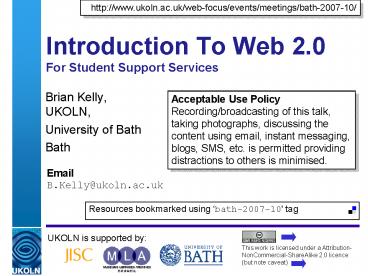
Title: Introduction To Web 2.0 For Student Support Services
1
Introduction To Web 2.0For Student Support
Services
http//www.ukoln.ac.uk/web-focus/events/meetings/b
ath-2007-10/
- Brian Kelly, UKOLN,
- University of Bath
- Bath
Acceptable Use Policy Recording/broadcasting of
this talk, taking photographs, discussing the
content using email, instant messaging, blogs,
SMS, etc. is permitted providing distractions to
others is minimised.
Email B.Kelly_at_ukoln.ac.uk
Resources bookmarked using bath-2007-10' tag
UKOLN is supported by
This work is licensed under a Attribution-NonComme
rcial-ShareAlike 2.0 licence (but note caveat)
2
About Me
Introduction
- Brian Kelly
- UK Web Focus a national Web advisory post
- Based at UKOLN, a national centre of expertise in
digital information management - Located at the University of Bath
- Funded by JISC and the MLA
- Involved in Web since Jan 1993
- Currently advising on best practices for Web 2.0
3
About You (1)
Introduction
- What is your interest in Web 2.0?
- Why are you here?
- Aims of this talk
- This talk aims to provide
- A better understanding of Web 2.0
- An awareness of how students may use Web 2.0
tools in an informal context - An understanding of possible dangers, both for
students and the institution - An opportunity to discuss how we should address
the opportunities and challenges (and
inevitabilities!)
4
About You (2)
Introduction
- How many of you
- Have heard of Web 2.0?
- Have read content in a blog or wiki?
- Use Facebook?
- Have used MSN Messenger, Skype, ?
- Use photo sharing sites (e.g. Flickr)?
- Have viewed video clips on YouTube?
- Do you
- Use the tools for work?
- Use the tools for social purposes (e.g.
communicating with your children)?
5
Contents
Introduction
- Web 2.0 What Is It? (Talking )
- Blogs ? Wikis
- Mashups ? Comms tools
- Social networks
- Deployment Strategies ( doing)
- User focus
- Information literacy staff development
- Risk assessment
- Safe experimentation
6
Lets Do It Now!
Introduction
http//www.gabbly.com/www.bath.ac.uk/
- Lets not just talk about Web 2.0 lets use it
now (assuming WiFi network available!) - Lets Talk
- Go to http//www.gabbly.com/ and in box enter
www.bath.ac.uk/ - Lets Share Resources
- Go to lthttp//del.icio.us/lisbk/bath-2007-10gt
to access resources
Discussion Lecture theatres with WiFi/pervasive
networking ? students with laptops will expect to
use them ? we need experience to establish best
practices manage problems
2 Mar 2007
7
Web 2.0
Web 2.0
Web 2.0
- What Is Web 2.0?
- Marketing term (derived from observing
'patterns') rather than technical standards - an
attitude not a technology
- Characteristics Of Web 2.0
- Network as platform
- Easy-to-use (Ajax)
- Always beta
- Remix and mash-ups
- Syndication (RSS)
- Architecture of participation
- Blogs Wikis
- Social networking
- Social tagging (folksonomies)
- Trust and openness
Web2MemeMap, Tim OReilly, 2005 (or see
Wikipedia )
8
Blogs
Openness Syndication Collaboration
Key Characteristics
Web 2.0
http//people.bath.ac.uk/tn205/blog.html
- The term blog is well-known, but perhaps
theres a lack of awareness of the potential of
blogs. Theres a need to - Explore how blogs can support business functions
(support users, staff organisation) - Theres also a need for information professionals
to - Understand blogging related technologies (e.g.
RSS, Technorati) - Be able to find resources in the 'Blogosphere'
9
Blogs Reading (RSS)
Openness Syndication Collaboration
Web 2.0
- How do you keep informed of new developments?
- You can use a blog reader
- This alerts you to changes to key blogs
- Provides a focus on the content, and avoid
distractions of ads, etc. - Part of information literacy, to ensure users can
process information more effectively
http//www.bloglines.com/myblogs
Bloglines a Web-based blog reader. You are
informed of changes since you last viewed the
page.
BlogBridge a desktop blog reader. You are
informed of changes since you last viewed the
page.
10
Blogs Engaging With Users
http//ukwebfocus.wordpress.com/2007/01/25/experi
ments-with-meebo/
- The ukwebfocus.wordpress.com blog provides
- Comments option for all postings
- A realtime chat facility
- Benefits
- Feedback on my thoughts and ideas
- Evaluation
11
Institutional Student Blogging
http//blogs.warwick.ac.uk/
- University of Warwick were first UK university to
provide (and actively promote) blogging service
for its students - Liberal policy toward content (quick response to
user concerns)
12
Social Networking Software (1)
Web 2.0
- But what if
- Students arent interested in university-provided
blogging services? - Students use commercial social networking
services such as Facebook?
- Should we
- Make use of these environments (save money by not
reinventing wheels) - Inform students on integration of our
information? - Ignore?
18 Feb 2007
13
Social Networking Software (2)
http//kera.name/articles/2007/01/404-university-
of-nottingham-not-found/
http//kera.name/articles/2006/12/uni-tech-team-st
orms-student-underground/
- What are they saying about your institution in
social networking services, on blogs, ? - Do you (and your departments) provide business
intelligence services to find out what your users
are saying about you? - Do you have policies on rebuttal?
14
Wikis
Openness Syndication Collaboration
Web 2.0
http//www.thestudentwiki.org/
- Wiki a collaborative Web-based authoring tool
- Leeds Metropolitan University launched a student
wiki in Feb 2007 - and had a high profile launch
Note a couple of Universities have had similar
high-profile launches of Web 2.0 services
15
Sharing - Flickr
Openness Network effect Syndication Collaboration
Web 2.0
http//www.flickr.com/
- Web 2.0 includes community-building
- You can help support your community-building by
making it easy to share photos at events - Flickr is popular in professional circles but
students probably use another service (Facebook?)
16
Sharing Slides
http//www.slideshare.net/lisbk/
- Slideshare.net
- Repository for PowerPoint slides
- Find (and reuse) slideshows of interest (I like
your Web 2.0 slideshow so maybe Ill like
yours, or others that you like) - Add comments, questions, etc.
- Use as planning, feedback, etc.
- Can assign Creative Commons rights
Lecturers could use but note sustainability
issue
17
Google Maps Mashups
Openness Mashup APIs
Web 2.0
http//www.ukoln.ac.uk/web-focus/events/workshops
/webmaster-2006/maps/
- Google Map mashup used for IWMW 2006 event
18
Communications
Web 2.0
- We said
- Content is king!
- But maybe
- Communications is king!
- Communications tool include
- Chat tools (MSN Messenger)
- Audio video (including MSN Messenger, Skype, )
- MS text messaging
Using Web 2.0
Also note Web-based video chat services such as
TokBox
19
Integration of Services
- Web 2.0 applications can be used in isolation
- They can also be integration into other services
(e.g. widgets in blogs and Web sites) - Facebook is (currently) the leading platform for
integrating many Web 2.0 tools
20
The Facebook Platform
- The Facebook platform provides access to (a)
Skype (b) Twitter micro-blogging service (c)
mini-questions
21
What is Facebook?
- A social networking Web site
- Had the largest number of registered users among
college-focused sites with over 30 million
members worldwide - Ranked between top 1020 Web sites
- Seventh most visited site in the US
Lets now look at one very popular Web 2.0
application the Facebook social networking
service
From Wikipedia
22
Your Profile Page
- Heres an example of a profile page
- Your details
- Access to default applications
- Access to applications your added
- Facebook could be used as a personalised portal
to various applications
And heres how others may see your profile Boring
isnt it!
23
Its a Social Network (1)
- The strength of Facebook is when it is used as a
social network. Here people can see - My updates to my Facebook account
- Applications Ive installed
- Groups Ive joined
- Photos videos Ive uploaded
- Blogs posts Ive written
- Messages Ive sent received
24
Its a Social Network (2)
- Heres the page of a former colleague (now at
Eduserv). This is valuable to me - Spot friends in common
- Keep informed of Andys professional interests
(of interest to me) - Keep informed of Andys discussions with others
25
Student Use (1)
- Example of groups subscribed by a student
- Student society
Facebook seems to be very popular for use
with Student union societies (nb is this a threat
to similar services provided on Student Union Web
site?)
26
Student Use (1)
- Example of groups subscribed by a student
- Student society
Notice how the issue of local versus global
Facebook groups is being discussed. Would a
local-only group act as a barrier to student
alumni?
27
Student Use (2)
- Example of groups subscribed by a student
- Student society
- Social
Facebook is popular for various social activities
especially for keeping in touch over summer
28
Student Use (2)
- Example of groups subscribed by a student
- Student society
- Social
Note that Facebook provides access to videos and
photos a way of providing seamless access or a
bandwidth hog?
29
The Opportunities
- Facebook provides great opportunities for
colleges and universities - Its popular
- Its easy-to-use
- No need for in-house development or to purchase
software - Useful for staff and post-graduate students too
- We can easily integrate our resources into
Facebook (e.g. RSS feeds, blogs, etc.) - It can provide alternative access to our services
cf. MyNewport portal which took a day to port to
Facebook
30
What Others Are Doing
- MyNewport
- VLE/portal used by staff students (course
material, news, blogs, forums, etc.) - Facebook app allows students to access to
MyLearning resources - Allows students to create their own personal
learning environment in a platform other than the
Universitys - Facebook targeted as its the fastest growing
community - If the users like idea but want to work in
another environment then that is fine
See info on UK Web Focus blog Michael Webbs
(IT Services director at Newport College) blog
31
Whats The Downside?
- Various concerns have been expressed about
- Privacy (is Facebook a private or public space?)
- Is Facebook a space for students or for all?
- Is Facebook a closed environment?
32
The Challenges The User
- Should people be concerned about the privacy
implications of Facebook? - Heres an example of a group set up on the
University of Bath network
33
Challenges The Institution (1)
- Facebook can provide challenges for the
institution - IT Service departments, for example, are always
liable to face criticism - These days as well as User Group meetings and
online forums, users can create their own
discussion groups
34
Challenges The Institution (2)
- How should the departments respond?
- Read the posts to gain feedback on areas in which
improvements may be needed? - Join in the discussions
- Ban such discussions / people who make
inappropriate comments? - Ignore the groups
35
Challenges The Institution (3)
- Note though
- Departments may find support being provided on
the discussion groups - There will always be criticism
Do our (fee-paying) students have a right to
watch crap on YouTube What if this slows
network down? How does the university engage in
discussions on this topic with the students?
36
Other Issues
- There are also challenges for individuals
What if this group Ive joined isnt about nos.
of UK Facebook users, but a BNP support group?
A friend has joined a group which advocates
violence!
Note that Facebook isnt a local University
service, so it cant easily be banned. Is this
were we need education (for staff as well as
students)?
37
You Can Manage Your Privacy
- You have control over the information others can
see about you
38
You Can Manage Your Privacy
- You have control over the information others can
see about you - But how many users change the default settings?
And what about what Facebook can do with your
information? Note that Wikipedia provides useful
information on Facebooks terms and conditions
39
Looking Back
- What if Facebook had been around in the 1970s and
1980s? - Photos of Gordon Brown, Tony Blair David
Cameron from their student (and schoolboy) days
are easily found - But what if they had been blogging about their
exploits views? - What will the Daily Mail be publishing in 30
years time?
40
Responding To The Challenges
BBC Video clip
- How to respond to the challenges?
- Ban Facebook to protect the institution / the
users - Disciplinary measures
- Take students to court
- Guidelines (how to configure settings)
- Education
- Information literacy
- ..
University moves to hush Facebook criticism The
administration was provoked by a Facebook group
called "James Knowles is a Twat".
Register, 22 Mar 2007
41
What Do My Friends Think?
- A question I asked on Facebook Facebook (a)
institutions need to engage with it as our
students like it or (b) its their social space
let's leave it alone?
Responses from my Facebook friends, 1 Aug 2007
42
Some Thoughts
- We cant ignore it!
- So should we
- Leave it for students to use as they see fit?
- Allow departments to use as they see fit?
- Make formal use of it?
- In all scenarios how should we
- Address privacy concerns for students (and
staff)? - Address the issue of whether the university
should respond to criticisms? - Protect the integrity of the institution?
- Provide advice, training, etc. on best practices?
Many of these issues will be addressed at a
one-day workshop on Exploiting The Potential Of
Blogs and Social Networks to be held in
Birmingham on 26 November 2007.
43
Conclusions
- To conclude
- Web 2.0 is here and many people are using it
- We cant stop students using many of these
services - Should we stop them?
- How do we address the balance between being
user-focussed educating digital citizens for
the real world and providing managed IT
environments? - We have a need for an information literacy
strategy
Many of these issues will be addressed at a
one-day workshop on Exploiting The Potential Of
Blogs and Social Networks to be held in
Birmingham on 26 November 2007.
44
Questions
- Any questions?
Recommended

