

The previous flow example has limited application since the body isn PowerPoint PPT Presentation
1 / 12
Title: The previous flow example has limited application since the body isn
1
Rankine Ovals
- The previous flow example has limited application
since the body isnt closed but extends
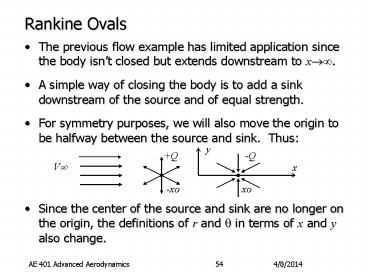
downstream to x??. - A simple way of closing the body is to add a sink
downstream of the source and of equal strength. - For symmetry purposes, we will also move the
origin to be halfway between the source and sink.
Thus - Since the center of the source and sink are no
longer on the origin, the definitions of r and ?
in terms of x and y also change.
2
Rankine Ovals 2
- For any point (x,y) in space, the following
relations apply - And the stream function solution is
3
Rankine Ovals 3
- The stream (and potential) function solution to
this case looks lie - This body type is known as a Rankine Oval.
4
Rankine Ovals 4
- First lets find the length of this body.
- Note that for this flow, there are two
stagnations points one at both the leading edge
and trailing edges. - To determine the location of these points on the
y axis, once again find where u0. - At the stagnation point (xs,0)
5
Rankine Ovals 5
- With reduction, this expression becomes
- Or
- The streamline which forms the body shape is
found from the value of psi at the right
stagnation point - Since psi is zero on the surface, the following
relationship exists
6
Rankine Ovals 6
- Or, the difference in the two angles is
- Where a nondimensional source strength, q, is
defined by - Taking the tangent of the first equation,
substituting for the tangent of the angles, and
then solving for x, the following equation is
found for the surface - Which is really x(Y) rather than Y(x) but is
the best we can do.
7
Rankine Ovals 6
- Just for completeness, the u and v components of
this flow velocity are - And, once again, the pressure coefficients can be
found from - But I really doubt it this can be simplified to a
short simple equation.
8
Doublets and Cylinders
- While Rankine ovals are not a common aerodynamic
shape, they do lead to one that is cylinders. - First, consider a source/sink pair and consider
the limit as they closer and closer (xo ? 0)
while their strengths increase such that Q 2xo
? constant, we get - This limit can be evaluated by looking at the
details of the triangle formed
9
Doublets and Cylinders 2
- By right triangle rules
- In the limit, d? is very small, r1 r2 r, and
?1 ?2 ?. - Thus
- Or similarly for the potential function
10
Doublets and Cylinders 3
- The streamlines defined by this Doublet look
like - One nice feature of a doublet is that it has a
zero net mass flux what flows out flows back
in! - The other nice feature is when a doubled is
combined with a uniform flow.
11
Doublets and Cylinders 4
- When a uniform flow is superimposed on a doublet,
the flow looks like that around a circular
cylinder.
12
Doublets and Cylinders 5
- The stream and potential functions for the flow
just shown are usually written as - As part of your homework, you will show that the
velocity on the surface of the cylinder is given
by - And thus the surface pressure coefficient is
Recommended

