

Nuclear Physics Work Group Meeting Report (6/17/05) PowerPoint PPT Presentation
Title: Nuclear Physics Work Group Meeting Report (6/17/05)
1
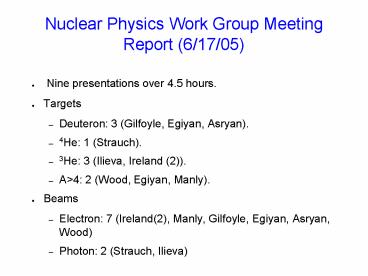
Nuclear Physics Work Group Meeting Report
(6/17/05)
- Nine presentations over 4.5 hours.
- Targets
- Deuteron 3 (Gilfoyle, Egiyan, Asryan).
- 4He 1 (Strauch).
- 3He 3 (Ilieva, Ireland (2)).
- Agt4 2 (Wood, Egiyan, Manly).
- Beams
- Electron 7 (Ireland(2), Manly, Gilfoyle, Egiyan,
Asryan, Wood) - Photon 2 (Strauch, Ilieva)
2
A Very Preliminary Analysis of the Two-Deuteron
Photodisintegration of 4HeSteffen Strauch
- 4He(g,dd) reaction identified for E 350-1200
MeV - Differential cross section.
- CLAS minimum at Qcm90o where E2 transition
dominates. - Differs from SAL, Bonn at 300 MeV.
3
- Total Cross Section
- stot 40-400 pb.
- Agrees with Bonn data at lowest energy
4
Two-body Breakup of 3He with Real
PhotonsYordanka Ilieva
- g3He -gt pd is complimentary to g3He -gt ppn with
respect to studying three-body mechanisms. - CLAS data at photon energies 0.4-1.5 GeV and
proton CM angles 40º -140º . - The invariant cross sections fall off extremely
fast with s power of s -22. - The differential cross sections exhibit large
forward-backward asymmetry one order of
magnitude. - The slope of the dfferential cross sections is
independent of Eg. - The cross sections are sensitive to three-body
mechanism contributions.
5
- A comparison with J.M. Laget's model shows that
the relative contribution of the three-body
mechanisms is larger at 600-800 MeV than at
higher photon energies. This has been also
observed in the three-body breakup of 3He.
6
Electroproduction of ?s in 3He
Joe Donnelly Dave Ireland University of Glasgow
- Modification of ?s in nuclear medium?
- Electroproduction of ?0 ? ?-p
- Electroproduction of ? ? ?0p
- Comparison with ? ? ?0p from free proton (CLAS
ANALYSIS 2001-008, papers)
7
Partial Wave Coefficients
p(e,e?0p)
3He(e,e?-p)
8
Extracted Multipole Distributions
3He(e,e?-p)
9
Three-body forces studied in 3He(e,epp) reactions
Dan Watts (University of Edinburgh) Dan
Protopopescu Dave Ireland (University of Glasgow)
10
Spectator or Active Neutron?
pm lt 0.2 GeV/c (spectator)
pm gt 0.2 GeV/c (active)
11
Variation with ?
All ?
00 lt ? lt 300
300 lt ? lt 600
??? 50, 150, 250, 350, 450 MeV
600 lt ? lt 900
900 lt ? lt 1200
Experimental Data
1200 lt ? lt 1500
1500 lt ? lt 1800
12
CLAS data and neutrinos summary S. Manly,
Univ. of Rochester
Neutrinos have mass and oscillate compelling us
to perform high statistics experiments in the
one-few GeV range with reduced systematic errors.
- High statistics, fully active, highly segmented
neutrino expt. (MINER?A) approved at FNAL. - Should produce ?A scattering.
- data complementary to JLab eA data.
- See MINER?A proposal hep-ex/405002
- New set of long baseline, expensive, neutrino
expts to measure last angle of neutrino mass
mixing matrix and possibly look for CP violation
in the neutrino sector (MINOS, T2K, NO?A) are
being designed/built (MINOS already taking data.
These experiments can benefit greatly from MC
constraints from eA data.
13
JUPITER - Jlab Unified Program to Investigate
nuclear Targets and Electroproduction of
Resonances
Study eA processes in the one-few GeV region that
are complementary to and useful for understanding
neutrino scattering in the same energy
range. With the push in neutrinos, complementary
expts (to eA) can be done that will help us
understand the nucleon, resonance production,
nuclear effects, etc. Also use this information
to reduce systematic errors in the neutrino
experiments, thus contributing to the fundamental
exploration of the neutrino sector.
JLab Hall C E04-001 and E02-109 Separated
vector structure functions for different nuclear
targets
Neutrinos - MINER?A, also feed info to other
expts.
Phenomenology development of structure function
parametrizations through resonance region (using
duality)
14
People R. Bradford at Rochester (0.5 CLAS, 0.5
MINER?A) Summer student working on CLAS analysis
(David Sher) J. Steinman working on Hall C E04-001
15
Summary of Progress Report for Analysis of
d(e,ep)n for the E5 Run PeriodJerry Gilfoyle,
Robert Burrell, and Kristen Greenholt
For E2.6 GeV, normal torus polarity, the fifth
structure function asymmetry ALT is sensitive to
the electron fiducial cuts. This appears to
reflect the underlying Q2 distribution in the
data. Other tests show no problems with the event
reconstruction near the coils.
We have generated fiducial cuts for the proton
for d(e,ep)n using a mixed sample of protons and
positive pions. The proton fiducial cuts have
little effect on ALT.
16
Study of Short Range Correlations in A(e,e)
Reaction at 1 ltxBlt3K. Egiyan, N. Dashyan, M.
Sargsian, M. Strikman, L. Weinstein
17
(No Transcript)
18
- Will use published CLAS and Brookhaven data to
study isotopic composition of 2-nucleon SRC in
12C. - Using the data from C(p,2pn) measurements of
EVA experiment at BNL for isotopic estimates. - Collaborating with authors E.Piasetzky and
J.Watson of the BNL experiment. - Preparing a paper for Science.
19
(No Transcript)
20
d(e,e'p)n exclusive reaction analysis extraction
of cross sectionG.Asryan, K.Egiyan
- Fitted the missing mass spectra to extract the
neutron yield and calculate the measured cross
section. - Consistent within 15 with previous cross
sections where neutron yields were determined
from simple cuts on missing mass spectra.
21
(No Transcript)
Recommended

