

Final results on galactic dark matter from the EROS-2 microlensing survey PowerPoint PPT Presentation
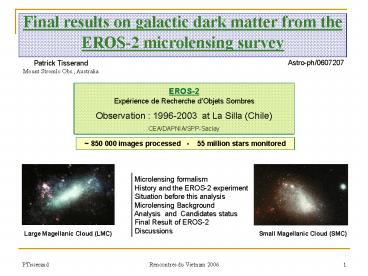
Title: Final results on galactic dark matter from the EROS-2 microlensing survey
1
Final results on galactic dark matter from the
EROS-2 microlensing survey
Astro-ph/0607207
Patrick Tisserand Mount Stromlo Obs., Australia
EROS-2 Expérience de Recherche dObjets
Sombres Observation 1996-2003 at La Silla
(Chile) CEA/DAPNIA/SPP-Saclay
850 000 images processed - 55 million
stars monitored
Microlensing formalism History and the EROS-2
experiment Situation before this analysis
Microlensing Background Analysis and
Candidates status Final Result of EROS-2
Discussions
Large Magellanic Cloud (LMC)
Small Magellanic Cloud (SMC)
2
Problem Galaxy rotation curve
One hypothesis
A halo full of machos...
A large amount of dark matter exists at the
galaxys scale
Machos Massive Astronomical Compact Halo
Objects
Surface luminosity (mag/arcsec2)
_ Planets _ Brown dwarfs _ Stellar remnants _
Unknown compact matter
Halo
Rotation velocity (km.sec-1)
Characteristics - spherical isothermal
distribution - Radius between 50 and 200 kpc -
Mass M(r) a r - Total Mass 1012 M? - Density
?(r) a 1/r2
Disc
Van Albada et al., 1985
3
Tool lensing effect
- Lensing effect Indirect detection
- For 1 M?
- Image Separation 0.2 milli arcsec
S
Exp
milli arcsec
arcsec
EROS MACHO OGLE
4
1986ApJ...304....1P, B.Paczynski
Microlensing effect
tE 70 ( )½ days
M
M?
tE ? tE (M, Dd, Vt ) Degeneracy !
- Light curve characteristics
- Symmetric
- Achromatic
- Unique ( 1 evt / 106?)
5
Some microlensing events observed
Appeared in 1993 tE 17 days, Amplification 7.5
MACHO LMC1
EROS2-LMC8
OGLE2-99-LMC1
Increase by 3.5 magnitudes !
Appeared in 2000 tE 10 days
Alert 1999 tE 66 days, Amplification 50
6
Event rate predictions from standard
isothermal halo model
- Probability (tOptical Depth)
t Probability that, a given time, a source
star is inside one Einstein disk (Amplification
gt 1.34)
t depends mainly on the halo density Independent
of machos velocity and mass
Virialised System ? ( v / c )2
Typical Value (in the case of a dark halo 100
machos)
?LMC ? 0.45 10-6 ?SMC ? 0.65 10-6
7
Events rate comparison
Lensing Galactic-Galactic stars ?gal-gal ?
2.0 10-6
Lensing LMC-Galactic stars ?LMC-gal ? 0.01
10-6
Full Macho Halo ?LMC ? 0.45 10-6 ?SMC
? 0.65 10-6
(?MACHO ? 0.12 10-6)
Self lensing ?LMC-LMC ? 0.005 - 0.05 10-6
?SMC-SMC ? 0.04 10-6
8
History
1986 B. Paczynski propose
microlensing effect to probe the halo. 1990-92
EROS1/MACHO/OGLE start the adventure. 1993
? First candidates ! 1994-95
First alert system by MACHO OGLE ?
Detection of exotic events (binary
lenses) 1994-98 EROS1/MACHO No short
timescale events discovered (10-7M?ltMlt10-3M?) 1996
Start of EROS-2. jan 2000 End of
the MACHO experiment. 2000 EROS2/MACHO
First result up to Mass10M? 2002
Start of the SuperMACHO experiment 3rd OGLE
phase. feb 2003 End of the EROS-2
observations.
9
EROS-2 Expérience de Recherche dObjets Sombres
- Second Phase July 1996 - February 2003
- Dedicated telescope 1m Ø (Marly),
- at La Silla (Chile)
- 2 cameras test for achromaticity
- 28 CCDs wide field (1deg²)
Red filter
Blue filter
Collaboration CEA/DAPNIA, LAL-IN2P3,
IAP-INSU, Observatoire de Marseille,
Collège de France (PCC), OHP
BEros between V and R REros I
10
Status before this analysis
11
Toward the Galactic center .
Hundreds of microlensing effect have been
observed
EROS2 120 MACHO 62 OGLE 33
Only Clump giant stars have been used !!
Galactic latitude (deg)
12
Halo constraints in 2003
Microlensing halo candidates EROS1 1
LMC EROS2 4 LMC 3 SMC MACHO 13
LMC
Exclusion diagram at 95 C.L.
Excluded at 95 C.L.
13
Physical Microlensing Background
14
known physical background (discovered by
MACHO)
BLUE BUMPER
Bright stars of the upper main sequence Amplificat
ion lt 2 Chromatic Variation
Easy to reject !
15
Candidates follow-up longer baseline ( 3
yrs)
3 candidates show a new bump a few years later
!! ? Variable Stars Background
Withdrawn !
- EROS 1 LMC1
1992
1998
- MACHO LMC23
1995
2001
16
(Probable) New background
Be type Stars. EROS1-LMC1 source star have
emission features.
ZOOM on the 2nd fluctuation
17
Supernovae
590 Supernovae detectable If ? Appeared
close to a cataloged star. ? or SN
cataloged. ? 26 Supernovae detected at low S/N
. (Similar rate for MACHO)
Serious background !
18
Supernovae elimination
- Galaxies seen on reference images
- Fit of an asymmetric microlensing light curve
and / or
Elimination if S gt 0.3
- Elimination of the 3 remaining EROS-2 LMC
candidates (5, 6 et 7) Better
Photometry!
EROS2-LMC5 S 0.5
EROS2-LMC7 S 0.62
19
Halo microlensing candidates status
MACHO
EROS
MACHO-A-LMC1 MACHO-A-LMC4 MACHO-A-LMC5
galactic red dwarf lens MACHO-A-LMC6
MACHO-A-LMC7 MACHO-A-LMC8 MACHO-A-LMC13
MACHO-A-LMC14 self-lensing MACHO-A-LMC15
MACHO-A-LMC18 MACHO-A-LMC21 MACHO-A-LMC23
Variable star MACHO-A-LMC25
EROS1-LMC1 Variable star EROS2-LMC3
Variable star EROS2-LMC5
Supernovae EROS2-LMC6 Supernovae EROS2-LMC7
Supernovae EROS2-SMC1 EROS2-SMC2 Long
Period Variable EROS2-SMC3 Long Period
Variable EROS2-SMC4 Long Period Variable
Only 1 on 9 candidates remain
10 on 13 could be considered as halo candidates
20
Data Analysis
21
Principe of the analysis
Detection efficiency controlled by a MONTE-CARLO
simulation gt False microlensing effects
added on real light curve ( 99 stable) They
passed the same selection cuts!
22
Blending problem
Star cataloged and surveyed
Fainter star located in the seeing disk (less
than 2)
Optical depth estimate
MACHO estimate an additional 30 error due to
blending EROS2 With HST LMC luminosity function
weighted with the probability to generate an
observable event. ? 1
under-estimated
Using bright star, we considerably reduce that
problem
23
Crowded field
24
Bright Star Sample
First time in LMC !
On our 33.4 Million stars sample, we retained
Better resolution ? better rejection of variable
stars Statistics still excellent due to a better
ltefficiencygt Largely reduce the Blending
problem Remember galactic center !
LMC 6 Million SMC 0.9 Million
LMC
Efficiency
Magnitude cut different for each
field Mag ? 16-Rmax with
Rmax 18.2-19.7 Homogeneous sample
uniform photometric resolution (7)
CLUMP
25
Number of events expected
in the case of a dark halo 100 machos
tLMC 0.45 10-6 tSMC 0.65 10-6
Efficiency
Macho mass Duration tE Number Magellanic events (full halo) Number Magellanic events (full halo)
Macho mass Duration tE effi. 100 Real effi.
10-3 M? 2.2 days 2500 63
10-2 M? 7 days 785 173
1 M? 70 days 78 35
10 M? 7.4 months 25 9
100 M? 2 years 8 0.4
For 6.9 million bright stars monitored during 6.7
years
tE 70 ( )½ days
M
M?
We need 13 events to confirm the positive signal
of MACHO at 20
26
No new microlensing event detected
1 candidate in the SMC still selected
EROS2-SMC1
Known since 1997 (EROSMACHO) ? Probably
due to SMC lens (for a halo lens, earth
motion would distort the light
curve visibly) tE 120 days
Duration expected for SMC self-lensing
27
Final EROS combined limit (1990-2003)
_3 at 10-2 M?
Domain excluded from all EROS data
_7 at 0.4 M?
_10 at 1 M?
ZOOM
LMC data set / No event
LMC SMC data set with 1 SMC halo candidate
28
Comparison EROS-2/MACHO
LMC
2 different strategies 2 different data
sets EROS2 7 Million Bright stars in
sparse wide field
(84 deg2 LMC 10deg2 SMC)
MACHO 11 Million faint and bright
stars in dense field
(13.4 deg2, LMC bar)
MACHO field
2 Million bright stars in common !
EROS2 field
Our Measurement is mainly based on a less crowded
area Photometry easier and result less affected
by blending
Remark A positive result must be seen
everywhere, not be concentrated in a special area
29
Discussion of the EROS2 result
- Our analysis is conservative
- - Use only bright-well measured sub-sample
of Magellanic stars (20 total) - - Largely reduce the blending effect
- Measurement obtained mainly with stars in the
outer part of the LMC (sparse field) - Machos in the mass range 10-7 M?lt M lt 5 M? are
ruled out as the primary occupants of the Milky
Way Halo. - Result compatible with the Optical depth expected
from the known star distribution (self-lensing
galactic disk stars) - 2 different Monte-Carlo have been computed to
estimate our detection efficiency - _ simulated microlensing effect
on true light curve - _ fake images that pass all the
photometric chain with simulated microlensed star - ? they are in excellent agreement for the
bright star sample. - An all star sample analysis (33.4 millions) has
been done with stricter cuts. Only 5
microlensing candidates have been selected for
one, the lens is a galactic red dwarf star
located at about 300pc. (result also compatible
with self-lensing) - Serious background Supernovae Variable
stars - Many former candidates died for these
reasons (ex EROS2-LMC1 and MACHO-LMC23)
30
Difference between MACHO/EROS2
- 2 completely different data sets
- _Most of the MACHO stars are considered too
faint for us 9 millions. - _MACHO observation concentrated in the LMC bar
crowded region - Blending effect MACHO suggest an additional 30
systematic error on the result. - Our limit is at flt7 for 0.4 M? , about 13
events would have been necessary to confirm the
MACHO signal. - The higher MACHO optical depth may be due, in
part, to self-lensing in central part of the LMC.
But this would contradict LMC models (Mancini et
al., 2004) which suggest that only 1-2 MACHO
candidates should be expected to be due to
self-lensing (9 and 14 are already known to be
self-lensing). - 5 MACHO candidates are really convincing 1,
5, 9, 14 and 21. - 3 are explained by LMC self-lensing or
due to a galactic lens.
Possible confirmation _ OGLE III and
SuperMACHO _ AGAPE, MEGA and
WeCaPP (toward M31) _ Photometric follow-up
of candidates
Recommended

