

Optical studies of sol-gel silica codoped with chromium and thulium PowerPoint PPT Presentation
1 / 1
Title: Optical studies of sol-gel silica codoped with chromium and thulium
1
Optical studies of sol-gel silica codoped with
chromium and thulium S.E. Meidt, J.K. Krebs, D.M.
Boye Department of Physics, Davidson College,
Davidson, NC U. Happek Department of Physics and
Astronomy, The University of Georgia, Athens,
GA A.J. Silversmith Department of Physics,
Hamilton College, Hamilton, NY
Introduction Recent advances in sol-gel science
enable the incorporation of large amounts of rare
earth impurities into silica glass. Although the
absorption of the lanthanide impurities is
similar to that in melt-grown glass, the emission
tends to be several orders lower. The presence of
aluminum cations in the sol-gel glass enhances
the luminescence, but the mechanism remains
unclear. Here, we investigate the effects on
lanthanide luminescence due to chromium codoping.
Sol-gel production Fast, Economical, Variable
outcomes Hydrolysis Mix a solid precursor with
water Peptization Adjust pH of hydrated solution
to initiate proper polymer reaction. Add dopant
here. Aging Allow solution to age, forming
colloidal particles Drying The removal of excess
water increases density of particles and long
chain molecules grow into networks Heat
treating Completes structural transformation by
densifying material. Lower temperatures than
melt methods
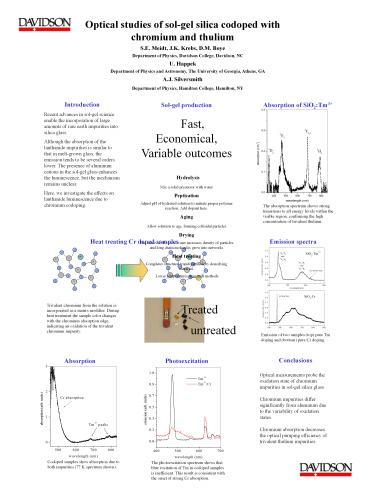
Absorption of SiO2Tm3
The absorption spectrum shows strong transitions
to all energy levels within the visible region,
confirming the high concentration of trivalent
thulium.
Heat treating Cr doped samples
Emission spectra
O
O
O
O
O
O
Cr3
Cr3
Si
Si
Si
Si
Si
Si
O
O
O
O
O
O
Si
Si
O
O
Si
Si
O
O
O
Si
O
Cr4 Cr5
O
Si
O
Si
O
O
O
O
Trivalent chromium from the solution is
incorporated as a matrix modifier. During heat
treatment the sample color changes with the
chromium absorption edge, indicating an oxidation
of the trivalent chromium impurity.
Treated
untreated
Emission of two samples (top) pure Tm doping and
(bottom) pure Cr doping.
Conclusions Optical measurements probe the
oxidation state of chromium impurities in sol-gel
silica glass. Chromium impurities differ
significantly from aluminum due to the
variability of oxidation states. Chromium
absorption decreases the optical pumping
efficiency of trivalent thulium impurities.
Absorption
Photoexcitation
Codoped samples show absorption due to both
impurities (77 K spectrum shown).
The photoexcitation spectrum shows that blue
excitation of Tm in codoped samples is
inefficient. This result is consistent with the
onset of strong Cr absorption.
Recommended

