

Hemolytic CType Lectin CELIII from Sea PowerPoint PPT Presentation
1 / 21
Title: Hemolytic CType Lectin CELIII from Sea
1
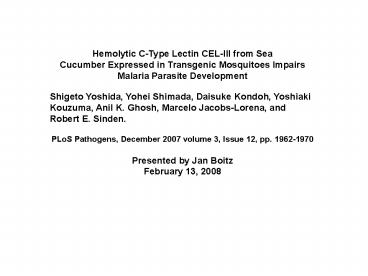
Hemolytic C-Type Lectin CEL-III from Sea
Cucumber Expressed in Transgenic Mosquitoes
Impairs Malaria Parasite Development Shigeto
Yoshida, Yohei Shimada, Daisuke Kondoh, Yoshiaki
Kouzuma, Anil K. Ghosh, Marcelo Jacobs-Lorena,
and Robert E. Sinden. PLoS Pathogens, December
2007 volume 3, Issue 12, pp. 1962-1970 Presented
by Jan Boitz February 13, 2008
2
- CEL-III
- Ca2-dependent, galactose-specific lectin
- Exhibits hemolytic and hemagglutinating
activities - Purified from the sea cucumber
- Cucumaria echinata
3
- CEL-III
- 6 molecules of CEL-III oligomerize to form an
ion permeable pore in the cell membrane - Three domains
- Two N-terminal carbohydrate-binding domains
which are highly homologous to ricin and
abrin - Unique C-terminal domain
4
Model for CEL-III Pore Formation in
Cell Membranes
Peptide 332 KGVIFAKASVSVKVTASLSK
5
Peptide 332 strongly active against Gram
bacteria
Mutated all K--gt R Mutated all V--gt L
6
Efforts regarding Transgenic Mosquito
production 2002 First transgenic mosquitoes
made using peptide that blocks transmission of
Plasmodium across the midgut epithelium 2002
Bee venom phospholipase inhibits Plasmodium
development 2007 CEL-III exhibits cytotoxicity
against Malaria parasites within infected
mosquitoes
7
Plasmodium Lifecycle Within the Mosquito Vector
8
Figure 1
Hemolytic activity /- FBS CEL-III has high
activity against human and rat erythrocytes at
low concentrations (FBS)
Abs at 550 nm, detecting free hemoglobin
9
CEL-III has no hemagglutination activity against
mouse erythrocytes
CEL-III does not bind the surface of mouse
erythrocytes
10
Figure 2
CEL-III binds to ookinetes
CEL-III inhibits ookinete development
11
Figure 3
CEL-III is secreted into the mosquito midgut and
has hemolytic activity
Blood meal induces CEL-III mRNA induction
12
Figure 4
Western blot analysis of CEL-III protein in
mosquito midgut. Native CEL-III is from the sea
cucumber.
13
Figure 5
Red blood cells are lysed in midguts of
mosquitoes expressing CEL-III
14
Tables 12
Rat and mouse Transmission blockade of intensity
(TBi) Prevalence number of infected
mosquitoes TBpPrevalence of (CEL-III/WT) Tbi
100-(CEL-III/WT)1000
15
Table 3
CEL-III transgenic mosquitoes have decreased
ability to infect mice
16
Table 4
CEL-III transgenic mosquitoes have fewer
sporozoites in salivary glands
17
Table 5
Oocyst production is decreased in CEL-III
expressing mosquitoes
18
- Conclusions
- CEL-III has hemolytic activity against human and
rat erythrocytes - CEL-III binds to ookinetes
- CEL-III appears to inhibit ookinete development
by decreasing progress to oocyst and sporozoite
formation - CEL-III expression does not appear to cause any
fitness issues in moquitoes thus far
19
- Considerations for Releasing Transgenic (GMO)
Mosquitoes into the Environment - Mosquito fitness
- Genetic drive
- Efficiency
- Effect on other organisms
- DISCUSSION
20
(No Transcript)
21
(No Transcript)
Recommended

