

SEV Hydrocarbon Emissions, Absorption Spectra, and Future Work PowerPoint PPT Presentation
1 / 29
Title: SEV Hydrocarbon Emissions, Absorption Spectra, and Future Work
1
SEV Hydrocarbon Emissions, Absorption Spectra,
and Future Work
Workers Court Strong Jose D Fuentes Bruce P
Hayden Daniel Wang
2
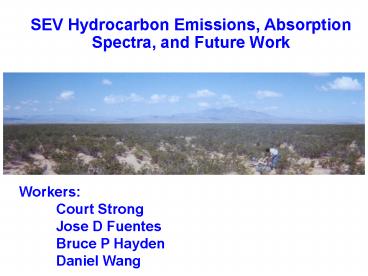
Air sampling methodology Sevilleta National
Wildlife Refuge
Emissions from foliage using
- A gas exchange system
- Electropolished canisters
- Mass flow controllers
3
Air sampling methodology Sevilleta National
Wildlife Refuge
Hydrocarbon concentration gradients
- Samples taken at 0.05, 0.5, 1.2, 2.0, and 3.0 m
- Samples stored in electropolished canisters
4
Air sampling methodology Sevilleta Field Station
Emissions from foliage using
- A gas exchange system
- Electropolished canisters
- Mass flow controllers
5
Preliminary data analyses
Data viewing on computer monitor with a size 3X
T-shirt!
6
Hydrocarbons produced by Chihuahuan desert plants
7
Irradiance absorption spectra
8
Absorption Spectrum for 3-hexen-1-ol(Z)
Window
9
Absorption Spectrum for ?-pinene
Window
10
Absorption Spectrum for Benzaldehyde
Window
11
Absorption Spectrum for Beta-Pinene
Window
12
Absorption Spectrum for Camphene
Window
13
Absorption Spectrum for Cyclohexanone
Window
14
Absorption Spectrum for Hexanal
Window
15
Absorption Spectrum for Isoprene
Window
16
Absorption Spectrum for Limonene
Window
17
Absorption Spectrum for Nonanal
Window
18
Absorption Spectrum for Octanal
Window
19
Laria (PMD 10)
20
Courtyard II
21
Snakeweed
22
Benzaldehyde
23
Cyclohexanone
24
Acetaldehyde
25
Ethanol
26
Future field and theoretical work
A. Hydrocarbon emissions from Laria vegetation
- Define hydrocarbon amounts in leaf tissue
- Establish diurnal emission rates
- Derive seasonal emissions rates
- Develop hydrocarbon emission model
27
Future field and theoretical work
B. Ecosystem-level hydrocarbon fluxes
- Study hydrocarbon fluxes during selected periods
of the growing season - Determine amounts of hydrocarbons reacted in the
atmospheric boundary layer - Quantify reaction products and yields from
hydrocarbon oxidation processes
28
Future field and theoretical work
C. Spatial distribution of hydrocarbons
- Define diurnal distribution of hydrocarbons in
the atmospheric boundary layer - Determine the amounts of hydrocarbons leaving the
atmospheric boundary layer
29
Future field and theoretical work
D. Thermal energy trapping by hydrocarbons
- Develop a one-dimension model to study the
thermal energy trapping by unreacted hydrocarbons - Investigate the shifts in the local energy
balance due to the presence of creosote
vegetation (comparative modeling studies for
creosote and grass lands)
0 m
Recommended

