

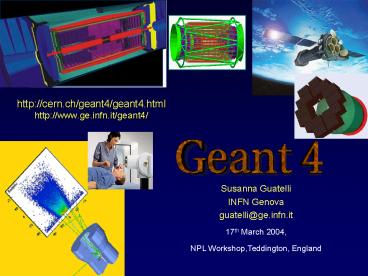
http://cern.ch/geant4/geant4.html http://www.ge.infn.it/geant4/ PowerPoint PPT Presentation
1 / 76
Title: http://cern.ch/geant4/geant4.html http://www.ge.infn.it/geant4/
1
http//cern.ch/geant4/geant4.htmlhttp//www.ge.in
fn.it/geant4/
Susanna Guatelli INFN Genova guatelli_at_ge.infn.it 1
7th March 2004, NPL Workshop,Teddington, England
2
Contents
- Introduction to Geant4 Simulation Toolkit
- Why Geant4 for Medical Physics
- Geant4 toolkit functionality
- Geant4 physics models
- Validation of Geant4 physics models
- Exploration of the use of geographically
distributed computing resources
3
What is ?
- OO Toolkit for the simulation of next generation
HEP detectors - ...of the current generation too
- ...not only of HEP detectors
- already used also in nuclear physics, medical
physics, astrophysics, space applications,
radiation background studies etc. - It is also an experiment of distributed software
production and management, as a large
international collaboration with the
participation of various experiments, labs and
institutes - It is also an experiment of application of
rigorous software engineering methodologies and
Object Oriented technologies to the HEP
environment
4
The kit
- Platforms
- Linux, SUN
- Windows-NT Visual C
- Commercial software
- None required
- Can be interfaced
- Free software
- CVS
- gmake, g
- CLHEP
- Graphics (G)UI
- OpenGL, X11, OpenInventor, DAWN, VRML...
- OPACS, GAG, MOMO...
- Code
- 1M lines of code
- continuously growing
- publicly downloadable from the web
- Documentation
- 6 manuals
- publicly available from the web
- Examples
- distributed with the code
- navigation between documentation and examples
code - various complete applications of (simplified)
real-life experimental set-ups
4
5
Geant4 Collaboration
- MoU based
- Distribution, Development and User Support of
Geant4
- Atlas, BaBar, CMS, HARP, LHCB
- CERN, JNL, KEK, SLAC, TRIUMF
- ESA, INFN, IN2P3, PPARC
- Frankfurt, Barcelona, Karolinska, Lebedev
- Serpukov, Novosibirsk, Pittsburg, Northeastern,
Helsinki
- Collaboration Board
- manages resources and responsibilities
- Technical Steering Board
- manages scientific and technical matters
- Working Groups
- do maintenance, development, QA, etc.
Budker Inst. of Physics IHEP Protvino MEPHI
Moscow Pittsburg University
6
The foundation
What characterizes Geant4 Or the fundamental
concepts, which all the rest is built upon
7
Physics
- From the Minutes of LCB (LHCC Computing Board)
meeting on 21 October, 1997
It was noted that experiments have requirements
for independent, alternative physics models. In
Geant4 these models, differently from the concept
of packages, allow the user to understand how the
results are produced, and hence improve the
physics validation. Geant4 is developed with a
modular architecture and is the ideal framework
where existing components are integrated and new
models continue to be developed.
8
Software Engineering
plays a fundamental role in Geant4
- formally collected
- systematically updated
- PSS-05 standard
User Requirements
Software Process
- spiral iterative approach
- regular assessments and improvements (SPI
process) - monitored following the ISO 15504 model
Object Oriented methods
Quality Assurance
- commercial tools
- code inspections
- automatic checks of coding guidelines
- testing procedures at unit and integration level
- dedicated testing team
Use of Standards
- de jure and de facto
9
Why Geant4 for Medical Physics
Advanced functionality in geometry, physics,
visualisation etc.
A rigorous software process
Specific facilities controlled by a friendly UI
Quality Assurance based on sound software
engineering
Extensibility to accomodate new user requirements
What in HEP software is relevant to the
bio-medical community?
Independent validation by a large user community
worldwide
Transparency of physics
Adoption of standards wherever available
Use of evaluated data libraries
User support from experts
10
Geant4 applications in Medical Physics
- Verification of conventional radiotherapy
treatment planning (as required by protocols) - Investigation of innovative methods of
radiotherapy - Radiodiagnostic
- Dosimetric studies at cellular level
11
Geant4 DICOM Interface
file
- Developed by L. Archambault, L. Beaulieu, V.-H.
Tremblay - (Univ. Laval and l'Hôtel-Dieu, Québec)
Model of complex structures
Model patients anatomy in A Geant4 application
12
Model of beam lines
13
Geant4 applications in radiodiagnostic
14
Dosimetric system for brachytherapy
Low Energy Physics for accurate dosimetry
Collaboration of frameworks Analysis, UI,
Visualisation, Access to distributed computing
resources
Dosimetry for all brachytherapic devices
F. Foppiano1, S. Guatelli2, M.G. Pia2, J.
Moscicki3 1. IST Genova, 2. INFN Genova, 3. CERN
15
Geant4 Hadrontherapy Application
Electromagnetic and hadronic Interactions for
protons and ions (and secondaries particles)
Proton beam line
G.A.P.Cirrone, G.Cuttone, S.Lo Nigro, L.Raffaele,
G.M.Sabini (LNS, INFN, IT)
16
- Collaboration ESA, ALENIA SPAZIO, INFN Genova in
AURORA project context
G.Brambati1,V.Guarnieri1, S.Guatelli2, C.
Lobascio1,P.Parodi1, M. G. Pia2, R.
Rampini 1.ALENIA SPAZIO, Torino, Italy,2.INFN
Genova, Italy
- Geant4 application for shielding and
astronauts radioprotection studies
AURORA explore the solar system and the Universe
Geant4 application in Medical Physics not only
in hospitals treatments
17
Simulation of Interactions of Radiation with
Biological Systems at the Cellular and DNA Level
Geant4 application in Radiobiology
18
The functionality
What Geant4 can do How well it does it
19
Tutorial material
- Geant4 User Documentation and further training
material can be found at Geant4 web site
http//cern.ch/geant4 - After this course, you may profit of Geant4 user
support, provided by the Geant4 Collaboration - including a User Forum accessible through
HyperNews (link from Geant4 homepage) - Geant4 Course
- IEEE Nuclear Science Symposium and Medical
Imaging Conference, Rome, October
2004 www.ge.infn.it/geant4/events
20
The kernel
- Run and event
- multiple events
- possibility to handle the pile-up
- multiple runs in the same job
- with different geometries, materials etc.
- powerful stacking mechanism
- three levels by default handle trigger studies,
loopers etc.
- Tracking
- decoupled from physics all processes handled
through the same abstract interface - tracking is independent from particle type
- it is possible to add new physics processes
without affecting the tracking
- Geant4 has only production thresholds, no
tracking cuts - all particles are tracked down to zero range
- energy, TOF ... cuts can be defined by the user
21
Describe the experimental set-up
- construct all necessary materials
- define shapes/solids required to describe the
geometry - construct and place volumes of your detector
geometry - define sensitive detectors and identify detector
volumes to associate them to - associate magnetic field to detector regions
- define visualisation attributes for the detector
elements
22
Materials
- Different kinds of materials can be defined
- isotopes G4Isotope
- elements G4Element
- molecules G4Material
- compounds and mixtures G4Material
- Attributes associated
- temperature
- pressure
- state
- density
It is possible to define homogeneous and
heterogeneous materials
23
Geometry
Role detailed detector description and efficient
navigation
Multiple representations (same abstract interface)
- CSG (Constructed Solid Geometries)
- - simple solids
- STEP extensions
- - polyhedra,, spheres, cylinders, cones, toroids,
etc. - BREPS (Boundary REPresented Solids)
- - volumes defined by boundary surfaces
- - include solids defined by NURBS (Non-Uniform
Rational B-Splines)
CAD exchange ISO STEP interface
Fields of variable non-uniformity and
differentiability
External tool for g3tog4 geometry conversion
24
Read-out Geometry
- Readout geometry is a virtual and artificial
geometry - it is associated to a sensitive detector
- can be defined in parallel to the real detector
geometry - helps optimising the performance
25
Hits and Digis
- A sensitive detector creates hits using the
information provided by the G4Step - One can store various types of information in a
hit - position and time of the step
- momentum and energy of the track
- energy deposition of the step
- geometrical information
- etc.
- A Digi represents a detector output
- e.g. ADC/TDC count, trigger signal
- A Digi is created with one or more hits and/or
other digits - Hits collections are accessible
- through G4Event at the end of an event
- through G4SDManager during processing an event
26
Generating primary particles
- Interface to Event Generators
- through ASCII file for generators supporting
/HEPEVT/ - abstract interface to Lund
- Various utilities provided within the Geant4
Toolkit - ParticleGun
- beam of selectable particle type, energy etc.
- GeneralParticleSource
- provides sophisticated facilities to model a
particle source - used to model space radiation environments,
sources of radioactivity in underground
experiments etc. - you can write your own, inheriting from
G4VUserPrimaryGeneratorAction
27
G4GeneralParticleSource
28
Physics general features
- Ample variety of physics functionalities
- Uniform treatment of electromagnetic and hadronic
processes - Abstract interface to physics processes
- Tracking independent from physics
- Distinction between processes and models
- often multiple models for the same physics
process (complementary/alternative) - Open system
- Users can easily create and use their own models
- Transparency (supported by encapsulation and
polymorfism) - Calculation of cross-sections independent from
the way they are accessed (data files, analytical
formulae etc.) - Distinction between the calculation of cross
sections and their use - Calculation of the final state independent from
tracking - Modular design, at a fine granularity, to expose
the physics - Explicit use of units throughout the code
- Public distribution of the code, from one
reference repository worldwide
29
Select physics processes
- Geant4 does not have any default particles or
processes - even for the particle transportation, one has to
define it explicitly - This is a mandatory and critical users task
- Derive your own concrete class from the
G4VUserPhysicsList abstract base class - define all necessary particles
- define all necessary processes and assign them to
proper particles - define production thresholds (in terms of range)
Read the Physics Reference Manual ! The Advanced
Examples offer a guidance for various typical
experimental domains
30
G4ParticleDefinition
- intrisic particle properties mass, width, spin,
lifetime - sensitivity to physics
- This is realized by a G4ProcessManager attached
to the G4ParticleDefinition - The G4ProcessManager manages the list of
processes the user wants the particle to be
sensitive
G4ParticleDefinition is the base class for
defining concrete particles
31
Summary view
Propagated by the tracking Snapshot of the
particle state
Momentum, pre-assigned decay
- The particle type
- G4Electron,
- G4PionPlus
Holds the physics sensitivity
The physics processes
- The classes involved in building the PhysicsList
are - the G4ParticleDefinition concrete classes
- the G4ProcessManager
- the processes
32
Cuts in Geant4
- In Geant4 there are no tracking cuts
- particles are tracked down to a zero
range/kinetic energy - Only production cuts exist
- i.e. cuts allowing a particle to be born or not
- Why are production cuts needed ?
- Some electromagnetic processes involve infrared
divergences - this leads to an infinity huge number of
smaller and smaller energy photons/electrons
(such as in Bremsstrahlung, d-ray production) - production cuts limit this production to
particles above the threshold - the remaining, divergent part is treated as a
continuous effect (i.e. AlongStep action) - Fix the cut compromise between calculation
accuracy and CPU performance
33
Control, monitor and analyse the simulation
34
Interface to external tools in Geant4
Through abstract interfaces
Anaphe
no dependence minimize coupling of components
The user is free to choose the concrete system
he/she prefers for each component
35
User Interface in Geant4
- Two phases of user actions
- setup of simulation
- control of event generation and processing
- Geant4 provides interfaces for various (G)UI
- G4UIterminal C-shell like character terminal
- G4UItcsh tcsh-like character terminal with
command completion, history, etc - G4UIGAG Java based GUI
- G4UIOPACS OPACS-based GUI, command completion,
etc - G4UIBatch Batch job with macro file
- G4UIXm Motif-based GUI, command completion, etc
36
Visualisation
- Geant4 Visualisation must respond to varieties of
user requirements - Quick response to survey successive events
- Impressive special effects for demonstration
- High-quality output to prepare journal papers
- Flexible camera control for debugging geometry
- Highlighting overlapping of physical volumes
- Interactive picking of visualised objects
37
Visualisation
- Control of several kinds of visualisation
- detector geometry
- particle trajectories
- hits in the detectors
- Visualisation drivers are interfaces to 3D
graphics software - You can select your favorite one(s) depending on
your purposes such as - Demo
- Preparing precise figures for journal papers
- Publication of results on Web
- Debugging geometry
- Etc
38
Available Graphics Software
- By default, Geant4 provides visualisation
drivers, i.e. interfaces, for - DAWN Technical high-quality PostScript output
- OPACS Interactivity, unified GUI
- OpenGL Quick and flexible visualisation
- OpenInventor Interactivity, virtual reality,
etc. - RayTracer Photo-realistic rendering
- VRML Interactivity, 3D graphics on Web
39
Debugging tools DAVID
- DAVID is a graphical debugging tool for detecting
potential intersections of volumes - Accuracy of the graphical representation can be
tuned to the exact geometrical description - physical-volume surfaces are automatically
decomposed into 3D polygons - intersections of the generated polygons are
parsed - if a polygon intersects with another one, the
physical volumes associated to these polygons are
highlighted in colour (red is the default) - DAVID can be downloaded from the web as an
external tool for Geant4
40
Physics Models
41
Physics processes
- Transparency
- Tracking independent from physics
- Final state independent from cross sections
- Use of public evaluated databases
- Object Oriented technology
- implement or modify any physics process without
changing other parts of the software - open to extension and evolution
- Electromagnetic and Hadronic Physics
- Complementary/alternative physics models
42
Electromagnetic physics
- Multiple scattering
- Bremsstrahlung
- Ionisation
- Annihilation
- Photoelectric effect
- Compton scattering
- Rayleigh effect
- g conversion
- ee- pair production
- Synchrotron radiation
- Transition radiation
- Cherenkov
- Refraction
- Reflection
- Absorption
- Scintillation
- Fluorescence
- Auger
energy loss
- electrons and positrons
- g, X-ray and optical photons
- muons
- charged hadrons
- ions
- High energy extensions
- needed for LHC experiments, cosmic ray
experiments - Low energy extensions
- fundamental for space and medical applications,
dark matter and n experiments, antimatter
spectroscopy etc. - Alternative models for the same process
All obeying to the same abstract Process interface
43
Standard electromagnetic physics in Geant4
- The model assumptions are
- The projectile has energy ? 1 keV
- Atomic electrons are quasi-free their binding
energy is neglected (except for the photoelectric
effect) - The atomic nucleus is free the recoil momentum
is neglected - Matter is described as homogeneous, isotropic,
amorphous
44
Standard electromagnetic processes
1 keV up to O(100 TeV)
- Multiple scattering
- new model (by L. Urbán)
- computes mean free path length and lateral
displacement - New energy loss algorithm
- optimises the generation of d rays near
boundaries - Variety of models for ionisation and energy loss
- including PhotoAbsorption Interaction model (for
thin layers) - Many optimised features
- Secondaries produced only when needed
- Sub-threshold production
45
Requirements for LowE p in
- UR 2.1 The user shall be able to simulate
electromagnetic interactions of positive charged
hadrons down to lt 1 KeV. - Need Essential
- Priority Required by end 1999
- Stability T. b. d.
- Source Medical physics groups, PIXE
- Clarity Clear
- Verifiability Verified
Requirement from Medical Physics
46
The Geant4 Low Energy package
- A package in the Geant4 electromagnetic package
- geant4/source/processes/electromagnetic/lowenergy/
- A set of processes extending the coverage of
electromagnetic interactions in Geant4 down to
low energy - 250 eV (in principle even below this limit)/100
ev for electrons and photons - down to the approximately the ionisation
potential of the interacting material for hadrons
and ions - A set of processes based on detailed models
- shell structure of the atom
- precise angular distributions
- Complementary to the standard electromagnetic
package
47
Low energy e.m. extensions
Fundamental for neutrino/dark matter experiments,
space and medical applications, antimatter
spectroscopy etc.
48
Fluorescence
Experimental validation test beam data, in
collaboration with ESA Advanced Concepts
Science Payload Division
Microscopic validation against reference data
Spectrum from a Mars-simulant rock sample
49
Auger effect
Auger electron emission from various materials
Sn, 3 keV photon beam, electron lines w.r.t.
published experimental results
50
Processes à la Penelope
- The whole physics content of the Penelope Monte
Carlo code has been re-engineered into Geant4
(except for multiple scattering) - processes for photons and electrons
- Physics models by F. Salvat (University of
Barcelona, Spain), - J.M. Fernandez-Varea (University of Barcelona,
Spain), E. Acosta - (University of Cordoba, Argentina), J. Sempau
(University of Catalonia, Spain) - Power of the OO technology
- extending the software system
- is easy
- all processes obey to the same
- abstract interfaces
- using new implementations in
- application code is simple
x-ray attenuation coeff in Al
Attenuation coeff. (cm2/g)
NIST data Penelope
51
Hadronic physics (1)
- Completely different approach w.r.t. the past
(Geant3) - native
- transparent
- no longer interface to external packages
- clear separation between data and their use in
algorithms - Cross section data sets
- transparent and interchangeable
- Final state calculation
- models by particle, energy, material
- Ample variety of models
- the most complete hadronic simulation kit on the
market - alternative and complementary models
- it is possible to mix-and-match, with fine
granularity - data-driven, parameterised and theoretical models
- Consequences for the users
- no more confined to the black box of one package
- the user has control on the physics used in the
simulation, which contributes to the validation
of experiments results
52
Hadronic physics (2)
- Parameterised and data-driven models
- Based on experimental data
- Some models originally from GHEISHA completely
reengineered into OO design refined physics
parameterisations
- New parameterisations
- pp, elastic differential cross section
- nN, total cross section
- pN, total cross section
- np, elastic differential cross section
- ?N, total cross section
- ?N, coherent elastic scattering
53
Radioactive Decay Module
- Handles ?, ?-, ?, ? and anti-?, de-excitation
?-rays - can follow all the descendants of the decay chain
- can apply variance reduction schemes to bias the
decays to occur at user-specified times of
observation - Branching ratio and decay scheme data based on
the Evaluated Nuclear Structure Data File (ENSDF) - Geant4 photo-evaporation model is used to treat
prompt nuclear de-excitation following decay to
an excited level in the daughter nucleus - Applications
- underground background
- backgrounds in spaceborne ?-ray and X-ray
instruments - radioactive decay induced by spallation
interactions - brachytherapy
- etc.
54
E.M. Physics Validation
- Validation is fundamental in Geant4
- Validations at different levels
- Comparisons to experimental measurements and
recognised standard references
- Unit, integration, system testing
- Microscopic physics validation
- Macroscopic validation experimental use cases
55
Microscopic validation
- Validation of Geant4 electromagnetic physics
models - Attenuation coefficients, CSDA ranges, Stopping
Power, - distributions of physics quantities
- Quantitative comparisons to experimental data and
recognised - standard references
- Regression test
- Tests are repeated for every public release
of Geant4 to control the evolution of the physics
models provided to users
56
Photon mass attenuation coefficient
x-ray attenuation coeff in U
NIST data Penelope
c219.3 n22 p0.63
Absorber Materials Be, Al, Si, Ge, Fe, Cs, Au,
Pb, U
57
Electron stopping power And CSDA range
G4 Standard G4 LowE-EPDL NIST
Absorber Materials Be, Al, Si, Ge, Fe, Cs, Au,
Pb, U
G4 Standard G4 LowE-EPDL NIST
CSDA range particle range without energy loss
fluctuations and multiple scattering
Experimental set-up
centre
58
Transmission tests
Experimental set-up
e- beam
59
Backscattering coefficient E100keV
Backscattered e-
Experimental set-up
Incident e- beam
Angle of incidence (with respect to the normal to
the sample surface) 0
60
Auger Effect, X-Ray Fluorescence
Anderson-Darling Test Ac (95) 0.752
Detector response
Simulation of Auger emission from pure materials
irradiated by an electron beam with continuous
spectrum
A.Mantero, M.Bavdaz, A.Owens, A.Peacock,
M.G.Pia Simulation of X-ray Fluorescence and
Application to Planetary Astrophysics
61
Bragg Peak
G.A.P.Cirrone, G.Cuttone, S.Donadio, S.Guatelli,
S.Lo Nigro, B.Mascialino, M.G.Pia, L.Raffaele,
G.M.Sabini
62
The problem of validation finding reliable data
Note Geant4 validation is not always
easy experimental data often exhibit large
differences!
Backscattering low energies - Au
63
Much more available or in progress
- Now and next future
- -Tests on physics quantities regarding protons,
alpha - particles and ions
- Requested by Geant4 medical physics community
interested in the use of ions for oncology
treatments - -Tests extended to hadronic processes
- Validation of physics models is always in
progress - - new tests
- - regression tests
- Many detailed results are available for the
validation of basic physics distributions
http//www.ge.infn.it/geant4/analysis/test
Geant4 e.m. physics models are subject to a
rigorous testing and validation process
Validation of physics models is fundamental for
critical application domains such as medical
physics
64
Access to distributed computing resources
How MC can nowadays be used in clinical practice
65
Monte Carlo methods in radiotherapy
- Monte Carlo methods have been explored for years
as a tool for precise dosimetry, in alternative
to analytical methods
de facto, Monte Carlo simulation is not used in
clinical practice (only side studies)
- The limiting factor is the speed
We explored the use of distributed computing
resources
66
Performance of the Geant4 brachytherapy
application
Sequential mode
1M events 61 minutes
Endocavitary brachytherapy
Superficial brachytherapy
1M events 65 minutes
Interstitial brachytherapy
1M events 67 minutes
With parallel mode performance adequate for
clinical application, but
it is not realistic to expect any hospital to own
and maintain a PC farm
67
Flow of the exploration
68
Parallel mode distributed resources
Distributed Geant 4 Simulation DIANE framework
and generic GRID middleware
69
Grid
Wave of interest in grid technology as a basis
for revolution in e-Science and e-Commerce
Ian Foster and Carl Kesselman's book A
computational Grid is a hardware and software
infrastructure that provides dependable,
consistent , pervasive and inexpensive access to
high-end computational capabilities".
An infrastructure and standard interfaces capable
of providing transparent access to geographically
distributed computing power and storage space in
a uniform way
Many GRID RD projects, many related to HEP
US projects
European projects
70
DIANE
- DIANE is a intermediate layer between
applications and a local cluster or the GRID
- Same application code as running on a sequential
machine or on a dedicated cluster or on the GRID
completely transparent to the user
J. Moscicki (CERN) www.cern.ch/diane
71
Running on the GRID
- Via DIANE
A hospital is not required to own and maintain
extensive computing resources to exploit the
scientific advantages of Monte Carlo simulation
for radiotherapy
Any hospital even small ones, or in less
wealthy countries, that cannot afford expensive
commercial software systems may have access to
advanced software technologies and tools for
radiotherapy
72
Traceback from a run on CrossGrid testbed
Resource broker running in Portugal
matchmaking CrossGrid computing elements
73
Conclusions (1)
- Geant4 Simulation Toolkit exploits modern
software technologies - Geant4 offers an ample variety of physics models
- - Both e.m. and hadronic physics models
- - Transparency of the physics
- - Penelope physics models were re-engineered in
Geant4 - - The choice of physics models is user
responsibility - Validation of physics models
- - E.M. physics models are validated in comparison
to experimental data or protocol data - - Regression test Complete control on the
evolution of the models - - Penelope physics models tested in comparison to
protocol data
74
Conclusion (2)
- Geant4 offers an ample variety of tools regarding
- -Physics models
- -Geometry set-up definition
- -Tracking of particles
- -User interfaces
- -Visualisation
- The responsibility of choice of the tools out of
the richness offered by the toolkit is user task - The access to geographically distributed
computing resources overcomes the problem of
speed constraint - Geant4 is a tool used widely in medical physics
- -IEEE Nuclear Science Symposium and Medical
Imaging Conference,Portland, Oregon, October 2003 - www.ge.infn.it/geant4/events
75
Conclusions (3)
- Geant4 Collaboration releases a new public
version of Geant4 toolkit every six months - Geant4 is continuously enriched of new
functionality - Milestones and deadlines are always respected
- Rigorous software process
- Large international collaboration
76
Conclusion(4)
- Useful websites
- -www.cern.ch/geant4
- -www.ge.infn.it/geant4
- Geant4 Collaboration provides user documentation
- Novice and Advanced examples are released as part
of the Geant4 Simulation Toolkit - Hypernews service provided
- A User Forum for Geant4 Medical Physics Community
will be created in the next future - Geant4 Collaboration offers User Support
Recommended

