

Ever wonder how they made STAR WARS or TOY STORY? PowerPoint PPT Presentation
1 / 1
Title: Ever wonder how they made STAR WARS or TOY STORY?
1
Ever wonder how they made STAR WARS or TOY STORY?
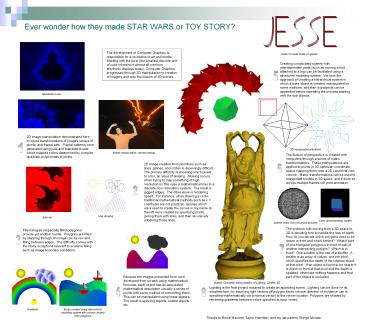
The development of Computer Graphics is
responsible for a revolution in art and media.
Starting with the pixel (the smallest discrete
unit of color inherent in almost all common
electronic displays today), Computer Graphics
progressed through 2D manipulation to creation of
imagery and onto the illusion of 3D scenes.
Authors name made of splines
Creating complicated scenes with interdependent
parts (such as moving a foot attached to a leg)
can be facilitated using a structured modeling
system. We took the approach of creating a
hierarchical system in which a base object is
created, manipulated by some matrices, and then
subobjects can be appended before repeating the
process starting with the sub objects.
5
Mandelbrot sets
2D image manipulation demonstrated here involved
transformations of images (arrays of pixels) and
fractal sets. Fractal patterns were generated
using julia and mandelbrot sets which mapped
colors determined by complex quadratic
polynomials to pixels.
1
3D manipulated primitives
The illusion of perspective is created with
computers through a series of matrix
transformations. These manipulations are applied
to points in 3D cartesian coordinate space
mapping them onto a 2D canonical view volume.
Matrix transformations can be used to manipulate
models in 3D space, and if done so across
multiple frames will yield animation.
Image manipulation chroma keying
2D image creation from primitives such as lines,
splines, and circles is deceivingly difficult.
The primary difficulty is choosing which pixels
to color, an issue of aliasing. Aliasing occurs
when trying to map something of high resolution
(in this case a mathematical line) to a discrete
(low resolution) system. The result is jagged
edges. The other issue is rendering speed. For
instance, when drawing a circle, traditional
mathematical methods such as x cos(theta) are
not practical. Splines which were used to create
the curves in my name on the left were created by
specifying points, joining them with lines, and
then recursively subdiving those lines.
6
2
Line drawing
Julia set
Cube demonstrating zbuffer
Sphere made from recursive process
The problem with moving from a 3D space to 2D is
deciding how to handle the loss of depth. How do
you decide which polygons need to be drawn in
front and which behind? What if part of one
triangular polygon is in front of part of another
intersecting polygon? Which is in front? One
solution is the use of a zbuffer. A zbuffer is
an array of values, one per pixel, which
specifies the depth of the nearest object at that
pixel. If an object is found to be nearer it is
drawn in front at that pixel and the depth is
updated, otherwise nothing happens and that part
of the object is occluded.
Filled shapes (especially filled polygons)
provide yet another hurdle. Polygons are filled
by stepping through an image row by row and
filling between edges. The difficulty comes with
the many exceptions relevant to scanline filling
such as image boundary conditions.
3
7
Because the images presented here were developed
from scratch using mathematical formulas, each
object has an associated mathematical description
(usually a series of points with some method of
connecting them). This can be manipulated using
linear algebra. The result is spinning objects,
scaled objects etc.
Budha Complete demonstration of Lighting,
Zbuffer, 3D
Lighting is the final project required to create
an appealing scene. Lighting can be done (in its
simplest form) by bouncing light vectors off
polygon faces (whose direction of incidence can
is specified mathematically via a normal vector)
to the viewer location. Polygons are shaded by
rendering gradients between colors specified at
each vertex.
4
8
Gradients
Boats created using hierarchical modeling system
with waves created from polygons
Thanks to Bruce Maxwell, Taylor Hamilton, and my
lab partner Shingo Murata.
Recommended

