

Electron probe microanalysis PowerPoint PPT Presentation
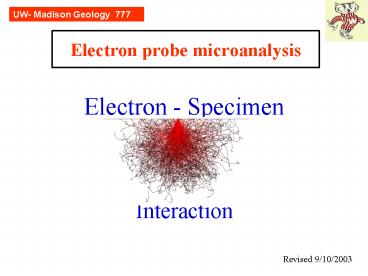
Title: Electron probe microanalysis
1
Electron probe microanalysis
UW- Madison Geology 777
- Electron - Specimen
Interaction
Revised 9/10/2003
2
Whats the point?
UW- Madison Geology 777
Electrons from a source interact with electrons
in specimen yielding a variety of photons and
electrons via elastic and inelastic scattering
processes. These are the signals that we
monitor and measure to characterize our
specimens.
3
Overview
UW- Madison Geology 777
- Elastic and inelastic processes
- Characteristic and continuum X-rays
- K,L,M etc families of X-rays
- Energy versus wavelength
- Moseleys relation
- Absorption or critical excitation energy
- Interaction volume and ranges
- Monte Carlo models
- Odds of X-ray production
4
Elastic and inelastic scattering of HV electron
by sample
UW- Madison Geology 777
Elastic (a) incident electrons direction
altered by Coulombic field of nucleus (Rutherford
scattering), screened by orbital electrons.
Direction may be changed by 0-180 (ave 2-5) but
velocity remains virtually constant. lt1 eV of
beam energy transferred. Inelastic (b) incident
electron transfers some energy (up to all, E0) to
tightly bound inner-shell electrons and loosely
bound outer-shell electrons. Direction barely
changes (lt0.1)
E0 accelerating voltage (of electrons emitted
from gun) usually 15-20 keV
(Goldstein et al, 1992, p.72)
5
Elastic and inelastic scattering of HV electron
by sample
UW- Madison Geology 777
This represents 1000 electron trajectories
(idealized), in a cross-section--both elastic and
inelastic scattering.
(Goldstein et al, 1992, p.72)
6
Scattering lexicon
UW- Madison Geology 777
Cross section a measure of the probability that
an event of a certain kind will occur, e.g.
K-shell cross section. Defined as Q N/nint,
where Nevents of certain type/vol (sites/cm3),
ninumber incident particles/unit area
(particles/cm2), and ntnumber target sites/vol
(sites/cm3). Q has units of cm2 and is thought of
as an effective size which the atom presents as
a target to incident particle. The Q for elastic
scattering is 10-17 cm2 and for K-shell
ionization is 10-20 cm2. Mean free path average
distance an electron travels within a specimen
between events of a specific type. MFPA/(NArQ)
where A is atomic wt (g/mol), NA is Avogadros
number, r is density (g/cm3).
7
Elastic and inelastic scattering
UW- Madison Geology 777
Elastic Backscattering of electrons (high
energy) Inelastic Plasmon excitation (in
metals, loosely bound outer-shell electrons are
excited) Phonon excitation (lattice oscillations
heating) Secondary electron excitation
Inner-shell ionization (Auger electrons,
X-rays) Bremsstrahlung (continuum) X-ray
generation Cathodoluminescence radiation
(non-metal valence shell phenomenon)
8
Backscattered Electrons
UW- Madison Geology 777
High energy beam electrons may suffer multiple
elastic scattering events in the solid, with
cumulative effect of escaping from the material.
The fraction of beam electrons that scatter back
(h) was found experimentally to vary directly as
a function of composition (atomic number Z). This
provides a valuable imaging tool a rapid means
to discriminate phases that have different mean Z
values.
Intensity (grey level) varies from black
(voids/epoxy), to plagioclase, olivine, basaltic
glass, with Ti-magnetitethe brightest phase.
9
Secondary Electrons
UW- Madison Geology 777
Inelastic scattering of HV beam electron can
promote loosely bound electrons from valence to
conduction band in semiconductor or insulator
with enough energy to move thru the solid (in
metals, promotion from conduction-band directly).
Backscattered electrons can also produce
secondary electrons.
By definition, these secondary electrons are lt50
eV, with most lt10 eV.
a) Complete energy distribution of electrons
emitted from target. Region I and II are BSE,
Region III secondary. b) Secondary electron
energy distribution, measured (points) and
modeled (lines)
(Goldstein et al, 1992, p. 107)
10
SE images
UW- Madison Geology 777
Secondary electrons are generated throughout the
interaction volume, but only secondary electrons
produced near the surface are able to escape (5
nm in metals, 50 nm in insulators). For this
reason, secondary electron imaging (SEI) yields
high resolution images of surface features.These
have grey-scales, though pseudo-coloring is
sometimes done.
Pollen, cat flea, and Si nanowires on alumina
sphere.
11
SE and BSE coefficients
UW- Madison Geology 777
Coefficients for backscattered-electron (h) and
secondary electron (d) as function of Z. Tilt of
specimen from 90 beam incidence (q) is 0.
E030 keV. Data from 1966 more recent views
suggest the flat SE curve may be due to carbon
contamination on specimen hindering SE escape.
(Goldstein et al, 1992, p. 109)
12
Inner-shell ionizationProduction of X-ray or
Auger e-
UW- Madison Geology 777
HV electron knocks inner shell (K here) electron
out of its orbit (time1). This is an unstable
configuration, and an electron from a higher
energy orbital (L here) falls in to fill the
void (time2). There is an excess of energy
present and this is released internally as a
photon. The photon has 2 ways to exit the atom
(time3), either by ejecting another outer shell
electron as an Auger electron (L here, thus a KLL
transition), or as X-ray (KL transition).
(Goldstein et al, 1992, p 120)
13
X-ray Lines - K, L, M
UW- Madison Geology 777
Ka X-ray is produced due to removal of K shell
electron, with L shell electron taking its place.
Kb occurs in the case where K shell electron is
replaced by electron from the M shell. La X-ray
is produced due to removal of L shell electron,
replaced by M shell electron. Ma X-ray is
produced due to removal of M shell electron,
replaced by N shell electron.
(Goldstein et al, 1992, p 121)
14
All possible K, L, M X-ray Lines
UW- Madison Geology 777
(Originally Woldseth, 1973, reprinted in
Goldstein et al, 1992, p 125)
15
X-ray Lines with initial final levels
UW- Madison Geology 777
(Reed, 1993)
16
Nomenclature of X-rays
UW- Madison Geology 777
There is some movement now to change the way
X-rays are described, from the traditional
Siegbahn notation (e.g. Ka1) to the the IUPAC
(K-L3). (International Union of Pure and Applied
Chemistry). This table is from their 1991
recommendation.
(Reed, 1993)
17
Absorption Edge Energy
UW- Madison Geology 777
Edge or Critical ionization energy minimum
energy required to remove an electron from a
particular shell. Also known as critical
excitation energy, X-ray absorption energy, or
absorption edge energy. It is higher than the
associated characteristic (line) X-ray energy
the characteristic energy is value measured by
our X-ray detector.
Example Pt (Z78) X-ray line
energies and associated critical excitation
(absorption edge) energies, in keV
18
Overvoltage
UW- Madison Geology 777
- Overvoltage is the ratio of accelerating (gun)
voltage to critical excitation energy for
particular line. U E0/Ec Maximum efficiency
(cross-section) is at 2-3x critical excitation
energy. - Example of Overvoltage for Pt for
efficient excitation of this line, would be
(minimally) thisß accelerating voltage - La -- 23 keV
- Ma -- 4 keV
Example Pt (Z78) X-ray line
energies and associated critical excitation
(absorption edge) energies, in keV
recall E0gun accelerating voltage
Eccritical excitation energy
19
Fluorescence yield
UW- Madison Geology 777
Fluorescence yield (w) is fraction of ionizations
that yield characteristic X-ray versus Auger
yield (a) within a particular family of X-rays. w
a 1
(Goldstein et al, 1992)
20
Continuum X-rays
UW- Madison Geology 777
HV beam electrons can decelerate in the Coulombic
field of the atom ( field of nucleus screened by
surrounding e-). The loss in energy as the
electron brakes is emitted as a photon, the
bremsstrahlung (braking radiation). The energy
emitted in this random process varies up from 0
eV to the maximum, E0. On an EDS plot of X-ray
intensity vs energy, the continuum intensity
decreases as energy increases. The high energy
value where the continuum goes to zero is known
as the Duane-Hunt limit.
21
Continuum and Atomic Number
UW- Madison Geology 777
At a given energy (or l), the intensity of the
continuum increases directly with Z (atomic
number) of the material. This is of critical
importance for minor or trace element analysis,
and also lends itself to a timesaving technique
(Mean Atomic Number,MAN).
MAN plot (Z-bar average Z MAN)
Continuum intensity around the Si Ka peak,
varying with Z Mo (42), Ti (22), B (5). X axis
is sin theta position units.
22
X-ray units A, keV, sin q, mm
UW- Madison Geology 777
l hc/E0 where hPlancks constant, cspeed of
light l 12.398/E0 where is l is in Å and E0 in
keV also, the 2 main EMPs plot up X-ray positions
thusly Cameca n l 2d sin q so for n1 and a
given 2d, an X-ray line can be given as a sin
value (or 105 times sin q) JEOL distance (L, in
mm) between the sample (beam spot) and the
diffracting crystal, i.e. L l R/d, where R is
Rowland circle radius (X-ray focusing locus of
points) and d is interlayer spacing of crystal.
23
Moseleys Relation
UW- Madison Geology 777
Moseley (1913, 1914) found that there is a
regular relationship between the atomic number of
a material and its characteristic X-ray
wavelength. l B/(Z-C)2, where B and C are
constants for each family of X-rays.
(Goldstein et al, 1992, p. 123)
24
Cathodoluminesce
When insulators and semiconductors are hit by HV
electrons, long l photons (UV, visible, IR light)
may be emitted. The light may be bright enough to
be seen in the reflected light image (examples
are benitoite, scheelite, zircon, corundum,
diamond, wollastonite, YAG, GaAlAs). Incident
electrons may promote valence shell electrons
across the band gap to the empty conduction band,
creating electron-hole pairs. With no bias to
sweep the electron away, it will recombine with
the hole. The excess energy ( gap energy) will
be emitted as a long l photon. Impurity atoms as
well as dislocations increase the possibilities
for additional gap energies, yielding different
wavelengths of emitted light.These may be
valuable for production of diagnostic images.
25
CL Images
UW- Madison Geology 777
Impurity atoms as well as dislocations increase
the possibilities for additional gap energies,
yielding different wavelengths of emitted
light.These may be valuable for production of
diagnostic images. CL is a cheap way to view
overgrowths (inherited cores) and healed
fractures in quartz and zircons.
CL image of zircon from Yellowstone tephra (Lava
Creek Tuff). Note faint oscillatory zoning
surrounding sector-zoned core, and healed
fractures. These are not visible in the BSE
image. 50 um grain. (courtesy Ilya Bindeman)
26
Electron interaction volumes
Effect of beam interaction (damage) in plastic
(polymethylmethacrylate), from Everhart et al.,
1972. All specimens received same beam dosage,
but were etched for progressively longer times,
showing in (a) strongest electron energies, to
(g) the region of least energetic electrons. Note
teardrop shape in (g). Same scale for all.
(Goldstein et al, 1992, p 80)
27
Ranges and interaction volumes
UW- Madison Geology 777
It is useful to have an understanding of the
distance traveled by the beam electrons, or the
depth of X-ray generation, i.e. specific ranges.
For example If you had a 1 um thick layer of
compound AB atop substrate BC, is EPMA of AB
possible?
28
Electron and X-ray Ranges
Several researchers have developed
physical/mathematical expressions to approximate
electron and X-ray ranges. Two common ones are
given below. Electron range. Kanaya and Okayama
(1972) developed an expression for the depth of
electron penetration RKO(0.0276 A E01.67)/(r
Z0.89) X-ray range. Anderson and Hasler (1966)
give the depth of X-ray production
as RAH(0.064)(E01.68 - Ec1.68)/ r where Ec is
the absorption edge (critical excitation)
energy. There are nomograms for these ranges,
given on the next slides.
29
Ranges
UW- Madison Geology 777
30
Ranges
UW- Madison Geology 777
From Will Bigelow, now emeritus U MI (Ann Arbor)
31
Monte Carlo simulations
UW- Madison Geology 777
With the development of PCs, Monte Carlo
simulations of electron-beam interactions have
been very easy to perform. You can input your
specific sample composition and run various what
if scenarios, e.g. what is the maximum
penetration of the electron beam through a thin
film, or what is the smallest size crystal in a
glass matrix that can be analyzed.
You will be performing some of these MC
simulations in a take home exercise.
Each MC run has distinct conditions specific E0,
specific composition (Atomic wt and average Z),
density, and potentially different tilt angle.
32
Specimen Heating
UW- Madison Geology 777
Castaing (1951) derived the maximum temperature
rise in a solid impacted by electrons of E0
energy and i current (in mA) and beam diameter d
(mm) DT 4.8 E0 i /kd where k is thermal
conductivity (W/cmK). For E020 keV and 20 nA,
d1 um, in a metal (k1), DT is 2 K. In a typical
mineral (k0.1), DT is 20 K. And in organic
material, (k0.002), DT is 1000 K! (e.g.
epoxy) Difficult materials carbonates, hydrated
materials, halides, phosphates, glasses,
feldspars.
(Reed 1993, p 158)
33
Harpers Index of EPMA
UW- Madison Geology 777
1 nA of beam electrons 10-9 coulomb/sec 1
electrons charge 1.6x 10⁻¹⁹ coulomb ergo, 1 nA
1010 electrons/sec Probability that an
electron will cause an ionization 1 in 1000 to 1
in 10,000 ergo, 1 nA of electrons in one second
will yield 106 ionizations/sec Probability that
ionization will yield characteristic X-ray (not
Auger electron) 1 in 10 to 4 in
10. ergo, our 1 nA of electrons in 1 second will
yield 105 xrays. Probability of detection for
EDS, solid angle lt 0.01 (1 in 100). WDS,
lt.001 ergo 103 X-rays/sec detected by EDS, and
102 by WDS. These are for pure elements. For
EDS, 10 wt, 102 X-rays 1 wt 10 X-rays 0.1 wt
1 X-ray/sec. ergo, counting statistics are very
important, and we need to get as high count rates
as possible within good operating practices.
Acknowledgement I first encountered this
treatment at the Lehigh Microscopy Summer School
34
Sources of X-ray data
UW- Madison Geology 777
- J.A. Bearden, 1964 (NBS AEC)
- White et al (Penn State 1965) tables
- main lines in tables in Goldstein et al, and
Reed texts - Probe for Windows database (includes higher
order lines for WDS), also online at
perry.geo.berkeley.edu/geology/labs/epma/xray.htm - NIST database click on X-ray Database at
bottom of page www.cstl.nist.gov/div837/Division/
outputs/DTSA/DTSA.htm - Lawrence Berkeley National Lab online at
xdb.lbl.gov for data and how to order handy free
reference book
Recommended

