

Chapter 23, Hormonal Regulation and Integration of Mammalian Metabolism PowerPoint PPT Presentation
1 / 34
Title: Chapter 23, Hormonal Regulation and Integration of Mammalian Metabolism
1
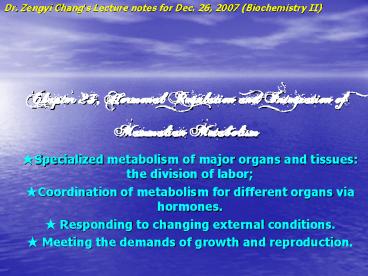
Chapter 23, Hormonal Regulation and Integration
of Mammalian Metabolism
Dr. Zengyi Changs Lecture notes for Dec. 26,
2007 (Biochemistry II)
- ?Specialized metabolism of major organs and
tissues the division of labor - ?Coordination of metabolism for different organs
via hormones. - ? Responding to changing external conditions.
- ? Meeting the demands of growth and reproduction.
2
Each organ has a specialized function The
division of labor.
Issues which fuels they use, which fuels they
generate, how they adjust their metabolism at
different physiological conditions
3
GLUT2
Metabolism of sugars in Liver.
Glucokinase (Km 10mM)
Blood Glc
(4 mM)
(then transported to other tissues)
Fatty acids are the preferred fuel for energy
production in heptocytes.
Occurs when the carbohydrate intake is in excess.
4
Metabolism of amino acids in liver.
Glucose-Alanine cycle smoothes out fluctuations
of blood glucose level during meals.
5
Metabolism of fatty acids in liver.
6
Excess carbohydrates are converted into lipids in
liver and transported to adipose tissue for
storage.
Adipose tissue stores and supplies fatty acids
Stored triacylglycerols are converted into fatty
acids when in need by other tissues (epinephrine
carries the message).
7
Muscle is a consumer of fatty acids, ketone
bodies and glucose.
Muscles lack glucose 6-phosphatase.
Phosphorylated Glc
Fermentation
Aerobic oxidation
8
Metabolic cooperation between the skeletal
muscle and liver.
The Cori Cycle
9
Mitochondria make up about half of the volume of
the heart Muscle cells.
The heart completely depends on aerobic oxidation
to obtain energy, i.e., O2 is absolutely needed
for heart to work!
10
Brain is a major glucose consumer
The most fastidious, one of the most voracious
of all the organs! O2 and glucose cannot
be interrupted!
Fatty acids do not serve as a fuel!
Consumes about 120 g glucose daily.
11
Blood mediates the metabolic interactions among
all tissues.
Blood
12
Metabolism is regulated at different levels
- At the level of the individual cells
- Regulation of enzyme activities by substrate
availability, allosteric mechanisms, covalent
modifications. - At the level of the whole organism
- Chemical messengers of the neuroendocrine system,
neurotransmitters and hormones.
13
Coordination of metabolism in separate organs
is achieved by the neuroendocrine system.
Over short distance
Over long distance
14
Fuel metabolism of different organs is
coordinated through various hormones
- Insulin, glucagon, and epinepherine have been
found to interplay in coordinating fuel
metabolism in muscle, liver, and adipose tissue,
thus keeping the blood glucose level near 4.5 mM. - Insulin signals high blood glucose (acts mainly
on liver, muscle and adipose tissues). - Glucagon signals low blood glucose (acts mainly
on liver and adipose tissues). - Epinepherine signals impending activity (acts on
muscle, liver and adipose tissues).
15
The well-fed state
Insulin stimulates glucose consumption and
storage in muscle and liver.
Stimulated by an increase in blood glucose level.
Stored as glycogen or triacyglycerol.
16
The fasting state
Glucagon stimulates glucose production and
release in liver.
Also mobilizes the fatty acids (sparing glucose
for the brain)
17
In untreated diabetes, insulin is either not
produced (Type I or IDDM) or is not recognized by
the tissues (Type II or NIDDM), and the uptake of
blood glucose is compromised.High level of
glucose in blood and urine production and
excretion of ketone bodies.
18
Active fatty acid mobilization
Active synthesis of ketone bodies.
Active protein degradation.
Fuel metabolism in liver during prolonged
fasting or uncontrolled diabetes mellitus.
Active gluconeogenesis
19
Hormones are chemical messengers secreted by
certain tissues into the blood or institial
fluid, serving to regulate the activity of other
tissues.
20
Hormones, extremely potent, are often present in
extremely low concentrations and a bioassay must
be established before their discovery and
characterization.
- For instance, insulin was discovered as a
substance affecting the volume and composition of
urine produced by a dog (Banting, Macleod and
Collip, 1920s).
21
The Nobel Prize in Physiology or Medicine 1923
"for the discovery of insulin"
Frederick Grant Banting
John James Richard Macleod
b. 1891d. 1941
b. 1876(in Cluny, Scotland)d. 1935
22
Radioimmunoassya (RIA) was an extremely sensitive
quantitative method developed to assay peptide
hormones (Yalow, 1970s)
- Antibodies binding to a hormone specifically and
with high affinity are used. - A constant amount of antibody is incubated with a
fixed amount of radioactively labeled hormone. - Unlabeled hormone in samples will compete with
the labeled ones to bind to the antibodies.
23
The amount of the unlabeled is revealed by
measuring the amount of the labeled that
disappears.
The principle of the radioimmunoassay (RIA)
The amount of labeled hormone bound will
reflects the concentration of unlabeled hormone
present (usually as a sample of blood or tissue
extract) .
24
The Nobel Prize in Physiology or Medicine 1977
"for their discoveries concerning the peptide
hormone production of the brain"
For her development of radioimmunoassays of
peptide hormones.
Roger Guillemin
Andrew V. Schally
Rosalyn Yalow
25
Hormones are chemically diverse
26
Peptide hormones are usually generated as larger
precursors.
27
Insulin is made from preproinsulin via
proteolytic processing.
28
POMC (in hypothalamus)
Multiple peptide hormones can be derived from
one prehormone polypeptide.
29
Two of the general mechanisms for hormone action.
30
There is a hierarchical chain of command in
hormonal signaling.
Coordination center of the endocrine system.
Via direct neuronal connection
31
The hormonal cascades result in large
amplification of the initial signal.
32
The adipose tissue was found to produce a protein
hormone, leptin, that act on the hypothalamus to
regulate the feeding behavior and energy
expenditure of a mammal to maintain a constant
body mass (homeostasis).
A defect in leptin production leads to obesity!
33
A set-point model for maintaining a constant
body mass
Leptin (1994)
34
Summary
- Each organ/tissue in a mammal has specialized
roles in metabolism. - Liver has remarkable metabolic flexibility and
works for other tissues in providing appropriate
fuels. - The working of all organs/tissues is highly
coordinated/integrated via the hormones, a group
of chemically diverse molecules.
Recommended

