

Population Dynamics and Mutualism: Functional Responses of Benefits and Costs PowerPoint PPT Presentation
1 / 12
Title: Population Dynamics and Mutualism: Functional Responses of Benefits and Costs
1
Population Dynamics and MutualismFunctional
Responses of Benefits and Costs
J. Nathaniel Holland, Donald L. DeAngelis, Judith
L. Bronstein
Presented by Kate Buenau
2
Generalizations for Mutualism
- Benefitscant be obtained in absence of partner
nutrients, transport, protection - Costsinvestments in attracting mutualists,
substances to reward them, energy and time to
obtain rewards - Both affect reproduction and survival
- Benefits and costs tend to be density dependent
- Positive feedback between mutualists
- Negative feedback needed for stability
3
The Goal
- Develop functional responses in terms of benefits
and costs as a function of the population of the
mutualist partner - General model
- Case study of senita cactus
4
Potential Functional Responses
- Net Effect Gross Benefit - Cost
5
Some Basic Models
- General model
- Functional responses
- linear
- saturating
- unimodal
6
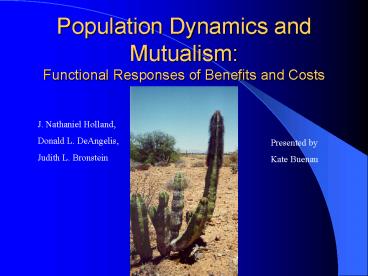
Senita Cacti and Moths
- Flowers must be pollinated by moths
- Moths lay eggs in flowers
- Not all flowers have fruit, and moth larvae eats
some immature fruit - Fruit with larvae cannot produce seeds
- Fruit may abort, and eggs and larvae die
(negative feedback)
7
The Model
- Benefits and costs to cacti depends upon
abundance of moths compared to flower production
(M/FP) unimodal net effect - Benefit Flowers are pollinated with a saturating
function, using a Poisson searching process
8
Building the equation II
- Costs (larval infestation) also saturate
- (1-a) represents fraction of flowers potentially
setting fruit - ? fraction of fruit ? cacti
9
The Other Side
- Moth benefits number of flowers effectively
oviposited - Costs fruit abortion (-a)
10
(No Transcript)
11
Variation
- Correlates pollination and oviposition
- Less likelihood of extinction
12
Some simulations
Recommended

