

Digging Deep Who can tell us most about medieval peasants PowerPoint PPT Presentation
1 / 9
Title: Digging Deep Who can tell us most about medieval peasants
1
Digging DeepWho can tell us most about medieval
peasants?
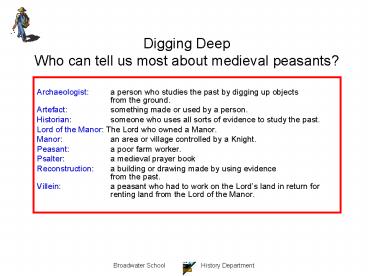
- Archaeologist a person who studies the past by
digging up objects from the ground. - Artefact something made or used by a
person. - Historian someone who uses all sorts of
evidence to study the past. - Lord of the Manor The Lord who owned a Manor.
- Manor an area or village controlled
by a Knight. - Peasant a poor farm worker.
- Psalter a medieval prayer book
- Reconstruction a building or drawing made by
using evidence from the
past. - Villein a peasant who had to work on
the Lords land in return for renting land
from the Lord of the Manor.
2
Digging DeepWho can tell us most about medieval
peasants?
- Step One The Skeletons
- Many of the skeletons were those of children.
- This tells me that
- The skeletons of the adults were about six
centimetres - shorter than people are today. This tells me that
- Many of the bone joints were worn and deformed.
- This tells me that
- The skeletons did not have tooth decay, but
their teeth - were quite worn. This tells me that
3
Digging DeepWho can tell us most about medieval
peasants?
- Step One The Skeletons
- Many of the skeletons were those of children.
- This tells me that living conditions must have
been hard and that there was not - enough food and effective medicines.
- The skeletons of the adults were about six
centimetres shorter than people are - today. This tells me that the diet of medieval
people was not as good as that - eaten by modern people.
- Many of the bone joints were worn and deformed.
This tells me that the - medieval villagers must have worked very hard.
- The skeletons did not have tooth decay, but
their teeth were quite worn. This - tells me that medieval people did not eat many
sweet foods as a part of their - diet. Their food must have been less processed
than todays foodstuffs.
4
Digging DeepWho can tell us most about medieval
peasants?
- Step One Aerial Photograph
- The aerial photograph tells me quite a lot about
Wharram Percy. In the photograph I can see the . - Step One Digs of the Peasant Houses
- The digs of peasant houses recovered some
interesting artefacts. These are - These artefacts have made it possible for an
artist to produce a reconstruction. The house had
5
Digging DeepWho can tell us most about medieval
peasants?
- Step One Aerial Photograph
- The aerial photograph tells me quite a lot about
Wharram Percy. In the - photograph I can see the outlines of the
peasants houses as well as the edges - of the fields and where there were roads.
- Step One Digs of Peasant Houses
- The digs of peasant houses recovered some
interesting - artefacts. These are clay pots, a needle and a
comb made out of bone - as well as a metal clasp and the blade of a
sickle. These tell me that - These artefacts have made it possible for an
artist to produce a - reconstruction. The house had a cruck roof,
wattle and daub walls, a floor of - beaten earth and a central fire place. There was
very little furniture and in the - winter the animals shared it with the people.
This tells me that
6
Digging DeepWho can tell us most about medieval
peasants?
- Step Two The Luttrell Psalter
- Different Jobs
- In the pictures from the Luttrell Psalter I can
see peasants . - Tools and Equipment
- In the pictures from the Luttrell Psalter I can
see peasants using . - Mens work and Womens work
- In the pictures from the Luttrell Psalter I can
see men . and I can see - women .
7
Digging DeepWho can tell us most about medieval
peasants?
- Step Two The Luttrell Psalter
- Different Jobs
- In the pictures from the Luttrell Psalter I can
see peasants breaking up - stones, cutting, threshing and milling corn.
- Tools and Equipment
- In the pictures from the Luttrell Psalter I can
see peasants using sledge hammers, sickles,
flails and a windmill. - Mens work and Womens work
- In the pictures from the Luttrell Psalter I can
see men working with - sledge hammers, flails and in a mill. Men did the
jobs that were - I can see women harvesting corn and a woman
begging. Some jobs - were shared by men and women, for instance
8
Digging DeepWho can tell us most about medieval
peasants?
- Step Three The Chatteris Court Rolls
- Freemen and Villeins
- Freemen and Villeins were forced to attend the
manorial court. The records - kept in the manor of Chatteris tell us a lot
about the control the Lord had of the - peasants. They could not . and they had to ask
permission - Manorial Courts
- Manorial courts were used by the Lord of the
Manor to keep the peasants - under control. The types of things that they did
wrong were - How the Abbess of Chatteris controlled her
Peasants - The Abbess used fines to control her peasants.
Some examples of these are ...
9
Digging DeepWho can tell us most about medieval
peasants?
- Step Three The Chatteris Court Rolls
- Freemen and Villeins
- Freemen and Villeins were forced to attend the
manorial court. The records - kept in the manor of Chatteris tell us a lot
about the control the Lord had of the - peasants. They could not leave the village
without the Lords consent and they - had to ask permission from the Lord to get
married. - Manorial Courts
- Manorial courts were used by the Lord of the
Manor to keep the peasants - under control. The types of things that they did
wrong were to make and sell - ale, plough up a footpath, set fish traps in
private waters and refuse to - thresh the Lords corn.
- How the Abbess of Chatteris controlled her
Peasants - The Abbess used fines to control her peasants.
Some examples of these are - 6d for brewing beer, 4d for becoming a priest
without permission, 2d for - illegally setting fish traps and 3 for careless
driving. The largest fines were for - crimes that were
Recommended

