

Absolute Structure Determination of Chiral Molecules: StateoftheArt Xray Diffraction based Tools PowerPoint PPT Presentation
1 / 52
Title: Absolute Structure Determination of Chiral Molecules: StateoftheArt Xray Diffraction based Tools
1
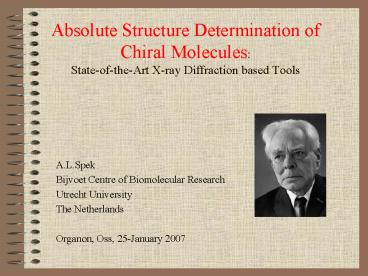
Absolute Structure Determination of Chiral
Molecules State-of-the-Art X-ray Diffraction
based Tools
- A.L.Spek
- Bijvoet Centre of Biomolecular Research
- Utrecht University
- The Netherlands
- Organon, Oss, 25-January 2007
2
Outline of this Talk
- Introduction to who we are.
- Intro to Single Crystal X-ray Structure
Determination. - Concept of Absolute Structure (Absolute
Configuration). - Resonant Scattering (Anomalous Dispersion).
- Early Applications (Bijvoet, Peerdeman van
Bommel). - The Flack Parameter The Current De-facto
Absolute Structure Analysis Tool (IUCr
Approved). - Absolute Structure Determination of Light Atom.
Structures Problems and Tentative New Tools. - Concluding Remarks.
3
Who are we ?
- The National facility for small molecule single
crystal structure determination since 1971 in the
Netherlands. - Embedded within the Crystal and Structural
- Chemistry group in Utrecht.
- Most of the Crystal and Structural Chemistry
research in Utrecht has moved from small molecule
to protein crystallography (Structural Biology
Piet Gros).
4
Small molecule and Protein XtallographyUtrecht
5
Some Statistics
- Collaboration of the National facility with most
synthetic groups in the Netherlands (mostly
academic and a few commercial) who send their
samples for analysis to Utrecht. - We handled over 3800 requests over the past 35
years. Mainly organometallic and coordination
chemistry, but also from organic, pharmaceutical
and mineralogical background. - Up to now, the results have been reported in over
1200 (joint) papers.
6
People Involved
- The last years 3 to 4, mostly PHDs, of which one
on a postdoc position. - Currently a permanent staff of 2 1 postdoc.
- Dr. Martin Lutz (since 1997)
- Dr. Lars von Chrzanowski
- (postdoc since Oct 15, 2006)
- Successor of Dr. Huub Kooijman (now SHELL)
- In the past a few trained chemists in the
context of their synthetic work.
7
Associated Functions
- Development of crystallographic software based on
local needs collected in the PLATON package. - Crystal Structure Validation (IUCr)
- Co-Editor of Acta Cryst. C (involved in the
handling of more than 1000 CIF-formatted papers).
8
Single Crystal Structure Determination Routine
- Select and Mount a Suitable Single Crystal,
preferably taken from the mother liquor (typical
size 0.3 mm in all directions) - Determine Lattice Parameters, Space Group
Symmetry - Collect (Redundant) Set of Reflection Intensity
Data, preferably on a CCD based diffractometer
system at 150 K (in N2 stream) (MoKa X-rays) - Solve the Phase Problem (I.e. Recover Phases
Associated with the Measured Intensities) - Least Squares Refinement of a Parameter Model
(Coordinates, Displacement parameters, etc.) - Analysis, Reporting Archiving of the Data
Results
9
X-Ray source, Goniometer Serial Detector
10
X-ray source, goniometer crystal, N2-cooling
and CCD Detector
11
One of the several hundreds of CCD images with
diffraction spots
12
Data Collection
- Diffraction Condition (determines the position of
the diffracted beams on the detector) - 2 dhkl sin(Q) n l (Bragg Equation)
- Result
- - Cell Dimensions, a,b,c, a, b, g
- - Reflection intensities by planes (hkl) in
the crystal I(hkl) (many thousands)
13
Structure Determination
- Experiment ? Ihkl ? Fhkl Sqrt(Ihkl)
- Needed for 3D structure (approximate) Phases
fhkl - Current Tools for Phase Recovery from Ihkl
with - - Patterson Techniques (heavy atom
structures) (DIRDIF) - - Direct Methods (SHELXS, SIR)
- - New Charge Flipping
- Brute Force, Random Start, Ab-Initio (FFT,
FFT-1) - - Fhkl fhkl Fhkl? 3D-Fourier Synthesis
- r(x,y,z) Shkl Fhkl exp-2p(hx ky
lz) / V
14
Contoured 2D-Section Through the 3D Structure
15
Abstracted and Interpreted Structure
16
Refinement of a 3D Model
- Extract the 3D Coordinates (x, y, z) of the
atoms. - Assign Atom Types (Scattering type C, O etc.)
- Assign Additional Parameters to Model the Thermal
Motion (T) of the Atoms. - Other Parameters Extinction, Twinning, Flack x
- Model Fhkl Sj1,n fj T exp2pi(hx ky lz)
- Non-linear Least-squares Parameter Refinement
until Convergence. - Minimize Shkl w (Fhklobs)2 (Fhklcalc)22
- Agreement Factor R S Fobs Fcalc / SFobs
17
ORTEP Presentation of Model Parameters
18
A-Priori Info Needed
- In principle nothing needs to be known about the
composition. - Any available (correct) info may speed up the
analysis and interpretation. - Often a service analysis turns up the structure
of a different compound than intended, either
boring or an interesting surprise. The only good
crystal in a batch may be a contamination.
19
Newly Obtained Info
- Confirmation of proposed structure
- Unexpected new structure or chemistry
- Detailed info on the geometry (bonds, angles,
torsion, ring puckering) - Polymorphism
- Molecular interactions
- Absolute Configuration
20
X-ray Analysis Routine ?
- Yes under optimal circumstances in the hands of a
professional. - No in many cases due to
- Poor Crystal Quality (fine needle bundles etc.)
- Complicated Twinning
- Disorder in part of the molecule
- Disordered (unknown) included lattice solvent
- Pseudo Symmetry, Incommensurate Structures
21
Absolute Structure of Chiral Compounds
- Question before 1951 how to correlate
microscopic absolute configurations to
macroscopic properties such as the sign of the
optical rotation of polarised light. - Emil Fischer relative system assign D
configuration to () Glyceraldehyde. - His lucky choice was later confirmed by
calculations and physical methods.
22
Example of a Macroscopic Property
23
Absolute Structure
D-()-Glyceraldehyde
Emil Fisher Arbitrary D assignments (50 chance
to be correct)
24
Natural Isomer L-(R,R-() Tartaric Acid)
CIP-Nomenclature for Chiral Atoms R,S
25
Bijvoet used Anomalous Dispersion (Resonant
Scattering) to Solve the Absolute Structure
Problem around 1950
Prof. Dr. J.M. Bijvoet (1892-1980)
26
Resonant Scattering
- X-rays interacting with the electrons in an atom
scatter in all directions or in crystals in only
certain directions due to interference. - The phase of the waves scattered by the outer
electrons of an atom is shifted by 180 degrees . - This is no longer true for the inner electrons in
heavier atoms resulting in a phase shift less
than 180 degrees - Therefore scattering factors are real numbers
only in a first order approximation (I.e. with
phase 0 or 180o) - Second order effects become prominent when the
frequency of the X-rays is close to the resonance
frequency of the inner electrons of a heavy atom - (e.g. K shell).
27
Complex Scattering Factors
- Scattering factor f f0 f if
- Where
- f0 a function of diffraction angle Q and
equal to the number of electrons in the atom at Q
0. - f and f atom type and l dependent
- i sqrt(-1)
- Note A phase shift is often represented
mathematically as a complex number.
28
Selected f - values
29
Friedel Pairs
- It can be derived from the expression for the
calculated structure factor that for
non-centrosymmetric crystal structures - Fhkl not necessarily equal to F-h-k-l
- for f gt 0, thus breaking the earlier
assumed Friedel Law Fhkl F-h-k-l - (The Friedel Law still holds for
centro-symmetric structures containing racemic
mixtures of chiral compounds).
30
H,K,L
-H,-K,-L
Friedel Pair of Reflections
31
Early Applications
- Around 1930 Coster, Knol Prins determined that
the shiny side of ZnS corresponds to the Sulfur
layer and the dull side to the Zink layer. - Around 1950 Bijvoet et al. generalized this
method and showed that the arbitrarily assigned
absolute L configuration of () tartaric acid was
the correct one. Later this result was also
confirmed with other techniques.
32
The First page of the famous 1951 Article in
Nature - E. Fischer turned out to have made the
correct choice by luck - Nobel Price ? Dorothy
Hodgkin
33
Experiments of Bijvoet et al.
- Accurate measurement of the Intensities of
Friedel Pairs - On Mixed salts of () Tartaric Acids
- NaRb Tartrate
- NaH Tartrate
- Using X-ray Film techniques
34
Qualitative Long Exposures Unstable X-Ray
Sources
35
Quantitative Methods
- Hamilton Test Refine both enantiomorph models
and statistically test whether the difference in - R-value is significant.
- Refine a multiplicative h parameter with value in
the range 1 to 1 to f . - Beurskens B parameter (from DIRDIF)
- Scatter Plot of Bijvoet Pair Differences
- Refine Inversion Twin Parameter x (Flack,1983)
36
Scatter Plot of Bijvoet Differences
- Plot of the Observed Bijvoet Differences against
the Calculated Differences. - A Least-Squares line and Correlation Coefficient
are calculated - The Least-squares line should run from the lower
left to to upper right corner for the correct
enantiomorph and the Correlation close to 1.0
37
Excellent Correlation
38
Flack Parameter
- The current official method to establish the
absolute configuration of a chiral molecule
calls for the determination of the Flack x
parameter. - Flack, H.D. (1983). Acta Cryst. A39, 876-881.
- Twinning Model (mixture model and image)
- Ihklcalc (1 x) Fhkl2 x F-h-k-l2
- Result of the least-squares refinement x(u)
- Where x has physically a value between 0 and
1 - and u the standard uncertainty (esd)
39
Interpretation of the Flack x
- H.D.Flack G. Bernardinelli (2000)
- J. Appl. Cryst. 33, 1143-1148.
- For a statistically valid determination of the
absolute structure - u should be lt 0.04 and x lt 2u
- For a compound with known enantiopurity
- u should be lt 0.1 and x lt 2u
40
Practical Aspects of Flack x
- The structure should contain atoms with
sufficiently strong anomalous dispersion
contributions for the radiation used (generally
MoKa) in the experiment (e.g. Br). - Preferably, but not nesessarily, a full set of
Friedel pairs is needed. - Unfortunately, many relevant pharmaceuticals
contain in their native form only light atoms
that at best have only weak anomalous scattering
power and thus fail the strict Flack conditions.
41
Light Atom Targets
- Options for the Absolute Structure
Determination of Light Atom Compounds - Add HBr in case of tertiary N.
- Co-crystallize with e.g. CBr4.
- Co-crystallize with compound with known. absolute
configuration. - Alternative Statistical analysis of Bijvoet pair
differences.
42
My First Abs. Struct. Determination Nature 1971
Dextro-Benzetimide HBr
43
Statistical Analysis of Bijvoet Pairs
- Many experimentalists have the experience that
the official Flack x method is too conservative,
based on multiple carefully executed experiments
with compounds with known absolute structure. - The feeling is that also in light atom structures
the average of thousands of small Bijvoet
differences will point in the direction of the
correct enantiomorph.
44
Example Ammonium Bitartrate Test
45
Ammonium BiTartrate (MoKa)
46
Bayesian Approach
- Rob Hooft (Former PhD student in Utrecht now with
Bruker-AXS) came up with a new statistical method
based on Bayesian statistics. - E.g. Assuming that the material is enantiopure,
the probability that the assumed absolute
structure is correct, given the set of observed
Friedel Pair Differences, is calculated. - This probability P2 is by a Delft colleague
dubbed to be called the swallow parameter. - An extension of the method offers the Hooft y
(or Fleq) parameter, comparable with the Flack x.
47
Natural Vitamin C, L-()Ascorbic Acid
48
L-() Ascorbic Acid
49
Current Status of the Bayesian Method
- Supporting Paper
- Determination of Absolute Structure using
Bayesian Statistics on Bijvoet Differences - R.W.W. Hooft, L.H. Straver A.L.Spek
- Rejected by J. Appl. Cryst., mainly on the basis
of the verdict of one well-known crystallographer
as a referee.
50
Concluding Remarks
- The Rob Hooft approach works well for the
multiple examples we tested but is not officially
accepted (yet). - WarningThe absolute structure determination on a
single crystal is not necessarily representative
for the absolute structure of all crystals in the
batch. In principle, multiple crystals should be
investigated by testing a number of
representative Friedel Pair differences. - An absolute structure determination is
meaningless if not related to a macroscopic
property such as the sign of the optical rotation
or special crystal faces etc..
51
END
- THANK YOU
- http//www.cryst.chem.uu.nl
52
(No Transcript)
Recommended

