

Index Investing Index Funds Vs ETFs PowerPoint PPT Presentation
1 / 9
Title: Index Investing Index Funds Vs ETFs
1
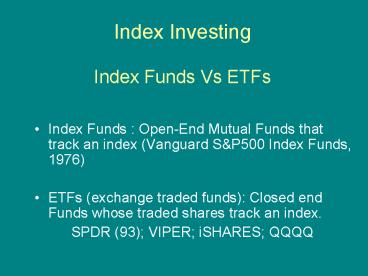
Index InvestingIndex Funds Vs ETFs
- Index Funds Open-End Mutual Funds that track an
index (Vanguard SP500 Index Funds, 1976) - ETFs (exchange traded funds) Closed end Funds
whose traded shares track an index. - SPDR (93) VIPER iSHARES QQQQ
2
Merits of ETFs
- ETFs are continuously priced throughout the
trading day, whereas mutual fund sales take place
at the end of the day price. - In theory, ETFs should be able to more closely
track an index than a mutual fund. Index fund
managers are confronted with the need to provide
liquidity to buyers and sellers of their fund's
shares, which requires them to hold a percentage
of their assets in cash.
3
Merits of ETFs
- Because ETFs trade like a stock, an investor can
employ a wider range of trading techniques with
them, such as stop loss and limit orders, and
short sales. Increasingly, futures and options
are becoming available on the more liquid ETFs,
which creates more potential trading strategies.
4
Merits of ETFs
- The operating expenses on many ETFs tend to be
lower than on index mutual funds which track the
same index, because ETFs don't provide the same
level of service to their owners that mutual fund
owners receive (e.g., telephone service centers,
free fund transfers, check writing privileges,
etc.).
5
Merits of Index Funds
- Operating expenses are only part of the story.
When you buy an ETF, you also pay a brokerage
commission, which you usually avoid when you buy
an index mutual fund (which rarely carry front
end sales loads). - For people who dollar cost average -- investing
an amount of money each month into the index fund
or funds they own, the ability to avoid trading
commissions makes mutual funds a much better deal
over time.
6
Merits of Index funds
- If you are a long term, buy and hold investor,
the ability to trade ETFs throughout the day, and
to employ a wide range of trading strategies
really isn't very useful. Mutual fund companies
provide a range of services that many discount
brokerages do not (this assumes that, in order to
minimize sales commissions, people buy ETFs
through discount rather than full service
stockbrokers). - In practice, many ETFs have had larger tracking
errors versus the index than comparable mutual
funds.
7
REIT ETFs
- REITs are companies that own and manage
properties in subsectors such as apartments,
malls, warehouses and offices. As an asset class,
REITs can reduce portfolio risk, since they tend
not to move in step with stocks and bonds.
8
Merits
- As a portfolio diversifier, however, REITs can
provide the right stuff in choppy stock markets.
For example, the MSCI REIT index added 26.8 in
2000 while the Standard Poor's 500 Index fell
9.1. - When stocks are strong, however, REITs tend to
weaken. The SP gained 21 in 1999, while the
REIT index lost 4.6.
9
Some REIT ETFs
- ETF investors can choose among four REIT
offerings, each tracking a different index
StreetTracks Wilshire REIT Vanguard REIT Index
Vipers iShares Cohen Steers Realty Majors, and
iShares Dow Jones U.S. Real Estate. - The iShares fund tracking the Cohen Steers
index has the fewest number of stocks, with 31
holdings, and focuses more on the large-cap
segment of the market.
Recommended

