

Remote Sensing of Atmosphere, Land and Ocean Properties from Terra PowerPoint PPT Presentation
1 / 57
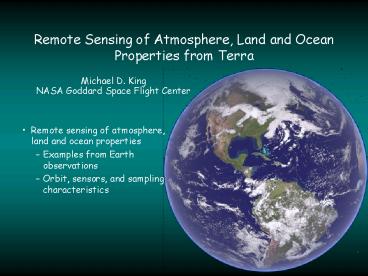
Title: Remote Sensing of Atmosphere, Land and Ocean Properties from Terra
1
Remote Sensing of Atmosphere, Land and Ocean
Properties from Terra
Michael D. King NASA Goddard Space Flight Center
- Remote sensing of atmosphere, land and ocean
properties - Examples from Earth observations
- Orbit, sensors, and sampling characteristics
2
EOS Goals Mission Objectives
- Goals
- Develop an understanding of the total Earth
system, and the effects of natural and
human-induced changes on the global environment - Expand scientific knowledge of the Earth system
using NASAs unique capabilities from the vantage
points of space, aircraft, and in situ platforms - Disseminate information about the Earth system
- Support national and international environmental
policy recommendations - Mission Objectives
- Create an integrated scientific observing system
that will enable multidisciplinary study of Earth
system science - Develop a comprehensive data and information
system, including a data retrieval and processing
system - Acquire and assemble a global database
emphasizing remote sensing measurements from
space over a decade or more - Improve predictive models of the Earth system
3
Terra Objectives
- Provide the first, consistent global snapshot
of numerous important Earth surface and
atmospheric characteristics - Improve the ability to detect the human impacts
on climate by identifying indicators, or
fingerprints, of human activity that can be
used to distinguish them from natural variability - Provide measurements of the effects of clouds,
aerosols, and greenhouse gases on the Earths
total energy balance - Provide estimates of global terrestrial and
marine productivity that will enable more
accurate calculations of global carbon storage,
exchange with the atmosphere, and year-to-year
variability - Provide observations that will improve
predictions of climate and of weather at seasonal
and interannual time scales - Contribute to improved methods of disaster
prediction, characterization, and risk reduction
from wild fires, volcanoes, floods, and droughts
4
Terras Global Perspective
- MODIS
- 1-2 day global coverage in 36 wavelengths from
250 m to 1 km resolution - MISR
- Stereo images at 9 look angles
- ASTER
- Hi-resolution, multi-spectral images from 15 m to
90 m resolution, plus stereo - MOPITT
- Global measures of CH4 CO
- CERES
- Measures Earths shortwave, longwave, and net
radiant energy budget
5
Terra
Launched December 18, 1999
MODIS
MOPITT
ASTER
MISR
CERES
6
Terra Launch Animation
7
Terra Deployment of Solar Panel
8
Terra Orbit Ground Track
9
MODerate-resolution Imaging Spectroradiometer
(MODIS)
- NASA, Terra Aqua
- launches 1999, 2002
- 705 km polar orbits, descending (1030 a.m.)
ascending (130 p.m.) - Sensor Characteristics
- 36 spectral bands ranging from 0.41 to 14.385 µm
- cross-track scan mirror with 2330 km swath width
- Spatial resolutions
- 250 m (bands 1 - 2)
- 500 m (bands 3 - 7)
- 1000 m (bands 8 - 36)
- 2 reflectance calibration accuracy
- onboard solar diffuser solar diffuser stability
monitor
10
MODIS Scan Swath
11
Global Level-1B Composite Image
May 28, 2001
R 0.65 µm G 0.56 µm B 0.47 µm
12
Cloud Optical Thickness(M. D. King, S. Platnick,
M. Gray, E. Moody, et al. NASA GSFC, UMBC)
Level-3 Monthly August 2001
tc
70
10
1
13
Cloud Top Pressure(W. P. Menzel, R. Frey, K.
Strabala, L. Gumley, et al. NOAA NESDIS, U.
Wisconsin/CIMSS)
Level-3 Monthly April 2001
pc (hPa)
1000
900
800
700
600
500
400
300
14
Precipitable Water over Land Sunglint(B. C.
Gao, et al. Naval Research Laboratory)
Level-3 Monthly August 2001
q (cm)
7.5
5.0
2.5
0.0
15
Aerosol Optical Thickness(Y. J. Kaufman, D.
Tanré, D. A. Chu, L. A. Remer et al. NASA GSFC,
University of Lille)
Level-3 Monthly September 2000
Fine mode
ta (0.55 µm)
0.8
0.7
0.6
0.5
0.4
0.3
0.2
0.1
0.0
16
Aerosol Optical Thickness(Y. J. Kaufman, D.
Tanré, D. A. Chu, L. A. Remer et al. NASA GSFC,
University of Lille)
Level-3 Monthly September 2000
Coarse mode
ta (0.55 µm)
0.4
0.3
0.2
0.1
0.0
17
Global Aerosol Optical Properties
1.0
Fine Aerosol Fraction
0.0
0.0
0.25
0.5
Aerosol Optical Thickness
18
MODIS Reveals Atmospheric Moisture Details As
Never Seen Before
MODIS Water Vapor (1 km)
GOES-8 Water Vapor (4 x 8 km)
19
Four Panel Zoom of Cloud-Free Orographic Waves
revealed in Water Vapor Imagery
Longwave Infrared Window
Visible
MODIS Water Vapor (1 km)
Shortwave Infrared Window
20
Every 100 Minutes MODIS Covers the Polar Regions
21
Every 100 Minutes MODIS Covers the Polar Regions
22
Winds from MODIS An Arctic Example
23
MODIS Detects Subvisible Cirrus
Central America April 4, 2000
24
Surface Reflectance of South AmericaMOD09
(atmospherically corrected radiance)
- South America
25
Surface Reflectance of South AmericaMOD09
(atmospherically corrected radiance)
- Brazil
26
MODIS Land Cover Classification
0 Water
6 Closed Shrublands
12 Croplands
1 Evergreen Needleleaf Forest
7 Open Shrublands
13 Urban and Built-Up
2 Evergreen Broadleaf Forest
8 Woody Savannas
14 Cropland/Natural Veg. Mosaic
3 Deciduous Needleleaf Forest
9 Savannas
15 Snow and Ice
4 Deciduous Broadleaf Forest
10 Grasslands
16 Barren or Sparsely Vegetated
5 Mixed Forests
11 Permanent Wetlands
17 Tundra
27
Surface Albedo Surface albedo ecosystem
MOD43 (Strahler, Schaaf et al.) aggregation
28
- Albedo Movies
- Loops through bands 0.65, 0.86,
- 1.24, 1.64, 2.1, and 3.7 µm
- Loops through seasonal equinox
- and solstice, progressing from
- Julian days 91, 173, 293, 356
- Ecosystem Color Scheme
- Pink Crops
- Green Trees
- Yellows Barren/Deserts
- Blues Savannas
29
MODIS Snow Cover(D. K. Hall, V. V. Salomonson,
G. A. Riggs NASA GSFC)
October 16, 2001 April 23, 2002
30
Nighttime Sea Surface Temperature(O. B. Brown,
P. J. Minnett, R. H. Evans University of Miami)
Level-3 Monthly May 2001
C
35
30
25
20
15
10
5
-2
31
Chlorophyll-a(K. L. Carder, R. H. Evans U.
South Florida, U. Miami)
Level-3 Monthly May 2001
mg m-3
20
10
1.0
0.1
0.01
32
MODIS Sea Surface Temperature off the East Coast
of the US
May 8, 2000
33
Clouds and the Earths Radiant Energy System
(CERES)
- NASA, TRMM, Terra Aqua
- launches 1997, 1999, 2002
- 350 km orbit (35 inclination), 705 km polar
orbits, descending (1030 a.m.) ascending (130
p.m.) - Sensor Characteristics
- 3 spectral bands
- Shortwave (0.3-5.0 µm)
- Window (8-12 µm)
- Total (0.3-gt200 µm)
- Spatial resolution
- 20 km
- 78 cross-track scan and 360 azimuth biaxial
scan - 0.5 calibration accuracy
- onboard blackbodies solar diffuser
34
CERES Scan Swath
35
CERES Scan Swath on Aqua
36
CERES Measurements
- Study cloud radiative forcing and feedbacks
- Develop an observational baseline of clear-sky
radiative fluxes - Document radiant input to atmospheric and oceanic
energetics models - Validate general circulation models and
- Enhance extended-range numerical weather
predictions
Shortwave Flux (W m-2)
0
105
210
Longwave Flux (W m-2)
100
210
320
37
Shortwave and Longwave Radiation as Determined
from Data of the Terra CERESMarch 2000 May 2001
- Longwave (on left) Radiation emitted to space
from the Earth system - Shortwave (on right) Sunlight reflected back to
space
38
Advanced Spaceborne Thermal Emission Reflection
Radiometer (ASTER)
- NASA MITI, Terra
- 705 km polar orbit, descending (1030 a.m.)
- Sensor Characteristics
- 14 spectral bands ranging from 0.56 to 11.3 µm
- 3 tiltable subsystems for acquiring stereoscopic
imagery over a swath width of 60 km - Spatial resolutions
- 15 m (bands 1, 2, 3N, 3B)
- 30 m (bands 4 - 9)
- 90 m (bands 10 - 14)
- 4 reflectance calibration accuracy (VNIR SWIR)
- 2 K brightness temperature accuracy (240-370 K)
VNIR (1,2,3N)
TIR
VNIR (3B)
SWIR
39
ASTER Scan Swath
40
ASTER Spectral Bands
41
ASTER Measurements
Color IR
Shortwave IR
- Spectral reflectances of the Earths surface at
15-30 m - Surface temperature and emissivities at 90 m
- Digital elevation maps from stereo images
- Surface composition and vegetation mapscloud,
sea ice, and polar ice products - Observation of natural hazards (volcanoes, etc.)
Thermal IR
SST
March 3, 2000
42
ASTER - Ji Paraná, Brazil
43
ASTER - Mount St. Helens
44
Multi-angle Imaging SpectroRadiometer (MISR)
- NASA, EOS Terra
- launched in 1999
- polar, descending orbits of 705 km, 1030 a.m.
crossing - Sensor Characteristics
- uses nine CCD-based push-broom cameras viewing
nadir and fore aft to 70.5 - swath width of 400 km
- four spectral bands for each camera (36
channels), at 443, 555, 670, 865 nm - resolutions of 275 m, 550 m, or 1.1 km
- Advantages
- high spectral stability
- 9 viewing angles helps determine aerosol by µ
dependence (fixed t)
45
MISR Scan
46
Fire Animation from MISR
multi-angle animation
47
Saharan Dust Storm near Canary Islands
February 29, 2000
70 Forward
Nadir
70 Aftward
48
Parallax Effect in MISR Images
March 6, 2000
- MISR is being used to study clouds and how they
interact with sunlight - Cycling through the nine views of this scene of
clouds over Florida, notice the displacement of
the clouds - This is due to a geometric effect called
parallax, and not true motion
49
Extratropical Cyclone in the Southern
OceanAugust 20, 2001
Cloud-tracked winds
cloud-top heights
50
MISR Imagery Aerosol Optical ThicknessAngola
and Namibia
?a (0.558 µm)
Nadir
70 backward
Multiangle
- Nadir
- True color RGB (672, 558, 446 nm)
- 70 backward-viewing camera
- True color RGB
- Multiangle (672 nm)
- Red nadir camera
- Green 70 forward
- Blue 70 backward
Diner et al. (2001)
51
Measurement of Pollution in the Troposphere
(MOPITT)
- NASA, EOS Terra
- launched in 1999
- polar, descending orbits of 705 km, 1030 a.m.
crossing - Sensor Characteristics
- Spectral bands2.223-2.294 µm CH42.323-2.345
µm CO4.562-4.673 µm CO - Spatial resolution22 km at nadir
- CO profiles22 km x 3 km
- Swath 640 km
52
MOPITT Scan Swath
53
MOPITT Measurements
Carbon Monoxide, March 2000
- Measure and model tropospheric carbon monoxide
and methane concentrations - Obtain carbon monoxide profiles with 22 km x 3 km
resolution - Measure the methane column in the troposphere
- Generate global maps of carbon monoxide and
methane distribution, and provide increased
knowledge of tropospheric chemistry
54
MOPITT CO PerspectiveThe First Year of Terra Data
55
Terras New Features
- Array of five Earth Science Instruments in space
- hardware, software and maneuvers to convert the
remote sensing signal into science - ASTER Thermal channels for geology and
environment, stereo looks, 15-90 m resolutions - CERES Cloud radiative forcing, better angular
sampling - MISR Multiangle views of clouds and land, BRDF,
275-1100 m resolutions - MODIS
- 250 m daily coverage for clouds and vegetation
change - 7 solar channels for land and aerosol
- 1.37 µm Cirrus clouds
- 0.94 µm water vapor
- fire channels and air temperature profiles at 1
km - MOPITT Global CO and CH4
56
Web SitesCheck them out
Mission
terra.nasa.gov
Education
earthobservatory.nasa.gov
Images
visibleearth.nasa.gov
57
MODIS Granule Flyby of the Himalayas(MOD09
Atmospherically Corrected Radiance)
Recommended

