

How NMR is Used for the Study of Biomacromolecules PowerPoint PPT Presentation
1 / 24
Title: How NMR is Used for the Study of Biomacromolecules
1
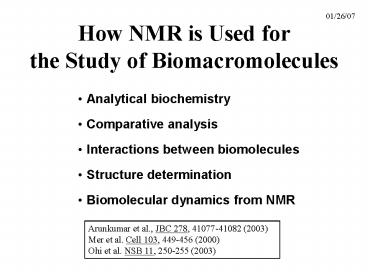
How NMR is Used forthe Study of Biomacromolecules
01/26/07
- Analytical biochemistry
- Comparative analysis
- Interactions between biomolecules
- Structure determination
- Biomolecular dynamics from NMR
Arunkumar et al., JBC 278, 41077-41082 (2003) Mer
et al. Cell 103, 449-456 (2000) Ohi et al. NSB
11, 250-255 (2003)
2
Analytical Protein Biochemistry
- Purity (can detect gt99)- heterogeneity,
degradation, contamination - Is a protein structured?- fast and easy assay,
detects aggregation and folding - Check on sequence (fingerprint regions)
- Dont need the sequence-specific assignments!
3
Protein Folding and Fingerprints
1H COSY
15N-1H HSQC
13C HSQC also!
Assay of tertiary structure check sequence
4
Comparative Analysis
- Different preparations, changes in conditions
- Domain structure
- Structural heterogeneity (e.g. Pro cis-trans
isomerization) - Homologous proteins, mutants, engineered
proteins
5
Folding and Domain StructureAre domains packed
together or independent?
- Chemical shift is extremely sensitive
- If peaks are the same, structure is the same
- If peaks are different, the structure is
different but we dont know how much
6
Biochemical Effect of MutationsAssay for proper
folding/stability
Wild-type
Partially destabilized
Structural heterogeneity
Unfolded
Ohi et al., NSB (2003)
7
Structural Basis for PhenotypeWhat is the cause
of defective RNA splicing by Prp19-1?
Initial interpretation was defect in some binding
interface ? NMR showed U-box folding defect
Ohi et al., NSB (2003)
8
NMR to Study Interactions
- Monitor the binding of molecules
- Determine binding constants (discrete off rates,
on rates) - Sequence and 3D structural mapping of binding
interfaces
9
NMR- The Master Spectroscopy
Titration monitored by 15N-1H HSQC
- NMR Provides
- Site-specific
- Multiple probes
- In-depth information
- Perturbations can be mapped on structure
10
Binding Constants FromChemical Shift Changes
Stronger
Weaker
Molar ratio of d-CTTCA
- Fit change in chemical shift to binding equation
Arunkumar et al., JBC (2003)
11
Probe Binding Events by NMR15N-RPA32C
Unlabeled XPA1-98
15N-1H HSQC
- Only 19 residues affected
- Discrete binding site
- Signal broadening ? exchange between the bound
and un-bound state - Kd 1 mM
RPA32C RPA32C XPA 1-98
Mer et al., Cell (2000)
12
Map XPA Binding Site on RPA32C Using NMR
- Map chemical shift perturbations on the
structure of RPA32C - Can even map directly on to sequence with no
structure
Mer et al., Cell (2000)
13
Structure Determination by NMR
14
NMR Experimental Observables Providing Structural
Information
- Distances from dipolar couplings (NOEs)
- Backbone and side chain dihedral angles from
scalar couplings - Backbone conformation from chemical shifts
(Chemical Shift Index- CSI) ?,? - Hydrogen bonds- NH exchange or J
- Relative inter-nuclear orientations from residual
dipolar couplings (RDCs)
15
NMR Structure Calculations
- Objective is to determine all conformations
consistent with the experimental data - Programs initially search geometry only
- More calculations using molecular force fields to
improve molecular properties - NMR data are not perfect (noise, incomplete) ?
multiple solutions (conformational ensemble)
16
Characteristics of NMR Structures
- Secondary structures well defined, loops
variable - Interiors well defined, surfaces more variable
- RMSD provides measure of variability
17
Restraints and Uncertainty
- Large of restraints low values of RMSD
- The most important restraints are long-range
18
Assessing the Accuracy and Precisionof NMR
Structures
- Number of experimental restraints (A/P)
- Violation of constraints- number, magnitude (A)
- Compare model and exptl. parameters (A)
- Comparison to known structures PROCHECK (A)
- Molecular energies (?A?, subjective)
- RMSD of structural ensemble (P, biased)
19
Biomolecular Dynamics from NMR
- Why? Function requires motion/kinetic energy
- Entropic contributions to binding events
- Protein folding/unfolding
- Uncertainty in NMR and crystal structures
- Effect on NMR experiments? dynamics to predict
outcomes and design new experiments - Calibration of computational methods
20
Characterizing Protein Dynamics
Parameters/Timescales
Residual Dipolar Couplings
21
NMR Observables and Dynamics
- Number of signals per atom multiple signals for
slow exchange between conformational states - Linewidths narrow faster motion, wide
slower dependent on MW and conformational states - Exchange of NH with solvent slow timescales
- NMR relaxation measurements (ps-ns, ms-ms)
- Direct measurements of motion of atoms
- Parameters R1 (T1), R2 (T2), Het. NOE (e.g. 15N-
1H)
22
Linewidth is Dependent on MW
- Linewidth determined by size of particle
- Fragments have narrower linewidths
Arunkumar et al., JBC (2003)
23
Independent Domains in Large Proteins
RPA32
RPA14
gt 400 residues / 80 signals
Why? A structurally-independent functional domain
24
Correlating Structure and Dynamics
?
?
?
?
?
- Measurements show if high RMSD is due to high
flexibility (low S2)
Weak correlation
?
?
Strong correlation
?
?
Recommended

