

Advantages of Cementless MiniIncision THA PowerPoint PPT Presentation
1 / 59
Title: Advantages of Cementless MiniIncision THA
1
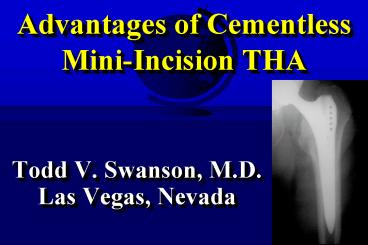
Advantages of CementlessMini-Incision THA
- Todd V. Swanson, M.D.
- Las Vegas, Nevada
2
Cemented THA
- Considered the Gold Standard for years
- Good long-term results in elderly patients
3
Cemented THA Results(Charnley Long-term Results)
4
Mid-term Cemented THA Results(2nd 3rd
Generation Cement Technique)
5
Cemented THA in Young Patients (1st generation
cement technique)
6
Introduction of Porous Ingrowth Fixation in USA
- Early 1980s
- Many poor designs
- Many early failures
- Loosening
- Osteolysis
- Thigh pain
7
Cementless THA Results(conventional designs)
8
Cementless THA Results(Conventional Designs)
9
Cementless THA Results
- Not all cementless hips are created equal
- Comparisons should not be between any cemented
and cementless designs, but between optimal
designs utilizing optimal technique
10
Cementless THA Results(Norwegian Arthroplasty
Register)(Havelin, et al, J. Bone Joint Surg.
77-B11, 1995)
- 2907 cementless hips
- 8 designs with gt100 each
- Group 1 (all titanium)
- Zweymuller
- Corail
- LMT
- Profile
- Group 2
- Bio-Fit
- Harris Galante
- Femora
- PM-Prosthesis
11
Cementless THA Results(Tapered Designs)
12
Zweymuller Results
13
A substantial incidence of thigh pain has been
noted by a variety of authors using femoral
designs with a large intramedullary rod. In
contrast, the use of a flat wedge-shaped femoral
implant has resulted in a considerably lower
incidence of thigh pain in the authors own
experience and that of others--Rothman, Clin
Orthop, 1990--
14
Cemented vs Cementless Results
15
Cemented vs Cementless Fixation
- Mid-term results are comparable when using
optimal designs and implantation techniques
16
The Quintessential Question
- Will the dynamic, biologic fixation of cementless
THA outlast the static, mechanical fixation of
cemented components? - Answer Only time will tell
17
Are there any Early Advantages to cementless
fixation?
- Peri-operative morbidity?
- Peri-operative mortality?
- Operative time?
- Blood loss?
- Length of Stay?
- Cost?
18
Operative Time(Barrack, et al, J. Arthroplasty
11373, 1996)
- 50 stratified THAs
- 25 cemented 3rd generation cement technique
- 25 cementless
- Operative time 20 minutes longer for cemented
implants - (OR time 8 per minute) x 20 160
- Plus additional anesthesia charge of 100
19
Operative Time(Laupacis, Bourne, Rorabeck, et
al,J. Arthroplasty 9481, 1994)
- Cost analysis of 60 THAs during 1st post-op year
- 30 Biomet cemented
- 30 Biomet cementless
- Operative time 25 minutes longer for cemented
implants - (OR time 6 per minute) x 25 150
20
Operative Time
- Bourne, Rorabeck, J. Arthroplasty, 1994
- Operative time 25 minutes longer for cemented
hips - Equivalent to 150 per case
- Barrack, J. Arthroplasty, 1996
- Operative time 20 minutes longer for cemented
hips - Equivalent to 260 per case
21
Cost(Barrack, et al, J. Arthroplasty 11373,
1996)
- 50 stratified THAs (25 cemented, 25 cementless)
- Cementless prosthesis cost 900 more than
cemented - Cementing accessories 700
- Extra OR time cost 260
- Overall costs equivalent
22
Cost(Laupacis, Bourne, Rorabeck, et al,J.
Arthroplasty 9481, 1994)
- Cost analysis of 60 THAs during 1st post-op year
(30 cemented, 30 cementless) - No difference in overall cost during
hospitalization or during 1st post-op year
23
Cost
- Bourne, 1994
- No difference in overall cost during
hospitalization or 1st post-op year
- Barrack, 1996
- Overall operative costs equivalent between
cemented vs cementless hips
24
Conclusions(cost OR time)
- Costs of cemented vs cementless THA equivalent
- OR time shorter with cementless THA (particularly
with Zweymuller prosthesis and abbreviated
posterior approach)
25
Morbidity Pulmonary Embolism(Sharrock, Ranawat,
Sculco, Salvati, et al,Clin. Orthop. 31916,
1995)
- 13 elective bilateral THAs studied with
intra-operative pulmonary artery catheters - 8 cemented
- 5 cementless
- Increased pulmonary artery pressure in cemented
group only, indicating intra-operative pulmonary
embolism
26
Morbidity Pulmonary Embolism(Christie, et
al,J. Bone Joint Surg. 76-B409, 1994)
- Intra-operative trans-esophageal echocardiography
performed on 20 femoral neck fractures - 10 uncemented Austin-Moores
- 10 cemented endoprostheses (finger packing of
cement) - Greater and more prolonged embolic cascades in
cemented group
27
Morbidity Pulmonary Embolism(Ereth, Lewallen,
et al,Mayo Clin. Proc. 671066, 1992)
- Trans-esophageal echocardiography and hemodynamic
monitoring in 35 THAs - 19 cemented
- 16 uncemented
- Cemented group
- Greater pulmonary embolization
- Increased pulmonary artery pressure and PVR
- Decreased cardiac output
28
Morbidity Pulmonary Embolism(Ries, et al, J.
Bone Joint Surg. 75-A581, 1993)
- Arterial oxygenation followed intra-operatively
in 34 THAs - 11 cemented (3rd generation technique)
- 23 cementless
- 28 increase in intra-operative pulmonary shunt
in cemented group no change in cementless group
29
Morbidity Pulmonary Embolism(Nolan, Anaesthesia
49293, 1994)
- pO2 and blood pressure monitored during THAs
- 10 cemented THAs
- 16 reduction in pO2
- 20 reduction in mean B.P.
- 10 Cementless THAs no change in pO2 or B.P.
30
Morbidity Pulmonary Embolism(Orsini, Waddell,
et al,J. Bone Joint Surg. 69-A822, 1987)
- 24 dogs studied
- non-cemented group
- cemented group
- non-cemented, with bone wax
- Cemented and bone wax groups
- Pulmonary microemboli
- Increased pulmonary artery pressure
- Increased intra-pulmonary artery shunt
- Decreased arterial pO2
31
ConclusionsPulmonary Embolism
- Pressurization causes embolization of debris and
fat to lungs - Pulmonary embolization causes
- Increased pulmonary artery pressure
- Increased pulmonary vascular resistance
- Decreased cardiac output
- Increased pulmonary shunt
- Oxygenation difficulties
32
Pulmonary Embolism(numerous studies)
- Cement pressurization can elevate intramedullary
pressures up to 5,800 mm Hg and expel 2g of
debris into the vasculature - Debris, fat, and bioactive substances embolize to
the lungs - Pulmonary embolization causes
- Increased pulmonary vascular resistance
- Increased pulmonary artery pressure
- Decreased cardiac output
- Increased pulmonary shunt
- Oxygenation difficulties
33
Fat Embolism after Cementless THA
34
Fat Embolism after Cementless THA(Gelinas, J.
Arthroplasty, 2000)
- Tight, cylindrical fit can cause intramedullary
pressurization and embolization of intramedullary
debris
35
Morbidity DVT(Sharrock, Ranawat, Sculco,
Salvati, et al,Clin. Orthop. 31916, 1995)
- 34 THAs monitored intra-operatively for
circulating markers of thrombogenesis - 21 cemented
- 13 cementless
- Circulating markers of thrombin generation and
fibrinolysis increased more during cemented
femoral component insertion than cementless
insertion
36
Morbidity DVT(Francis, Marder,
Evarts,Lancet, April 5, 1986, p. 769)
- 46 THAs followed prospectively
- 13 cemented (3rd generation technique)
- 23 cementless
- Venography 1 week post-op
- 31 DVTs in cemented group none in cementless
group (plt0.025)
37
ConclusionsDVT
- Cement pressurization causes release of
thrombogenic agents - Some studies document clinically increased risk
of DVT with cemented arthroplasty
38
Deep Venous Thrombosis(HSS, Clin Orthop,
1995Francis, Lancet, 1986)
- Cement pressurization causes release of
thrombogenic agents - Some studies document clinically increased risk
of DVT with cemented arthroplasty
39
Mortality(Lennox McLauchlan,Injury 24185,
1993)
- 207 consecutive femoral neck fractures
- Cemented vs cementless hemiarthroplasties
- Higher mortality in cemented group during initial
48 hours (4 vs 0) - 3 myocardial infarctions
- 2 fat embolism
- 1 pulmonary embolus
40
Mortality(Johnson Lewallen,Orthop. Trans.
19224, 1995)
- Review of 976 elective endoprostheses
- 20 mortalities w/i first 30 days
- Higher mortality with cemented vs cementless
endoprosthesis (3 vs 0.3)
41
Mortality(Lewallen, unpublished data, 1992)
- Review of 21,895 THAs
- 15,211 cemented
- 6684 cementless
- 19 intra-operative deaths in cemented group
(0.12) none in cementless group (plt0.05)
42
ConclusionsMortality
- Cemented endoprosthesis for femoral neck
fractures may increase mortality rate in first 48
hours - Elective cemented endoprosthesis may increase
mortality rate in first 30 days - Cemented THA may increase mortality rate
43
Mortality(Lennox, Injury, 1993 Johnson, Orthop
Trans, 1995 Lewallen, 1992)
- Cemented endoprosthesis for femoral neck
fractures may increase mortality rate in first 48
hours (4 vs 0 in 207 patients) - Elective cemented endoprosthesis may increase
mortality rate in first 30 days (3 vs 0.3 in
976 patients) - Cemented THA may increase mortality rate (0.12
vs 0 in 21,895 THAs)
44
SummaryEarly Advantages of Cementless Fixation
- Shortened operative time
- Decreased pulmonary morbidity
- Decreased thromboembolism
- Decreased mortality
45
Hybrid vs Zweymuller THAEarly Post-op
Complications(a prospective study with
historical controls)
- 51 hybrid THAs
- Standard posterior approach
- 3rd generation cement technique
- Richards or DePuy cemented stem
- Richards cementless cup
- 268 cementless THAs
- Abbreviated posterior approach (mini-incision)
- Plus Zweymuller stem
- Richards or Plus cementless cup
46
Abbreviated Posterior Approach
47
Study Methods
- Study groups matched by excluding all patients
lt60 y.o. - 94 osteoarthritics
- General anesthesia
- PCA analgesia until 2nd POD
- Immediate weight bearing as tolerated
- Mechanical DVT prophylaxis ASA
48
Hybrid vs ZweymullerMean Age
- 48 hybrid hips
- 172 Zweymuller hips
- No difference in mean age
- Hybrid 70.3 (60-83)
- Zweymuller 71.5 (60-94)
49
Hybrid vs ZweymullerMean Operative Time
- Hybrid 79 minutes (46-111)
- Zweymuller 50 minutes (23-110)
- 29 minute difference (hybrids took 58 longer)
50
Hybrid vs ZweymullerMean Blood Loss
- Hybrid 450 cc (200-1000)
- Zweymuller 301 cc (100-2000)
- 149 cc difference (50 more blood loss with
standard approach) - (No statistical difference in blood replacement)
51
Hybrid vs ZweymullerDifficult Pain
Management(deviation from standard analgesic
regimen)
- Hybrid 8
- Zweymuller 0
52
Hybrid vs ZweymullerPost-op O2 Requirements
- Hybrid 10 required O2 past POD-1
- Zweymuller 1.4 required O2 past POD-1
53
Hybrid vs ZweymullerMental Status
Changes(Confusion, Agitation, Disorientation)
- Hybrid 6.2
- Zweymuller 2.3
54
Hybrid vs ZweymullerAll Peri-operative
Complications
- Complications Included
- Bleeding
- Pneumonia
- Cardiac problem
- Ileus
- Dislocation
- Urinary retention/UTI
- DVT/PE
- Wound problem
- Mental status changes
- Difficult pain management
- Miscellaneous
- Hybrid 22 of patients
- Zweymuller 4.2 of patients
55
Hybrid vs ZweymullerMean Length of Stay
- Acute Days
- Hybrid 5.0 days
- Zweymuller 4.0 days
- Total Days
- Hybrid 9.1 days
- Zweymuller 6.8 days
- Acute days plt0.005
- Total days plt0.025
56
ConclusionsZweymuller Total Hip Stem with
Abbreviated Posterior Approach
- Less blood loss
- Shorter operative time
- Less pain
- Fewer post-op mental status changes
- Fewer total peri-operative complications
- Shorter length of stay
57
Reasons to use Cementless Fixation with
Abbreviated Approach
- Less pulmonary morbidity
- Less thromboembolism
- Lower mortality
- Shorter OR time
- Less blood loss
- Fewer mental status changes
- Less post-op pain
- Fewer overall complications
- Shorter hospital length of stay
58
Etiologies of Differences
- Shorter operative time
- Mini-incision
- Simplified prosthesis insertion
- Less blood loss
- Mini-incision
- Shortened OR time
- Less pain
- Mini-incision
- Mental Status Changes
- Cementless fixation
- Less anesthesia
- Fewer pain meds
- Fewer total peri-operative complications
- Mini-incision
- Shorter OR time
- Cementless fixation
- Fewer pain meds
- Less blood loss
- Shorter length of stay
- Mini-incision
- Immediate weight-bearing
- Fewer complications
59
THANK-YOU
Todd V. Swanson, MD Las Vegas, Nevada, USA
Recommended

