

Will WholeSlide Imaging Change the Practice of Pathology Point CounterPoint PowerPoint PPT Presentation
1 / 38
Title: Will WholeSlide Imaging Change the Practice of Pathology Point CounterPoint
1
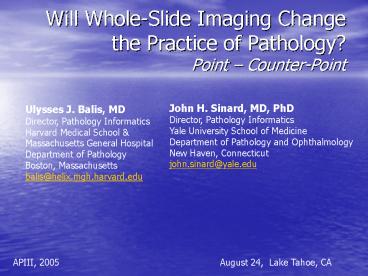
Will Whole-Slide Imaging Change the Practice of
Pathology?Point Counter-Point
John H. Sinard, MD, PhD Director, Pathology
Informatics Yale University School of
Medicine Department of Pathology and
Ophthalmology New Haven, Connecticut john.sinard_at_y
ale.edu
Ulysses J. Balis, MD Director, Pathology
Informatics Harvard Medical School
Massachusetts General Hospital Department of
Pathology Boston, Massachusetts balis_at_helix.mgh.ha
rvard.edu
APIII, 2005 August 24, Lake Tahoe, CA
2
Educational Objectives
- Salient Review of Underlying Wide-Field
Technology - Review of Wide-Field Capture Strategies
- Current and Anticipated State-of-the-art
- Review of Likely Application Settings
- Pros
- Cons
- Open Debate
- Audience questions and Open Discussion
3
The CCD the fundamental enabling tool of
digital image capture
4
- Pixel - A picture element a single location of
a digital image made of x by y locations, or
pixels.
Overall Digital Image
5
Image
Analog to digital converter
Each image location contributes a series of
analog voltages specific for its location only.
10011011011 00100110111 00010111010 11011101001 00
101110111......
Array of photosensitive elements
A binary number is finally obtained for each
unique location within the rectangular array.
6
Wide-Field Image Capture (type 1)formerly known
as the store and forward model
- Acquire the whole slide into the digital realm
- Image is scanned and reconstructed in some
predefined time interval (minutes to hours) - The data set is then available for display or
dissemination. - Better performance is achieved with increasing
computational power and system memory
7
Wide-Field Image Capture (type 2)(RANA
Robotically Actuated Network Appliance model)
- Utilize remotely operated stage/focus/lighting/obj
ective robotics to control microscope. - Scan field of interest in a just-in-time digital
delivery model, using the internet as the
delivery conduit. - Better performance is achieved with better
communication bandwidth.
8
Wide-Field Image Capture Strategies
- Multiple technical approaches
- Area scan CCD camera utilizing conventional X-Y
stage robotics for tiled reconstruction. - Push Broom X-Y capture where the camera moves
with the slide in one axis - Line scan CCD with image strip reconstruction
- MEMs-based (microfabricated electromechanical
systems) lens array technology
9
Representative tiling artifacts
10
Current State of Wide-Field Slide Scanning
- Single slide (and small set) scanning reduced to
practice. - Generally confined to a single acquisition plane
- Storage technology currently based on multiplanar
TIFF / JPEG 2000 storage/compression technology. - Optical path engineering is approaching the
quality of modern brightfield microscopes
11
Wide-Field Microscopy Competing factors.
- Compression Ratio
- Too low digital storage is prohibitively
expensive - Too high Image is useless, diagnostically
- Resolution (image quality)
- Too low Image is useless, diagnostically
- Too high Image acquisition too timely to allow
for conversion to an all digital signout paradigm.
12
Conventional Loss-basedImage Compression
Raw Data
Restored Data
Compression Algorithm
Restoration Algorithm
Compressed data (may or may not preserve spatial
organization of original data)
Depending on the selected compression ratio,
restored loss-compression imagery may or may not
be of diagnostic quality.
13
Vector Quantization
Original Image
Division of image into local domains
Extraction of Local Domain Composite Vectors
VKSLx0y0Order , LxnymOrder
Vectorization of each local kernal
Individual assessment of each composite vector
14
Vector Quantization
VKSLx0y0Order , LxnymOrder
Established Vocabulary
Query Against library (Vocabulary) of established
vectors
Novel Vector
Previously Identified Vector
Assignment of a unique serial number and
inclusion into global vocabulary
Assembly of compressed dataset
38857448643
15
VQ - BasedImage Compression
Raw Data
Restored Data
Compressed data (preserved spatial organization
of original data)
Depending on the selected compression ratio,
restored loss-compression imagery may or may not
be of diagnostic quality.
16
Resolution
- CCD Facts
- Number of pixels (i.e. MegaPixel Count) is
directly proportional to the maximum number of
transistors that current microphotolithographic
techniques can allow on a single substrate - Transistor count for both CCDs and CMOS imagers
closely follows Moores Law, which states that
total number of possible transistors on a chip
doubles every 18 months. This has been generally
accurate since the mid-1960s - Current State of the art (mid-2005) in
single-device imagers - Consumer grade imaging 16.2 Megapixel (Canon)
- Scientific-grade imaging 22.6 Megapixel (Dalsa
Corporation) - This capability will likely double by the close
of 2006
17
Some Observations concerning our revered subject
matter (the slide)
- Charactistics
- 2.5 by 7.5 cm
- 1/3 used for label
- 2.5 x 5.0 cm for tissue display
- Typical light microscopy is diffraction-limited
to 0.25 microns - Yields an effective required pixel count of 100K
by 200k pixels (2.3 Gb) or a 20k MPixel Image - This is the same things as saying that one would
need to capture 20,000 images with a 1 MPixel
camera to obtain a single slide - Herein lies the essence of why telepathology has
been so long in approaching an operational
reality.
2.5 cm
7.5 cm
5 cm
(1000 x 25) / 0.25 microns 100,000 linear pixels
(1000 x 50) / 0.25 microns 200,000 linear pixels
This is a 20 GPixel image
18
What happens as Moores Law is applied to the
pathology problem?
19
Observations
- Current scanning throughput capabilities (based
on 2000-2001 technologies when scanners were
designed) take about 42 minutes to scan a single
slide at diffraction-limited resolution - At some point in the future, imager MPixel
density will reach a critical point where
throughput will no longer be a critical factor
rather storage will then prevail as the single
largest operational concern - Various Scanners circumvent the 42 minute rule by
playing tricks with the data and with the optics
20
Current Exploits in High-Speed Wide-field Capture
- Capture at less than diffraction-limited
resolution (i.e. 20x or even 10x) - Pre-scan slide at very low magnification to
identify where tissue is present for subsequent
high-resolution scanning - (given that the average histological slide
uses 38 of the available surface area, this
makes the worst case scan time of approx. 16
minutes for some scanner topologies) - Throw multiple imagers into the fray, thus
obtaining parallel acquisition channels - (the latter two have no impact on image quality)
21
So, While Were waiting for 2010 (scan of 1.89
minutes / slide or better)
- What is there for us to debate?
- Venues in which current technology can be
leveraged - Educational potential
- Archival potential longitudinal view of patient
- Academic/research potential
22
Uses Today
- Educational compendia
- Rare Slides Database
- Cytology
- Small Biopsies where the block is easily
exhausted - Surrogate for FedExTM Pathology for real-time
consultative pathology - Cost effective replacement for recuts
23
Uses Today (continued)
- Electronic Proficiency Testing
- Use as a daily documentation tool in routine
clinical practice - Rapid access to archival image repositories
without manifest dependence on conventional
filing systems (slide file rooms, etc.) - Digital representation of pathology domain images
is the first step to true domain-specific
interoperability (using Radiology as the
prototypic specialty, via the use of DICOM
Digital Image Communications of Medicine)
24
Education Arguments in Favor
- Image Acquisition need only be performed once and
scan duration is not a gating factor for
assemblage of salient case sets - Image quality has the potential to approach that
of a slide, if focal plane issues are addressed
during scanning - With identical teaching images, students are
exposed to a controlled set of archetypical cases
for enhanced communication of salient image-based
learning
25
Current Capabilities of Wide-Field Scanning
Technology Education
- Make an exact, diagnostic grade, digital copy of
one or more slides, for assembly into a
convenient and inexpensive repository. - DVD single layer technology enables one to store
about 15-45 typical slides in JPEG 2000 format - DVD dual layer technology hold the promise of
30-90 slides per disc. - Simplified content dissemination and media use
for derivative academic works.
26
Education Arguments Against
- The current generation of scanners are relatively
expensive. - Scanning benefits from some degree of technical
imaging expertise, thus the platform may not be
suitable for all use-cases. - High cost associated with storage of wide-field
digital imagery - High compression ratios, to alleviate storage
requirements, may render the images to be
sub-par, even for teaching. - Some departments may lack infrastructure to
switch from microscopy-based instruction to a
computer-based model (need for computer
labs/workstations etc.)
27
Digital Consultative Pathology Arguments in Favor
- Often (but not always), a subset of the slide
will suffice for a consultative question, making
the scan time less than 42 minutes. - Image quality (with diffraction-based scanning)
is on a similar caliber with direct viewing of
microscopy. - Images may be sent in near real-time over the
internet, with the availability of suitable
bandwidth.
28
Recuts Arguments in Favor
- No limit to the number of copies
- Copies are an exact reproduction of the original
- Z representation from digital capture for
cytology is now possible (Synthetic Microscopy)
29
Synthetic Aperture Microscopy
- Use of mathematical technology from other
synthetic reconstruction fields (synthetic
aperture radar, etc) to efficiently model the Z
continuum for fluid motion focus simulation - Added benefit of data compression along with fast
playback - Reduced to practice
30
Synthetic Microscopy
Based on Agard and Sedat, 1992
QA0A1ZA2Z2A3Z3..AnZn
31
Maintenance of Competency / Proficiency
TestingArguments in Favor
- Simplified generation of cohort sets of challenge
slides - All slides identical
- Creates the possibility to share en masse small
and even minute biopsies - Increased statistical power of evaluation from
comparing viewer performance based upon identical
imagery - No attrition of disseminated precious material
- Ability to track area of the slide reviewed by
individual program participants.
32
Centralized Digital Image Repositories Arguments
in Favor Immediately helpful for Integrated
Patient Care Activities
- Centralized repositories for multidisciplinary
tumor board meetings and longitudinal patient
treatment planning sessions - Access point for direct patient education
- Simplified tumor registry image access
33
Centralized Digital Image Repositories Arguments
in Favor Immediately helpful for Integrated
Patient Care Activities
- Immediate personal access to salient imagery
data, with prior diagnostic annotations (voice,
overlay, cartographic fiduciary marking for
relocation of points of interest) - Reduced dependence on HE recuts
- Simplified sharing of interesting cases with
colleagues
34
Image Repositories and Interoperability
- Goal create central repositories of electronic
medical record data - improve statistical power of retrospective
studies - improve outcomes analysis
- simplify reporting of required diagnostic
entities - improve economy of healthcare delivery
- enhanced medical education
35
Interoperability Argument in Favor
- Interoperability
- simplify data exchange across disparate
information systems - typically carried out with a messaging standard
- based upon pre-coordinated usage of medical
terminology data structure - metadata
36
Metadata of Images
- Specimen / patient demographics / prior history
- Accession / slide / block number
- Anatomic location
- Stain / antibody
- Magnification
- Capture equipment
- Packaged with associated XML-based synoptic report
37
Current Promising Pathology Metadata Projects
- DICOM (Digital Image and Communication in
Medicine) Visible Light Supplement for microscopy
and endoscopy - LDIP (Association of Pathology Informatics)
- www.pathologyinformatics.org
- National Cancer Institute (U.S.) Spin Project
(Shared Pathology Informatics Network)
38
Wide-Field Slide Scanning(a summary)
- Strengths
- Multiple commercially available platforms
- Largely automated image capture process
- Image quality can be of acceptable diagnostic
quality - Already useful as an educational / repository
tool - Ability to make unlimited copies
- Potentially faster than postal consultative
pathology - A necessary gating factor for pathology becoming
an all-digital specialty
- Weaknesses/limitations
- Can be slow
- Need for extensive data storage infrastructure
- Z-data not routinely captured
- Focus algorithms imperfect
- Interoperability not currently available for
metadata - Potential dataset size can be excessively large,
especially with the use of Z-encoding and storage
Recommended

