

BioHealthBase: The Bioinformatics Resource Center for Francisella tularensis PowerPoint PPT Presentation
1 / 1
Title: BioHealthBase: The Bioinformatics Resource Center for Francisella tularensis
1
BioHealthBase The Bioinformatics Resource Center
for Francisella tularensis Shubhada Godbole1,
Stephen M. Beckstrom-Sternberg2,3, Paul S.
Keim2,3, Raymond K. Auerbach2,3, Zuoming Deng4,
Aihui Wang4, Jianjun Wang4, Burke Squires1,
Christopher N. Larsen5, Alvin Ramsey5, Kevin
Biersack4, Tom Brettin6 and Richard H.
Scheuermann1 1Department of Pathology and
Division of Biomedical Informatics, University of
Texas Southwestern Medical Center, Dallas, TX,
2Department of Biological Sciences, Northern
Arizona University, Flagstaff, AZ, 3Pathogen
Genomics Division, Translational Genomics
Research Institute (TGen), Phoenix, AZ, 4Northrop
Grumman Information Technology, Rockville, MD,
5Vecna Technologies, Inc., College Park, MD,
6Bioscience Division and the Joint Genome
Institute, Los Alamos National Laboratory, Los
Alamos, NM.
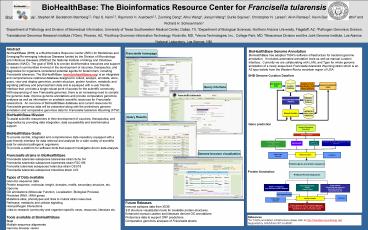
Abstract BioHealthBase (BHB) is a Bioinformatics
Resource Center (BRC) for Biodefense and
Emerging/Re-emerging Infectious Diseases funded
by the Division of Microbiology and Infectious
Diseases (DMID)of the National Institute of
Allergy and Infectious Diseases (NIAID). The goal
of BHB is to provide bioinformatics resources and
support to research communities involved in the
development of vaccines, therapeutics, and
diagnostics for organisms considered potential
agents for bioterrorism, including Francisella
tularensis. The BioHealthBase (www.biohealthbase.o
rg) is an integrated and comprehensive relational
database designed to collect, analyze, annotate,
store, query, view and display genomics, protein
structure, protein function, metabolic and
signaling pathway and polymorphism data and is
equipped with a user friendly interface that
provides a single robust point of access for the
scientific community. With sequencing of new
Francisella genomes, there is an increasing need
to compile the genomic data, improve genome
annotations and provide comparative genomics
analyses as well as information on available
scientific resources for Francisella researchers.
An overview of BioHealthBase database and
current resources for Francisella genomics data
will be presented along with the preliminary
genome annotation and comparative genomics data
for Francisella tularensis Wyoming (FTW) strain.
BioHealthBase Mission To assist scientific
researchers in their development of vaccines,
therapeutics, and diagnostics by providing data
integration, data accessibility and
bioinformatics support. BioHealthBase Goals To
provide central, integrated and comprehensive
data repository equipped with a user-friendly
interface for data retrieval and analysis for a
wide variety of scientific data for selected
pathogenic organisms To provide a platform for
software tools that support investigator-driven
data analysis. Francisella strains in
BioHealthBase Francisella tularensis subspecies
tularesnsis strain Schu S4 Francisella tularensis
subspecies tularesnsis strain FSC198 Franciella
tularensis subspecies holarctica strain
OSU18 Francisella tularensis subspecies
holarctica strain LVS Types of Data
available Genomic sequence data Protein sequence,
molecular weight, domains, motifs, secondary
structure, etc. Operons GO annotations (Molecular
Function, Localization, Biological
Process) Predicted tRNA, rRNA genes Mutations
sites, phenotypes and links to mutant strain
resources Pathways metabolic and cellular
signaling Host-pathogen interactions Links to
research community and organism specific news,
resources, literature etc. Tools available at
BioHealthBase Blast Multiple sequence
alignments Genome browser viewer
Future Releases Immune epitopes data from
IEDB 3-D structure visualization tools for
available protein structures Enhanced manual
curation and literature derived GO
annotations Proteomics data to support ORF
predictions Comparative genomics analyses of
Francisella strains
References for TIGRs annotation infrastructure
please refer to http//manatee.sourceforge.net/ Su
pported by NIAID/NIH N01-AI-40041
Recommended

