

Performance of dairy cattle clones and evaluation of their milk composition PowerPoint PPT Presentation
1 / 14
Title: Performance of dairy cattle clones and evaluation of their milk composition
1
Performance of dairy cattle clones and evaluation
of their milk composition
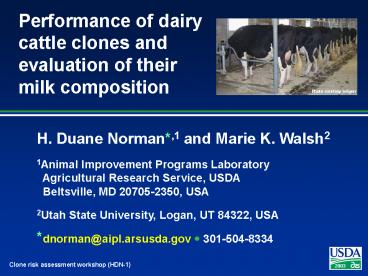
Photo courtesy Infigen
H. Duane Norman,1 and Marie K. Walsh2 1Animal
Improvement Programs Laboratory Agricultural
Research Service, USDA Beltsville, MD
20705-2350, USA 2Utah State University, Logan, UT
84322, USA dnorman_at_aipl.arsusda.gov ?
301-504-8334
2
Cloning biotechnology
- Embryo splitting
- Nuclear transfer
- Embryo
- Somatic cell
- Fetal
- Adult
3
Normal performance?
- Animal health (developmental issues)
- Mitochondrial DNA differences
- Genotype identification (bloodtyping)
- Genetic merit
- Food safety
4
Research studies
- Norman, Lawlor, and Wright (2002). Proceedings of
7th World Congress on Genetics Applied to
Livestock Production 33, 699-702. - Norman, Lawlor, and Wright (2003). Journal of
Dairy Science (in press). - Walsh, Lucey, Govindasamy-Lucey, et al. (2003).
Cloning and Stem Cells 5, 213-219.
5
U.S. Holstein clone population
6
Pedigree merit
- Mean genetic merit of parents
- Mean genetic superiority (p?0.01) of parents
relative to population for same birth year
Embryo split Embryo split Nuclear transfer Nuclear transfer
Trait Females Males Females Males
Milk (kg) 186 254 165 246
Fat (kg) 9 11 10 10
Protein (kg) 7 9 8 9
7
Genetic merit (PTA) cows
Embryo split Embryo split Nuclear transfer Nuclear transfer
Trait Clones Full sibs Clones Full sibs
Milk (kg) -37 -1 -18 9
Fat (kg) 1 2 -3 0
Fat () 0.02 0.02 -0.02 0.02
Protein (kg) 0 1 2 2
Protein () 0.01 0.01 0.02 0.02
SCS 3.08 3.09 3.18 3.15
PL (mo) 0.1 0.2 -0.6 -0.4
DPR () 0.1 0.1 -0.2 -0.1
p?0.01 p?0.001
8
Genetic merit (PTA) bulls
Embryo split Embryo split
Trait Clones Full sibs
Milk (kg) -86 -78
Fat (kg) 0 1
Fat () 0.03 0.03
Protein (kg) -2 -1
Protein () 0.01 0.01
SCS 3.2 3.1
PL (mo) -0.5 -0.3
DPR () 0.0 0.2
9
Mean standardized performance
Embryo split Embryo split Nuclear transfer Nuclear transfer
Trait Clones Full sibs Clones Full sibs
Milk (kg) 10,716 11,016 10,456 10,715
Fat (kg) 394 402 379 389
Fat () 3.68 3.65 3.62 3.63
Protein (kg) 320 329 326 325
Protein () 2.99 2.99 3.11 3.03
SCC 3.1 3.1 3.6 3.0
PL (mo) 25.7 26.4 23.1 26.7
p?0.01 p?0.001
10
Deviation from contemporaries
Embryo split Embryo split Nuclear transfer Nuclear transfer
Trait Clones Full sibs Clones Full sibs
Milk (kg) -199 3 -278 -305
Fat (kg) -2 3 -17 -13
Protein (kg) -3 2 -2 -7
p?0.05 p?0.01
11
Milk composition
- Traits analyzed
Solids, fat, fatty
acid profile, lactose, protein - Nuclear-transfer clone breeds
Brown Swiss, Holstein, Holstein ? Jersey - No differences between clones and non-clones for
gross chemical composition of milk - Slight difference for palmitic acid
- Mineral content most variable component
12
Milk composition (Holstein)
Component Clones Non-clones Kaufmann Hagemeister (1987) U.S. mean (2001)
Solids () 12.9 13.3 13.3
Fat () 4.0 4.3 4.1 3.8
Protein () 3.2 3.1 3.6 3.0
Lactose () 5.0 5.0 5.0
13
Conclusions
- U.S. dairy cattle selected for cloning slightly
superior genetically to population for yield - No obvious differences between cloned and
non-cloned cows - Performance
- Milk produced
- No food safety concerns related to milk from
cloned cows
14
U.S. Food Drug Administration
- Most clones that survive the perinatal period
are normal and healthy as determined by
physiological measurements, behavior, and
veterinary examinations. - Edible products from normal, healthy clones or
their progeny do not appear to pose increased
food consumption risks relative to comparable
products from conventional animals.
Draft Executive Summary of Animal Cloning A Risk
Assessment (2003)
Recommended

