

My Internship Experience At The Food Animal Health Research Program PowerPoint PPT Presentation
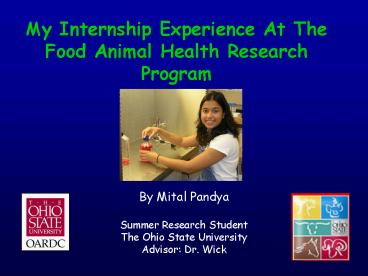
Title: My Internship Experience At The Food Animal Health Research Program
1
My Internship Experience At The Food Animal
Health Research Program
- By Mital Pandya
- Summer Research Student
- The Ohio State University
- Advisor Dr. Wick
2
Background
- Ohio Agriculture Research and Development Center
(OARDC) located in Wooster, Ohio - ATI Apartments
- 8.00/hour paid internship
- I worked for Dr. Linda Saif, her areas of
expertise include Animal immunology, Animal
Virology, Diseases/swine (enteric), Enteric
diseases of cattle, Enteric diseases of swine,
Immunology
Dr.Linda Saif
3
My Responsibilities
- My Research Project
- General Lab Work
- Autoclave room
- Cleaning
- Paperwork
4
Introduction
- First recognized in 1969 in calves and later in
1973 in humans, rotavirus is the most common
cause of severe diarrhea among children,
resulting in the hospitalization of approximately
55,000 children each year in the United States
and the death of over 600,000 children annually
worldwide - An effective rotavirus vaccine could save the
lives of approximately 1,400 children per day
5
Background
Rotaviruses are nonenveloped, triple-shelled
viruses. They belong to the Reoviridae family.
Rotavirus has a wheel-like shape under an
electron microscope, which earned it the name of
rota virus
- The virus genome is composed of 11 segments
of double-stranded RNA, which encode for six
structural and six nonstructural proteins. The
virus is stable in the environment
ds RNA segments
Proteins VP1 VP2 VP3 VP4 NSP1 VP6 NSP2 NSP3
VP7 NSP4 NSP5
1 2 3 4 6 7 8 9 10 11
5
(European Molecular Biology Organization,
www.nature.com)
6
Background
- A recent study in gnotobiotic pigs showed that
the virulent (Vir) Wa strain human rotavirus
(HRV) and the attenuated (Att) Wa strain HRV have
different replication efficacy (Azevedo, et al.,
2005. J. Virol) - The AttHRV replicated more effectively in the
respiratory tract than in the intestine the
VirHRV replicated to higher titers in the
intestine than in the respiratory tract
7
Objectives of My Project
- To compare the physiochemical properties of
VirHRV and AttHRV - Compare effects of different pH and temperature
on virus stability and in-vitro replication
between the AttHRV and the VirHRV - Compare effects of trypsin and pancreatin on
virus replication of the AttHRV and the VirHRV
8
Approaches of My Study
- To compile a growth curve at 27ºC, 33ºC and 37ºC
temperatures for AttHRV and VirHRV - Verify the stability of AttHRV and VirHRV after
exposures to pHs 3 and 5
9
Materials and Methods
- MA 104 Cells
- Cell culture immunofluorescence assay (CCIF) for
VirHRV and AttHRV - Enzyme linked immunoabsorbant Assay (ELISA)
Un-infected MA104 Cells
HRV-infected MA104 cells detected by CCIF
10
Resistance to Temperature
4oC
AttHRV Stock
Tested by CCIF, ELISA
30 minutes
37oC
56oC
4oC
30 minutes
Tested by CCIF, ELISA
37oC
VirHRV Stock
56oC
11
Resistance to pH
Not treated
AttHRV Stock
pH adjusted to 7.2 with NaOH
30 minutes At 37oC
pH 5.0
pH 3.0
Not treated
pH adjusted to 7.2 with NaOH
30 minutes At 37oC
VirHRV Stock
pH 5.0
pH 3.0
12
Influence of trypsin and pancreatin in the growth
of VirHRV and AttHRV by CCIF
Trypsin
37oC and 33oC
AttHRV Stock
Pancreatin
CCIF
Trypsin
VirHRV Stock
37oC and 33oC
Pancreatin
13
Effects of temperature on titers (FFU) of AttHRV
and VirHRV
Temperature
Type of Virus
37oC
4oC
56oC
AttHRV
2.8x10⁵ 7.0x10⁵
3.0x10⁶ 1.0x10⁶
2.6x10⁶ 1.65x10⁶
1.2x10⁶
2.0x10⁶
1.1x10⁶
VirHRV
- Summary
- Titers of VirHRV reduced slightly after
treatment - with high (560C) temperatures compared to
temperatures of 4oC and 370C
14
Effects of pH on titers (FFU) of AttHRV and
VirHRV
pH
Type of Virus
pH 3
pH 5
Control (pH7.2)
2.2x10⁶ 7.0x10⁶
AttHRV
2.0x10⁶ 9.5x10⁴
6.5x10³ 1.1x10³
2.5x10⁶ 4.0x10⁵
1.2x10⁶ 7.2x10⁵
4.8x10⁵ 4.8x10⁴
VirHRV
- Summary
- Titers of both AttHRV and VirHRV reduced more
- after treatment with pH 3 compared to pH 5
15
Virus titers (FFU) after cell-culture passage at
different temperatures measured by CCIF
- Summary
- VirHRV had higher titer at 370C than at 330C
after first passage in MA104 cells - AttHRV had higher titer at 330C than at 370C
after first passage in MA104 cells
16
Trypsin Pancreatin 33oC
Trypsin Pancreatin 37oC
- Summary
- AttHRV trypsin treatment in 370C showed to be
more efficient in virus replication - VirHRV there was no difference between trypsin
and pancreatin treatments with the highest titers
being reached at temperature of 37oC
17
Virus titers after cell-culture passage at
different temperatures measured by ELISA
- Summary
- VirHRV extremely decreased titers after first
passage in MA104 cells at 370C or 330C - AttHRV showed no difference in the virus titer
after four passages at 330C or 370C in MA104
cells
18
Preliminary Conclusions
- AttHRV and VirHRV did not differ significantly in
their resistance to treatment with low pH or low
or high temperatures - Titers of AttHRV and VirHRV were equally affected
(reduced) by treatment with low pH (pH 3.0) - Low temperature (330C) did not negatively affect
the replication of AttHRV in cell culture, but
reduced the replication of VirHRV after one
passage
19
Future Studies
- Complete and repeat all the experiments
- Passage AttHRV and VirHRV in cell culture for at
least 5 times at different temperatures
20
My Experience Future Goals
- Highly Recommended for anyone who is interested
in research - Hands on Experience
- Graduate School for Public Health
21
Acknowledgements
- Advisors Dr. Lijuan Yuan Dr.Wick
- Dr. Linda Saif
- Dr. Marli Azevedo
- Dr. Ana Gonzalez
- Lab 113 Family
22
Any Questions?
Recommended

