

Groundwater evolution within a catchment affected by dryland salinity, southeastern Australia PowerPoint PPT Presentation
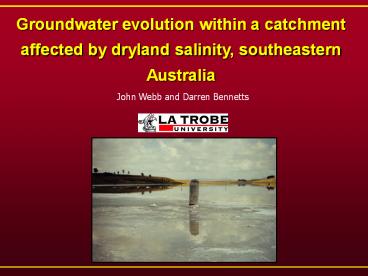
Title: Groundwater evolution within a catchment affected by dryland salinity, southeastern Australia
1
Groundwater evolution within a catchment affected
by dryland salinity, southeastern Australia
John Webb and Darren Bennetts
2
Areas at high risk of dryland salinity in 2000
Study area
3
Increasing salinisation of the landscape
Boggy Creek Spring
Gellerts Seep
1952
1996
4
Gellerts Swamp today
5
Topography
Grampians
Boggy Creek Spring
Willaura
Hopkins River
Hamilton
Gellerts Seep
Cockajemmy Lakes
Stavely Range
6
Surface Geology
Quaternary
Swamp deposits
Stream Alluvium
Alluvium
Colluvium
Pleistocene
Basalt
Devonian
Granite
Silurian
Grampians Group
Cambrian
Sandstone/shale
Greenstone
7
Hydrogeology flow paths
250
270
240
Flow path 1
260
230
250
220
Flow path 2
250
8
Groundwater composition dominated by Na and Cl
9
36Cl analyses from adjacent area
- median of 19 x 10-15 36Cl/Cl-
- consistent with atmospheric precipitation
- in southwest Victoria
- contributions from connate water and/or
- basalt weathering unlikely - 36Cl/Cl- ratios
- from these sources would be zero or 4 x 10-15
- groundwater Cl- is probably sourced
- exclusively from cyclic sources
- (rainfall and/or windblown dust)
10
Hydrogeology groundwater age (tritium)
Only samples in the west contain tritium -
recharged after 1950
Waters in centre and east contain no tritium
11
Hydrogeology groundwater age rates of
movement (14C)
14C ages may be overestimates, but indicate flow
times of several thousand years
4000 years old
7900 years old
12
Hydrogeology flow path 1
250
270
240
Flow path 1
260
230
250
220
250
13
Hydrogeology flow path 1 cross section
Mt William Swamp
Hopkins River
14
Salinity increases along flow path 1
Mt William Swamp
Hopkins River
3
7
9
13
8
8
5
1
Salinity (mS/cm)
- Progressive salinity increase along flow path
due to addition - of diffuse recharge from overlying soil zone,
where rainfall - concentrated by evapotranspiration
- Note dilution along flowpath due to lateral flow
from north
15
Hydrogeology flow path 2
250
270
240
Flow path 2
260
230
250
220
250
16
Hydrogeology flow path 2 cross section
Cockajemmy Lakes
Lake Muirhead
Gellerts Swamp
17
Salinity increases along flow path 2
Cockajemmy Lakes
Lake Muirhead
Gellerts Swamp
15-30
3
9
22
15
- Increase along flow path again due to addition
of saline diffuse - recharge from overlying soils, with some addition
from salt in - bed of Lake Muirhead.
- very saline brines beneath Cockajemmy Lakes
18
- groundwater samples all plot close to local
meteoric water line - groundwater stable isotope composition becomes
heavier downflow - probably reflects addition of soil water
evaporated under high humidities
19
- groundwater becomes more reducing downflow
- reflects organic content of shallow alluvial
aquifer - oxidising waters downflow in basalt and basement
aquifers
20
Downflow change from kaolinite to smectite
stability fields
21
Decrease in Si/Cl ratio with increasing salinity
(downflow) probably reflects reaction of
groundwater silica with kaolinite to form
smectites
22
Marked pH increase downflow probably due to H
removal on clays
23
Conclusions
Groundwater chemistry dominated by
- rainfall input
- evapotranspiration
Groundwater evolution reflects
- progressive addition of saline
- infiltration from soil zone
- interactions with clay minerals
- some oxidation of organic matter in aquifer
Recommended

