

Tevatron BPM Upgrade PowerPoint PPT Presentation
1 / 34
Title: Tevatron BPM Upgrade
1
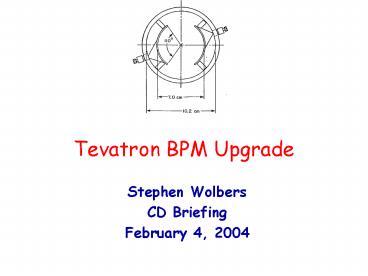
Tevatron BPM Upgrade
- Stephen Wolbers
- CD Briefing
- February 4, 2004
2
Outline of this talk
- Project definition
- Management/organization
- Short history
- Project plan/wbs/effort/milestones
- Accomplishments so far
- Issues/concerns where we are headed
- Summary
3
Project Definition
- The Tevatron BPM Upgrade Project will replace the
current BPM electronics and the data acquisiton
system used to transfer information between the
BPMs and the Accelerator Controls Systems. As
part of the project, the software used to read
out, transfer, store, and analyze the BPM data
will be upgraded. The goal of the project is to
provide a BPM system based on modern hardware and
software that gives the higher resolution and
expanded functionality necessary to efficiently
understand and operate the Tevatron Collider now
and for the forseeable future. Deliverables of
the project include all relevant documentation,
manuals, users guides and any other written
records necessary for maintaining the system.
The project includes replacing the
Tevatron BLM system interface hardware and
software that is tightly coupled to the BPM
system.
4
What is to be delivered by the project?
- All new electronics.
- Front-end software.
- Data to the online/controls system.
- Applications to use the new data.
- The pickups in the accelerator will not be
modified!
Pickups
Controls/Offline
Electronics/VME
5
Project management organization
- The project is a joint Accelerator
Division/Computing Division project. - It is a subproject of the Run 2 upgrade project,
which is headed by Jeff Spalding and Dave
McGinnis. - We report to many people, and try to keep them
all informed (and happy). - It is highly likely (100?) that the project will
become an AIP project (Accelerator Improvement)
shortly (but I said that in December).
6
Tev BPM Upgrade Project Organization
S. Wolbers Project Manager B. Webber Deputy
Project Manager J. Steimel Technical
Coordinator B. Banerjee Project Assistant J.
Nicholls Project Assistant
Requirements Mike Martens
Front-End/ DAQ Software Margaret Votava
Online Software Brain Hendricks
Offline Software Rob Kutschke
Electronics Vince Pavlicek
7
CD People Working on the Project
- Steve Wolbers, Bakul Banerjee, Judy Nicholls,
Margaret Votava, Vince Pavlicek, Rob Kutschke,
Mark Bowden, Bill Haynes, Luciano Piccoli, Dehong
Zhang, Dinker Charak, Greg Duerling, Julia Yarba,
Mark Fischler, Tom Boes, Mike Behnke, Bill
Barker, Stu Bledsoe,
8
AD/PPD People Working on the Project
- Bob Webber, Jim Steimel, Mike Martens, Brian
Hendricks, Jean Slaughter, Joel Butler, Stephen
Pordes, Marv Olson, Ken Koch, Brian Chase, Duane
Voy, Jim Patrick, Al Baumbaugh, Judy Sabo, Fritz
DeJongh, Eric James,
9
Partial Project History
- Steve Wolbers joined the effort as Project
Manager in mid-July, 2003. - This is the project start as far as I am
concerned. - Lots of work was done prior to that time by many
people and that should not be forgotten. - August-September was spent getting up to speed
- Most of us are not accelerator instrumentation
experts - There was a need to talk the same language,
understand the same concepts - There was also a large amount of vacation to deal
with in this time-frame.
10
Partial Project History (2)
- September-December serious planning and analysis
toward picking a hardware solution and
understanding the needs of the system. - December-Now Design, requisition writing,
prototype measurements, test stands, etc.
11
Working with AD
- Working with AD is quite interesting.
- Really good people.
- They know the accelerator.
- AD is a big division!
- Sometimes it takes time to figure out who does
what and how to interact. - Bob, Jim, Mike, Brian have all been extremely
helpful in getting us connected with the right
people.
12
Project Planning
- A wbs has been developed for the project. There
are 5 major tasks and 4 major subtasks in this
structure. - The 5 tasks are
- Development, Fabrication, Installation,
Commissioning, Project Management - The 4 subtasks are
- Electronics, Front-end Software, Online Software,
Offline Software - Note that Requirements and Specifications are a
part of the Project Management - Technical Coordination is new and will help to
provide overall organization for the project
13
Project Planning - Cost
- The wbs is effort loaded and contains all MS and
SWF. - Totals (not including overhead and contingency)
- MS 1.66 Million
- SWF 1.0 Million lt- may rise depending on the
length of the project
14
Project Planning
- An important part of planning is the handoff to
operations and the long-term support of the
hardware and software developed as part of the
project. - This is still undecided/unplanned in most cases.
- A roll up of the effort estimates shows a
steady-state effort of about 10-11 FTE working
until next autumn.
15
First complete wbs effort estimate
Not synchronized with The commissioning plan
3.5 5.5 11.4 6.6 5.8
Effort Report
16
Current estimated effort for the Project by
Division
Not synchronized with The commissioning plan
17
(No Transcript)
18
Project Planning Schedule DOE Milestones
- 9/22/03 Tev BPM Requirements Review
- 12/16/03 Tev BPM Technology Review
- 2/13/04 Core Electronics PO placed
- 4/1/04 First modified board delivered
- 4/28/04 Electronics system design review
- 6/1/04 First Production Board delivered
- 6/15/04 First crate in Tevatron
- 9/10/04 All Echotek boards delivered
- 9/29/04 System complete and cabled
- 12/21/04 Commissioning complete
19
Internal Milestones
20
A Few Key Project Accomplishments
- Requirements document and review.
- Cable work in the tunnel during the fall shutdown
to enable readout of the p and pbar ends of each
BPM (using MR cables). - BLM (Beam Loss Monitor) interface electronics
prototyping. - Measurements in A1 from Echotek and Damper
Boards. - P/pbar separation studies.
- Software specification for the DAQ, online and
offline software.
21
Cables ready for electronics
BPM Pickup Ports In the tunnel
22
Test Stand in FCC
- Required ACNET and beam clock signals in FCC!
- Thanks to CD Networking, Accelerator Division
Controls and Networking, Margaret, Vince, others,
it happened (and is still happening) - The test stand will be an important part of the
project, giving CD a dedicated place for tests
(hardware and software)
23
Test Stand in FCC3 Last Week
Connection To ACNET
24
Test Stand in FCC3 This Week
Two More Slots Filled
One More Card
25
Recycler Crate in AP60
26
Issues/Concerns
- Aggressive Timescale
- October 1, 2004 was imposed as a goal for the
project. - We are working hard to install systems starting
in June, 2004. - Obviously it will be difficult to hold to this
schedule but it is our goal and we will work hard
to keep to the schedule.
27
Issues/Concerns(2)
- Long Timescale
- Summer/fall shutdown may have an impact on
commissioning - The draft commissioning plan does not allow
commissioning during the shutdown. - This implies that the project will extend into
late 2004/early 2005. - Other aspects of the project also will drive us
to longer times - Full system commissioning
- Application software
- Full documentation
28
Issues/Concerns (2)
- Technological Challenges
- Pbar measurement
- This is an important part of the system
requirements - We are still investigating whether and how we can
make the pbar position measurement - Ideas include frequency domain p-pbar
subtraction, timing, different hardware at key
locations. - Off-axis and other corrections
- To make full advantage of the improved resolution
(x10 or more) of this system corrections will
have to be made, probably in the offline
software.
29
Issues/Concerns (3)
- Controls System/Database
- Just beginning to explore the impact of the new
BPM system on controls and databases. - There likely will be other issues to resolve
- e.g. 10 Mbit shared in service buildings
- Offline Applications
- We still have to define the scope of the project
with respect to offline applications - Additional work would be the responsibility of
the Tevatron department, the users of the system
30
Issues/Concerns (4)
- BLM interface/new BLM?
- We have put the BLM part of the project on hold
until we learn what is required/requested of the
BPM system - The minimal requirement is that we carry the BLM
systems through the BPM VME crate to the controls
system. - Because we remove the old interface when we
remove the old BPM hardware
31
Issues/Concerns (5)
- More BPMs (Main Injector, Transfer Lines)
- The TeV BPM project has in its scope only the
Tevatron BPMs (240) - The Main Injector and Transfer lines could use
the same system. - There currently is no project organized to design
and build those other systems. - There is some desire to continue this project to
complete the other BPMs.
32
Issues/Concerns (6)
- AIP Project
- Making this an AIP is non-trivial.
- To do it right means getting the effort properly
assigned and then charged. - Need to keep up with all expenditures,
milestones, effort - But were doing that anyway, by and large
33
Issues/Concerns (7)
- What does the project need from CD?
- People!
- Engineers
- Physicists
- Computer Professionals
- Technicians (especially for board checkout,
installation)
34
Summary
- The Tevatron BPM Upgrade Project is a joint
Accelerator Division-Computing Division Project
and it is up and running. - Our plan is to finish the design, acquire and
install hardware and software, and hand off
operations in 2004. - There remains a great deal of work to accomplish
all of the project goals.
Recommended

