

Results PowerPoint PPT Presentation
1 / 1
Title: Results
1
Passive Autofocusing For Visual Telescopic Systems
Muller Buffington Sharpness Measure
System Flow Chart
Abstract
Stars have been always been a source of
fascination to man. To observe these stellar
bodies, NASA and other large international space
organizations have developed telescopes with
extremely powerful optics, controlled by
sophisticated hardware and complex software.
However, the majority of stargazers are hobbyists
with relatively cheap telescopes and mounts that
need to be manually controlled and focused.
Handling a telescope is no easy feat. Setting up
a telescope, orienting it, and carefully tracking
the desired celestial body is a tedious process
that requires much patience. Imaging the body
becomes even more exasperating due to the
replacement of the eyepiece with an imager. The
user now has to rely solely on the images
displayed on his computer screen, which are
subject to finicky software settings. The imager
also provides a smaller field of view, which,
combined with the extreme magnification of the
imager (200x), causes even the slightest
vibration by the users touch to displace the
point source (such as a star or a planet) from
its field of view. Additionally, the image needs
to be re-focused when the imager replaces the
eyepiece, as they have different optics. For an
amateur telescope hobbyist this much need for
precision may prove discouraging. Our project
minimizes the amount of work required to focus an
image, by automating this process for the user.
This is accomplished using the following
microcontroller-based closed-loop feedback
system The imager feeds the image from the
telescope into MATLAB, which calculates its
sharpness measure. This value is sent to a
microcontroller, which moves the focus motor via
an H-bridge for a calculated duration in the
predicted direction of better focus. This process
is constantly repeated until successive sharpness
measures are close enough to assume that the
image has converged to the point of maximum
focus.
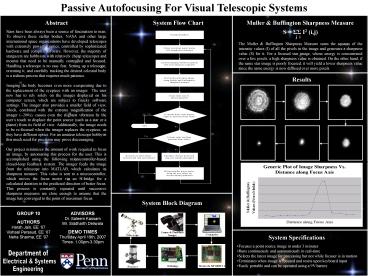
The Muller Buffington Sharpness Measure sums
the squares of the intensity values (I) of all
the pixels in the image and generates a sharpness
value (S) for it. For a focused star image, whose
energy is concentrated over a few pixels, a high
sharpness value is obtained. On the other hand,
if the same star image is poorly focused, it will
yield a lower sharpness value since the same
energy is now diffused over more pixels.
Results
System Block Diagram
GROUP 10 AUTHORS Harsh Jain, EE 07 Vishaal
Persaud, EE 07 Neha Sharma, EE 07
ADVISORS Dr. Saleem Kassam Mr. Siddharth
Deliwala DEMO TIMES Thursday April 19th,
2007 Times 1.00pm-3.30pm
System Specifications
- Focuses a point source image in under 3 minutes
- Runs continuously and autonomously in real-time
- Selects the latest image for processing but not
while focuser is in motion - Terminates when image is focused and resets upon
keyboard input - Easily portable and can be operated using a 9V
battery
Department of
Electrical Systems
Engineering
Recommended

