

What Makes Cultures Different: Concepts and Descriptors of Culture PowerPoint PPT Presentation
1 / 65
Title: What Makes Cultures Different: Concepts and Descriptors of Culture
1
What Makes Cultures DifferentConcepts and
Descriptors of Culture
Das Problem des Fundalismus im Islam kann nur
aus dem Islam selbst heraus gelöst werden. Der
Westen besitzt kulturell dazu keinen Schlüssel.
dem Verlust alter Ordnungsmuster, der Armut,
Destabilisierung oder Demütigung ganzer Kulturen
und Regionen.
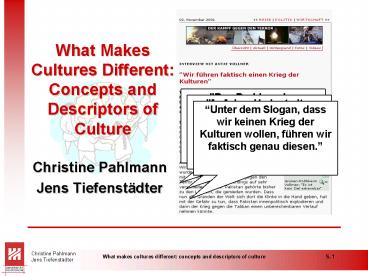
Unter dem Slogan, dass wir keinen Krieg der
Kulturen wollen, führen wir faktisch genau
diesen.
- Christine Pahlmann
- Jens Tiefenstädter
2
Gestures and meaning
Graphic from Göpferich, Susanne.
Interkulturelles Technical Writing. Fachliches
adressatengerecht vermitteln. Gunter Narr Verlag,
Tübingen. 1998 p.287
3
Gestures and meaning
Graphic from Göpferich, Susanne.
Interkulturelles Technical Writing. Fachliches
adressatengerecht vermitteln. Gunter Narr Verlag,
Tübingen. 1998 p.287
4
Gestures and meaning
Graphic from Göpferich, Susanne.
Interkulturelles Technical Writing. Fachliches
adressatengerecht vermitteln. Gunter Narr Verlag,
Tübingen. 1998 p.287
5
Gestures and meaning
Graphic from Göpferich, Susanne.
Interkulturelles Technical Writing. Fachliches
adressatengerecht vermitteln. Gunter Narr Verlag,
Tübingen. 1998 p.287
6
Agenda
- Definitions of Culture
- Descriptors / Dimensions of Culture
- Edward T. Hall
- Geert Hofstede
- Fons Trompenaars
- Flaws / Weaknesses General Problems of Working
with Cultures - Selected Readings / Sources
7
1. Definitions of Culture
- There exist various definitions of culture. Wed
like to introduce into the most common in modern
intercultural studies. - The word Culture comes from the Latin colere,
which stands for cultivation of soil and plants. - It first appeared in the 17th century, in
opposition to nature. Culture stood for things
created by mans own will and skill.
8
What Means Culture to You?
- Discussion
- What do you think culture is?
9
Definitions of Cultures Hochkultur Goethe,
Duerer Co.
- The German elites often defined culture as
Hochkultur. - Heinrich Rickert Kultur ist die...Gesamtheit
der realen Objekte, an denen allgemein anerkannte
Werte oder durch sie konstruierte Sinngebilde
haften und die mit Rücksicht auf die Werte
gepflegt werden. 5
- Rickert, Heinrich. Kulturwissenschaft und
Naturwissenschaft. P.28 in - Maletzke, Gerhard. Interkulturelle
Kommunikation. Westdeutscher Verlag, Opladen.
1996 p. 16
10
Definitions of Cultures Culture as
Communication and Interpretation Knowledge
- Keesing R.Culture, conceived as a system of
competence shared in its broad design and deeper
principles ... is then not all of what an
individual knows and thinks and feels about his
(or her) world. It is his (or her) theory of
what his (or her) fellows know, believe, and
mean, his (or her) theory of the code being
followed, the game being played, in the society
into which he (or she) was born...7
7 Keesing, R. Theories of culture. Annual Review
of Anthropology, 3. 1974. p.73-97 in Gudykunst,
William B., Kim, Young Yun. Communicating with
strangers. Mc Graw-Hill, New York. 1992 p.12
11
Definitions of Cultures Culture as
Communication System
- Edward T. HallCultures are unified wholes in
which everything interrelates.1 - Any culture is primarily a system for creating,
sending, storing and processing information.
Communication underlies everything.2 - According to Hall, 80 to 90 of communication
are not language, but words, material things and
behaviour.
- Hall, Edward T. Hidden Differences Doing Business
with the Japanese. Anchor Books 1987. p.XVIII - Hall, Edward T. Hidden Differences Doing Business
with the Japanese. Anchor Books 1987. p.3
12
The Unconscious Defines Culture
- Edward T. HallCulture defines
CommunicationCommunication defines
Culture.Hall introduces the term informatics
for the behaviour outside conscious awareness.
It includes evolutionary, emergent ideas,
practices and solutions and even shared
experiences that we all hold.
13
Culture as Communication System is Masterable
- Edward T. HallCulture can be likened to an
enormous, subtle extraordinarily complex
computer. It programs the actions and responses
of every person, and these programs must be
mastered by anyone wishing to make the system
work3
3 Hall, Edward T. Hidden Differences Doing
Business with the Japanese. Anchor Books 1987. p.4
14
Definitions of cultures Culture as Way of
Dealing With Problems
- Fons Trompenaars, Geert Hofstede
- Culture is the way in which a group of people
solves problems and reconciles dilemmas.6
6 Trompenaars, Fons. Riding the waves of culture.
McGraw-Hill, New York. 1998. p.6
15
Culture is What we Take for Granted
- In order to work with cultures, to describe them,
we need a common ground or definition. - Hofstedes definition, culture as set of problem
solutions and basic understanding of the world,
is a good basis. - It is more fundamental than the Hochkultur or
even culture as tacit civilization and includes
Halls point of view, culture as communication
system, and other definitions that see culture as
tool for differentiating groups.
16
Agenda
- Definitions of Culture ?
- Descriptors / Dimensions of Culture
- Edward T. Hall
- Geert Hofstede
- Fons Trompenaars
- Flaws / Weaknesses general Problems of working
with Cultures - Selected Readings / Sources
17
2. Descriptors / Dimensions of Culture
- Examining cultures and gathering data on them can
be done in two ways. - Trying to understand a particular culture from
the inside point of view - .. Or looking from the outside trying to find
variables that occur in many cultures and thus
enable comparison.
18
2. Dimensions of Culture Emic / Etic Approach
- The linguist Pike named these approaches first
- Understanding from the inside point of view, is
called Emic, - While the outside examination and comparison of
one culture with another is called Etic. - Both approaches are useful and have strengths and
weaknesses.
Cf. Pike, K.L. Etic and emic standpoints for the
description of behaviour. In L. Wheeler (Ed.),
Review of personality and social psychologie (Vol
3), Sage Publications, Beverly Hills.
19
2. Dimensions of Culture Etic Search for
Comparable Elements
- In our opinion, it is possible to examine certain
phenomena without knowing why they occur, for
example proxemics. - Such phenomena can usually be measured and thus
compared with other cultures. - The etic approach gives us comparable data, it
helps us to familiarize ourselves with visible
habits of other cultures. - Alas it cannot give us explanations of the
underlying motivation for these phenomena.
20
2. Dimensions of Culture Emic Understanding
Like a Native
- The emic approach cant help us comparing one
culture with another. - But it may help us understanding the underlying
rules and values that shape the visible rim of a
culture, for a culture is described as the
subjects of this culture perceive it.
21
2. Dimensions of Culture Emic / Etic When to
Use Which?
- Discussion
- What do you think where the strengths and
weaknesses of these approaches are? - Is a pure etic or pure emic approach possible? Or
do we always compare with our own experience? Is
it possible to understand phenomena as a
foreigner?
22
2. Descriptors / Dimensions of Culture The big
5 General Questions
- According to Florence Kluckhorn and Fred
Strodtbeck mankind faces 5 general dilemmas
coming forth from interaction with fellow humans,
time, nature and activities. - These dilemmas need to be solved, for every
dilemma, there exist but a limited number of
solutions. - Every culture can choose from these solutions. By
the particular selection, cultures can be
compared.
23
2. Descriptors / Dimensions of Culture The Big
5 General Questions
Orientation Range of Variations Range of Variations Range of Variations Range of Variations Range of Variations Range of Variations
Human nature Evil Evil Neutral Mix of Good-and-Evil Good Good
Human nature mutable immutable mutable immutable mutable immutable
Man-Nature Subjugation-to-Nature Subjugation-to-Nature Harmony-with-Nature Harmony-with-Nature Mastery-over-Nature Mastery-over-Nature
Time Past Past Present Present Future Future
Activity Being Being Being-in-Becoming Being-in-Becoming Doing Doing
Relational Lineality Lineality Collaterality Collaterality Individualism Individualism
Graphic according to Maletzke, Gerhard.
Interkulturelle Kommunikation. Westdeutscher
Verlag, Opladen. 1996 p.82
24
2. Dimensions of Culture Pattern Variables
- Parsons and Shils introduced the concept of
pattern variables in 1951. - Pattern variables are mutually exclusive choices
individuals make prior to engaging in action. - The choices are made both consciously and
unconsciously however, they are generally made
unconsciously since they are learned during the
socialization process at an early age.8
8 Gudykunst, William B., Kim, Young Yun.
Communicating with strangers. Mc Graw-Hill, New
York. 1992 p.51
25
2. Dimensions of Culture Pattern Variables
- Self-orientation vs. collective-orientation(
individualism vs. collectivism) - Affectivity vs. Affective NeutralityWhat is the
nature of the gratification we seek? - Universalism vs. ParticularismHow do we
categorize people and objects? - Diffuseness vs. SpecificityHow do we respond to
people and objects? - Ascription vs. AchievementAre people / objects
treated in terms of their ascribed or their
achieved qualities ? - Instrumental vs. Expressive OrientationWhat is
the nature of our goals of interaction?
26
2.1 Dimensions of Culture Edward T. Hall
- High and Low Context
- Space
- TimeSpeed of messages (Fast / Slow)
27
2.1 Dimensions of Culture Hall High and Low
Context
- Context is the information surrounding an object
or event. - Together with the object / event these additional
information produce a meaning. - The proportion event / context differs from
culture to culture. - The two poles are High Context ?? Low Context
28
2.1 Dimensions of Culture Hall High and Low
Context
High Context Low Context
Little extra information on the event is provided the social network (context) gives enough hints Theres a lot of additional, explicit information added to give the right meaning to the event.
e.g. Latin cultures, Asian cultures e.g. Scandinavian, north European cultures, North America
? Usually well informed through informal channels ? Before making a decision, we need additional information to base our decision on. / need to know whats going on
29
2.1 Dimensions of Culture Hall Space
- Space is organized and perceived differently in
cultures. - Space has the function of giving order,
organization and even clues about the social
position of an individual. - There exist several boundaries around us.
- Innermost the physical boundary of our body,
- outermost our territorial border.
- Any border beside the physical border is
individually perceived and chosen and shaped by
culture. Violating or accepting the borders is
communication.
30
2.1 Dimensions of Culture Hall Space
- Territoriality
- Feeling about personal spaceOften
communicates status, e.g. size and position of
office, neighbourhood - Personal Space
- The size of an invisible bubble around us. Sort
of a mobile territory.The size depends on the
situation, emotional states, culture a.o.
31
2.1 Dimensions of Culture Hall Time
- Time
- Natural Circles Day / night, seasons, life
circle - Time as Structure Time as Communication
- Monochronic Appointments, advance time
- Polychronic Speed of actions
32
2.1 Dimensions of Culture Hall Time as
Structure
Monochronic Time Polychronic Time
Linear Cyclical
segmented simultaneous events
start-end / point2point completing events
serial parallel
33
2.1 Dimensions of Culture Hall Time as
Communication
- Time is the primary system of organization, the
informal rules can be used to communicate.E.g.
Advance time, proper timing, appointments - Rhythm and speed, time needed for making
decisions, for talking, for getting used to
another. - This phenomenon is closely related to Halls
speed of messages as described later.
34
2.1 Dimensions of Culture Hall Speed of
Messages
- Hall defines culture as communication system.
- Therefore every action transmits information that
can be decoded in different speeds. - Cultures, persons, messages all might have a
particular speed necessary to decode them. People
used to a different speed find it difficult to
decode them.
35
2.1 Dimensions of Culture Hall - Speed of
Messages
Fast Messages Slow Messages
Prose Poetry
Headlines Books
TV Commercials TV documentary
TV Print
Ideologies Culture
36
2.2 Dimensions of Culture Hofstedes
Definition of Culture
Culture 1 "Refinement of the mind" and in
particular the results of such refinement like
education, art and literature Culture 2 The
set of mental rules, the software of the
mind.(cf. Hall, Trompenaars) Culture, as
mental software, is at least partly shared with
other people who live or lived within the same
social environment. This shared software
distinguishes members of one group from
others. Even for adults it is possible, though
it might be hard, to adopt to or learn a
different set of mental rules. The mental
software is learned throughout the whole live.
Cf. Hofstede, Geert. Lokales Denken, Globales
Handeln. C.H. Beck, Munich. 1997 p.3f
37
2.2 Dimensions of Culture Hofstedes
Definition of Culture
Cf. Hofstede, Geert. Lokales Denken, Globales
Handeln. C.H. Beck, Munich. 1997 p.5
38
2.2 Dimensions of Culture Hofstedes Onion
Values determine the definition of good and bad,
logical vs. paradoxical Rituals Collective
activities which are considered socially
essential. Heroes Represent characteristics
which are highly prized in a culture. Symbols
Words, gestures, objects which carry a specific
meaning which is only recognised within the
culture "Practices" are visible to outsiders
and therefore can be learned.
39
2.2 Dimensions of Culture Hofstedes 41
Dimensions
- The dimensions are situated between the core and
the practices. Individual expressions and
feelings based on values, but not unquestioned
collective rituals. - Power Distance
- Masculinity / Femininity
- Uncertainty Avoidance
- Individualism / Collectivism
- Confucian Dynamics
40
2.2 Dimensions of Culture Power Distance
- Power distance, as a characteristic of a
culture, defines the extent to which the less
powerful person in a society accepts inequality
in power and considers it as normal. Inequality
exists within any culture, but the degree of it
that is tolerated varies between one culture and
another. - All societies are unequal, but some are more
unequal than others.
41
2.2 Dimensions of Culture Masculine vs.
Feminine Cultures
- Defines the predetermination of gender roles in a
society. - Masculine cultures use the biological existence
of two sexes to define the different social roles
of men and women.Men are expected to be
assertive, ambitious and competitive and to
strive for material success.Women are expected
to serve and to care for the non-material quality
of life, for children and the weak.
42
2.2 Dimensions of Culture Feminine Cultures
- Feminine cultures define relatively overlapping
social roles for the sexes, in which neither men
nor women need to be ambitious or
competitive.Both sexes may go for a different
quality of life than material success and may
respect whatever is small, weak and slow.
43
2.2 Dimensions of Culture Masculine vs.
Feminine Cultures
- Masculinity
- Earnings
- Social recognition
- Advancement (career)
- Challenge
- Femininity
- Manager (good relations to superior)
- Cooperative work
- Comfortable living area
- Employment secureness
44
2.2 Dimensions of Culture Uncertainty Avoidance
- Defines the extend to which people within a
culture are made nervous by situations that
consider to be unstructured, unclear, or
unpredictable, and the extend to which they try
to avoid such situations by adopting strict codes
of behaviour and a believe in absolute truth.
45
2.2 Dimensions of Culture Uncertainty Avoidance
- Cultures with weak UA
- contemplative
- less aggressive
- unemotional
- accepting of personal risk
- relatively tolerant
- Cultures with strong UA
- active
- aggressive
- emotional
- security-seeking
- intolerant
46
2.2 Dimensions of Culture Individualism vs.
Collectivism
- Collectivist cultures
- Individuals are assumed to belong to one or more
close in-groups from which they can not detach
themselves. - Tightly integrated.
- In-group offers protection but demands loyalty.
Individualist cultures Individuals are assumed to
look primarily after their own interest and those
of their immediate family. Loosely integrated.
47
2.2 Dimensions of Culture Are there
differences to Halls dimensions?
- Discussion
- Is there a qualitative difference to Halls
dimensions or Parsons patterns? - Do you think Uncertainty Avoidance, Context
(HC/LC) and Universalism / Particularism
correlate?
48
2.3 Dimensions of Culture Trompenaars Onion
Trompenaars adds to Hofstedes onion a new core
which contains the basic assumptions about nature
and mankind. These are derived from Kluckhorns
and Strodbecks value orientation.
49
2.3 Dimensions of Culture Fons Trompenaars
- Universalism vs. Particularism (Parsons)
- Individualism vs. Collectivism (Parsons)
- Neutral vs. Emotional (cf. Affectively neutral
vs. Emotional (Parsons)) - Specific vs. Diffuse (Parsons LC/HC)
- Achievement vs. Ascription (Parsons)
- Attitude to time (Hall / Strodbeck)
- Attitude to the environment. (Strodbeck)
50
Agenda
- Definitions of Culture ?
- Descriptors / Dimensions of Culture ?
- Edward T. Hall ?
- Geert Hofstede ?
- Fons Trompenaars ?
- Flaws / Weaknesses general Problems of working
with Cultures - Selected Readings / Sources
51
Problems / Critic on the theories
- Hall Emic not possible because you always know
things that the natives are unaware of. Therefore
it is impossible to understand a foreign culture
the same way natives do. - Can a foreign culture be learned? Hall denies
this, s.a. Hofstede says it is hard but possible
to reinitiate the process of learning values and
norms like children do. - Hall Some examples are outdated, the conclusions
based on these should be checked.
52
Problems / Critic on the theories
- Methodological weaknessesHall Interviews,
hearsay, Experiences from training for USA
government, fieldwork with natives. Hofstede
Consultant for IBM worldwide in the
70s.Trompenaars 15 years field research /
1000 trainings in over 20 years. About 30.000
participants.
53
Agenda
- Definitions of Culture ?
- Descriptors / Dimensions of Culture ?
- Edward T. Hall ?
- Geert Hofstede ?
- Fons Trompenaars ?
- Flaws / Weaknesses general Problems of working
with Cultures ? - Selected Readings / Sources
54
Selected Readings / Sources
- Hall, Edward T. The Silent Language. Anchor
Books, 1990.Halls basic work on culture, his
main concepts (PMS and dimensions) are described. - Hall, Edward T Reed Hall, Mildred. Hidden
Differences. Doing Business with the Japanese.
Anchor Books, 1987.A How to Guide to the
Japanese. Introduces into the Japanese culture,
some parts are outdated, nevertheless interesting
to read. - Hall, Edward T. Hidden Dimension. Anchor Books,
1990.Halls major work on Proxemics.
55
Selected Readings / Sources
- Gudykunst, William B., Kim, Young Yun.
Communicating with strangers. Mc Graw-Hill, New
York. 1992.If you want to study the topic, start
with this book. It gives a short introduction
into many different concepts and theories and is
well written. - Trompenaars, Fons. Riding the waves of culture.
McGraw-Hill, New York. 1998.Trompenaars uses
different theories (Hofstedes Dimensions,
Pattersons Variables...) and presents them in an
easy to understand form. He also offers figures
from various studies he conducted.
56
Selected Readings / Sources
- Appadurai, Arjun. Modernity at Large. Cultural
Dimensions of Globalization University of
Minnesota Press, London. 1998.This book
concentrates on the effects of modernity, ethnic
movements, mass media and so on. The authors
concept of culture is different from the here
used, so it is sometimes confusing to read and
hard to grasp. - Maletzke, Gerhard. Interkulturelle Kommunikation.
Westdeutscher Verlag, Opladen. 1996.Another good
introduction. Based on the papers of an congress
in 1966 it is still of good value. Parts resemble
the book by Gudykunst,William, Kim.
57
Selected Readings / Sources
- Hofstede, Geert. Lokales Denken, Globales
Handeln. C.H. Beck, Munich. 1997 - Weaver, Gary R. (ed). Culture, Communication and
Conflict. Readings in Intercultural Relations.
Simon Schuster Publishing, Needham Heights. 1998
58
Backup
- Additional slides
59
Definitions of Cultures Culture as Device of
Differentiation
- Arjun AppaduraiCulture is not usefully
regarded as a substance but is better regarded as
a dimension of phenomena, a dimension that
attends to situated and embodied difference.
Stressing the dimensionality of culture rather
than its substantiality permits our thinking of
culture less as a property of individuals and
groups and more as a heuristic device that we can
use to talk about difference. 4 - The idea of culture as involving the
naturalized organization of certain differences
in the interests of group identity, through and
in the historical process ...4(p.14)
4 Appadurai, Arjun. Modernity at Large. Cultural
Dimensions of Globalization University of
Minnesota Press, London. 1998. p.13
60
2.1 Dimensions of Culture Primary Message
Systems
- According to Hall and Trager, a cultural system
had to be - Rooted in a biological activity widely shared
with other advanced living forms. 9 - Capable of analysis in its own terms without
reference to the other systems and so organized
that it contained isolated components that could
be built up into more complex units 9 - constituted in a way that it reflected all
the rest of culture and was reflected in the rest
of culture.9
9 Hall, Edward T. The Silent Language. Anchor
Books 1990. p.37f
61
2.1 Dimensions of Culture Primary Message
Systems
- This leads to 10 Message systems, 9 of which are
non-linguistic. - Interaction
- Association
- Subsistence
- Bisexuality
- Territoriality
- Temporality
- Learning
- Play
- Defense
- Exploitation
62
2.1 Dimensions of Culture Hall The Major
Triad
- Hall and Trager developed a theory that culture
has three levels - Formal
- Informal
- Technical
- This paradigm applies to the individuals
behaviour. Again, all three modes are always
present, but one dominates.
63
Graphic from Hall, Edward T. The silent Language.
Anchor Books 1990. p.190f
64
Graphic from Hall, Edward T. The silent Language.
Anchor Books 1990. p.92
65
2.2 Dimensions of Culture Confucian Dynamics
- Short-term orientation
- Steadiness and stability
- Protecting face
- Respect for tradition
- Reciprocation of greetings and gifts
- Long-term orientation
- Persistence
- Ordering relationships by status
- Following the order
- Thrift
- Having a sense of shame
Recommended

