

Target Classification and Localization in a Habitat Monitoring Application PowerPoint PPT Presentation
1 / 1
Title: Target Classification and Localization in a Habitat Monitoring Application
1
Target Classification and Localization in a
Habitat Monitoring Application
Center for Embedded Networked Sensing
UCLA UCR Caltech USC CSU
Hanbiao Wang1, Jeremy Elson1, Lewis Girod1,
Deborah Estrin1, Kung Yao2 1LECS
http//lecs.cs.ucla.edu/ 2http//www.ee.ucla.edu/f
aculty/bios/yao.htm
Introduction When an animal calls, we wonder
what it is and where it is
Goals
Challenges and Tentative Solutions
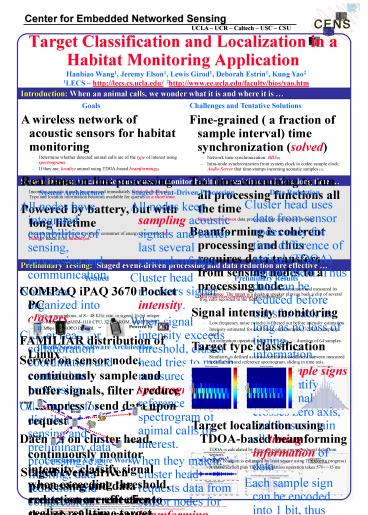
- A wireless network of acoustic sensors for
habitat monitoring - Determine whether detected animal calls are of
the type of interest using spectrograms. - If they are, localize animal using TDOA-based
beamforming1. - Real time on-line processing
- Incoming acoustic signals are processed
immediately inside the network. Type and
location information becomes available for
queries in a short time. - Powered by battery, but with long lifetime
- Because communication is a primary consumer of
energy, inter-node data transfer needs to be
minimized.
- Fine-grained ( a fraction of sample interval)
time synchronization (solved) - Network time synchronization RBS2.
- Intra-node synchronization from system clock to
codec sample clock Audio Server that time-stamps
incoming acoustic samples 3. - Too time-consuming to run all processing
functions all the time - Staged event-driven data processing that
operates on demand - Beamforming is coherent processing and thus
requires data transfers from sensing nodes to a
processing node - Data reduction/compression before transfer
System Design An acoustic sensor net to monitor
habitat in real time and for a long time
Data Reduction
Staged Event-Driven Processing
System Architecture
- Cluster head uses data from sensor nodes only for
time difference of arrival (TDOA) among them.
Thus data can be reduced before transfer back as
long as no loss of timing information. - Signal sample signs fully identify when signal
crosses zero axis, and thus contain all timing
information of data - Each sample sign can be encoded into 1 bit, thus
data size can be significantly reduced.
- All nodes have integrated capabilities of
sensing, processing and communication. - Nodes are organized into clusters.
- Cluster head for collaboration coordination and
central data processing. - Other nodes for distributed sensing and
preliminary data processing, e.g. filtering, data
reduction and compression.
- All nodes keep sampling acoustic signals and
buffer last several seconds of data. - Cluster head monitors signal intensity.
- When signal intensity exceeds threshold, cluster
head tries to match measured signals spectrogram
to a reference spectrogram of animal calls of
interest. - When they match, cluster head requests data from
sensor nodes for beamforming.
Preliminary Testing Staged event-driven
processing and data reduction are effective
Testbed
Preliminary Results
- COMPAQ iPAQ 3670 Pocket PC
- Built-in microphone, at 8 - 48 KHz rate, in
signed 16-bit integer. - 206 MHz StrongARM-1110 CPU, 32 MB ROM, 64 MB RAM
. - 11 Mbps ORiNOCO PC card.
- FAMILIAR distribution of Linux 4
We deployed the test bed in an outdoor
environment and measured its performance. The
target is a desktop speaker playing back a clip
of several frog calls recorded in the field.
- Signal intensity monitoring
- Low frequency noise (winds) is filtered out
before intensity estimation. - Intensity estimated for each block of 64 samples
(32 KHz sampling rate). - An estimation operation takes 785/-5 us, ltlt
duration of 64 samples.
Powered by
- Target type classification
- Similarity is defined as cross-correlation
coefficient between measured spectrogram and
reference spectrogram, sliding in time axis. - A classification operation takes 361/-1 ms
Client/Server Software Architecture
- Server on sensor node, continuously sample and
buffer signals, filter / reduce / compress / send
data upon request. - Daemon on cluster head, continuously monitor
intensity, classify signal when exceeding
threshold, create concurrent client threads of
data-request when call of interest is recognized,
starts beamforming to locate target when all data
received.
sensor
sensor
head
- Target localization using TDOA-based beamforming
- TDOA is calculated by cross-correlation among
reduced data from sensors. - Target Location is estimated by least square
using TDOAs (in progress) - A classification plus TDOA-calculation operation
takes 570/-15 ms
sensor
sensor
Conclusion Future Work
sensor position o real target position x
estimated target position
- Staged event-driven processing and data reduction
are effective to realize real-time target
classification and localization - We will investigate system power efficiency
improved by data reduction
Reference 1 Chris W. Reed, Ralph Hudson, and
Kung Yao, Direct joint source localization and
propagation speed estimation, Proc. IEEE ICASSP,
vol. 3, Mar. 1999, pp. 1169-1172. 2 Jeremy
Elson, Lewis Girod, and Deborah Estrin.
Fine-grained network time synchronization using
reference broadcasts. Technical Report
UCLA-CS-020008, University of California
LosAngeles, May 2002. http//lecs.cs.ucla.edu/Publ
ications/Publications.html. 3 Lewis Girod,
Vladimir Bychkovskiy, Jeremy Elson, and Deborah
Estrin, Locating tiny sensors in time and space
A case study, Proc. ICCD, 2002.
http//lecs.cs.ucla.edu/Publications/Publications.
html. 4 Familiar Linux. http//www.handhelds.or
g.
Recommended

