

The Scientific Method Is the Basis for Scientific Inquiry PowerPoint PPT Presentation
1 / 36
Title: The Scientific Method Is the Basis for Scientific Inquiry
1
The Scientific Method Is the Basis for Scientific
Inquiry
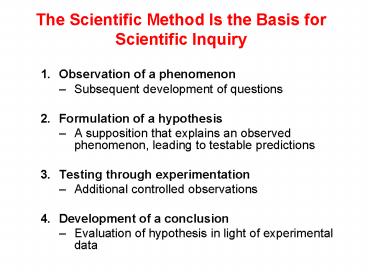
- Observation of a phenomenon
- Subsequent development of questions
- Formulation of a hypothesis
- A supposition that explains an observed
phenomenon, leading to testable predictions - Testing through experimentation
- Additional controlled observations
- Development of a conclusion
- Evaluation of hypothesis in light of experimental
data
2
- Initially, scientists make an observation that
leads them to a question they want to answer - This question is turned into a hypothesis or a
tentative answer to the question - The hypothesis must be testable and falsifiable
3
(No Transcript)
4
Controls and Variables in Experimental Design
- Variable are the factors influencing processes
being examined. - hypothesis examines ONE variable, holding others
constant. This is the experimental group. - Control group examined variable is left
unaltered
5
Applying the Scientific Method to an Everyday
Situation
- You wake up late, miss the bus and your dad has
to drive you to school, butthe car wont start - Observation The car wont start
- Hypothesis the battery is dead
- Experimental design Replace your battery with
another and restart the car - What conclusion can you draw?
6
Limitations of the Scientific Method
- Can never be sure all untested variables are
controlled - Conclusions based on the experimental data must
remain tentative - Results of experimentation must be communicated
thoroughly and accurately to other scientists for
repetition - Repetition by other scientists add verification
that findings can be used as the basis for
further studies
7
Science is a Human Endeavor
- Human personality traits are part of real
science - Scientists, like other people may be driven by
pride, ambition, or fear - Scientists sometimes make mistakes
- Accidents, lucky guesses, intellectual powers,
and controversies with others contribute strongly
to scientific advances
8
Flemings Discovery of Penicillin Highlights Real
Science in the 1920s
- Microbiologists grow microbes in in pure
(single-species) cultures on Petri plates - One of Alexander Flemings bacterial cultures was
contaminated with a mold - Fleming nearly destroyed the culture when he
noticed the mold (Penicillium) inhibited
bacterial growth on the dish
9
(No Transcript)
10
- Fleming hypothesized that the mold produced an
antibacterial substance - Further tests using broth from pure Penicillium
cultures lead to the discovery of the first
antibiotic, penicillin - Fleming continued beyond a lucky accident with
further scientific investigation to a great
discovery - Chance favors the prepared mind (Louis Pasteur)
11
Colds, Vitamins and Nutritional Supplements
12
The Logic of Hypothesis TestingInductive vs
Deductive Reasoning
- Hypothesis Consuming vitamin C decreases the
risk of catching a cold - This hypothesis is based on observations and
inductive reasoning A logical process that
argues from specific instances to a general
conclusion
13
- Prediction If vitamin C decreases the risk of
catching a cold, then people who take vitamin C
supplements with their regular diets will
experience fewer colds than people who do not
take supplements - Making predictions about the outcome of a test
sometimes in if then statements is deductive
reasoning
14
(No Transcript)
15
(No Transcript)
16
Proof ??? Theory ???
- Even though we cant prove a hypothesis 100
true, we can gather enough evidence to determine
whether a hypothesis is reasonably true
17
Some Scientific Background
- Experimentation has led to the understanding that
colds are caused by viruses - Viruses are composed of
- A small amount of genetic material
- Some proteins
- An outer protective coating
18
(No Transcript)
19
- Viruses are non-living
- Viruses need to enter a cell to reproduce
- Viruses enter a cell and use the cell machinery
to make more virus particles, which leave to
infect more cells - There are several hundred types of cold viruses
- They normally infect the cells of our noses and
throats, causing the typical cold symptoms of
sneezing, coughing, sore throat, and congestion
20
(No Transcript)
21
Scientific Theory
- Viruses cause the common cold
- Scientists feel this statement is true because
- There are no other reasonable supported
hypotheses - This hypothesis has not been rejected
- It conforms to a well-accepted scientific
principle, the germ theory
22
- A scientific theory is an explanation of a set of
related observations based on well-supported
hypotheses from several different, independent
lines of research - The germ theory arose from the accumulated
observations of scientists such as Pasteur and
Koch
23
- Scientists in the 1800s noticed a relationship
between disease and specific microorganisms - Many experiments and observations since then all
support the idea that certain microorganisms
cause human diseases - Because of the germ theory of disease, science
believes that colds are caused by viruses, which
are microorganisms
24
A Scientific Theory is not a guess
- Truth in science can be defined as What we
know and understand based on all available
information - If a hypothesis appears to explain all instances
of a particular phenomenon and has been
repeatedly tested and supported, it may
eventually be accepted as accurate - If there is an abundance of evidence, then the
idea may be referred to as a theory
25
- In common speech, a theory is the same as a
hypothesis an untested idea - Is this characteristic of science?
- Is a guess an uncompleted experiment?
- Is one completed experiment enough to form a
scientific theory?
26
Proof??? Theory????
- Many people believe that colds can be treated
with Echinacea to lessen the duration and
severity of the cold symptoms
27
Experimental Design
- One group drank tea which contained Echinacea
extract - A second group (the control group) drank tea
which did not contain Echinacea extract - The participants were asked to rate the
effectiveness of the tea at reducing the cold
symptoms
28
Results
- In this study, people who received echinacea tea
felt that it was 33 more effective at reducing
symptoms - The 33 more effective is in comparison to the
opinions of people about the effectiveness of a
tea that did not contain Echinacea extract that
is, the results from the control group
29
(No Transcript)
30
What does this really mean?
- Since the only difference between the two groups
was that the experimental group had Echinacea
extract in their tea, that difference should
account for the difference in results - But was that the only difference?
31
Other possibilities
- Were the participants all the same in
- age?
- diet?
- stress level?
- how often they visited a health care provider?
- Do these other variables matter?
32
Controls, Controls, Controls
- The only way to be sure that the experimental
treatment causes the result is to have no other
differences between the groups - If this is true, then you have a good robust
controlled experiment - Good controls are the basis of strong inference
a strong statement about the truth of a given
hypothesis possible when an experimental protocol
greatly minimizes the number of alternative
hypotheses that can explain a result
33
- In the study, the data indicated that cold
severity was lower in the experimental group
compared to the placebo group - The use of controls in the study allows
researchers to have high confidence that they
differed because Echinacea extract relieves cold
symptoms - A strong inference was possible
34
(No Transcript)
35
- One study alone usually isnt enough to convince
the scientific community - Many more studies of Echinacea were done, some
supported the collected data. some conflicted
with the collected data - As of now, the use of Echinacea as a cold
treatment is not scientifically supported, even
though it continues to be commonly used
36
Scientific Method Lessons
- Using M M candy to learn about the Scientific
Method - http//www.scienceteacherprogram.org/genscience/AM
eyer05.html - Ant behavior and the Scientific Method
- http//biology.arizona.edu/sciconn/lessons2/Shinde
lman/Objectives.htm
Recommended

