

Education For All Fast Track Initiative EFA FTI Status Report PowerPoint PPT Presentation
1 / 22
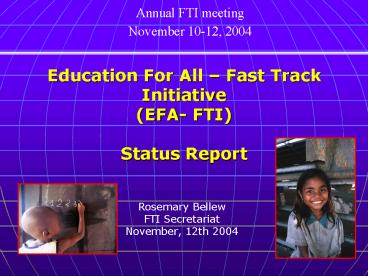
Title: Education For All Fast Track Initiative EFA FTI Status Report
1
Education For All Fast Track Initiative(EFA-
FTI)Status Report
Annual FTI meeting November 10-12, 2004
- Rosemary Bellew
- FTI Secretariat
- November, 12th 2004
2
Presentation Plan
- Overall picture on UPC
- FTI country progress in education
- Resource mobilization
- Domestic
- External
- Potential countries and resource requirements
- Policy and Institutional Environment,
Implementation Ratings - Harmonization
- Other FTI work to advance the goals of the FTI
- Challenges
3
Over half of low income countries are off track
in achieving Universal Primary Complete (UPC)
- Children out of school
- - 54 in S.Asia
- - 44 in S-S.Africa
4
Progress in all regions over the last ten years
- South Asia double the rate of progress
- Sub-Saharan Africa nine times the rate of
progress
5
FTI endorsed countries range considerably in PCR..
- Vietnam achieved UPC, Guyana is On-track
- 10 countries Off-track (incl. 3 Seriously
off-track)
SourceWorld Bank
6
FTI endorsed countries show significant progress
in recent years on other access indicators
7
Quite significant progress, on average, in
lowering repetition .
- FTI endorsed countries have reduced repetition
from 12.4 to 10,2 (low income average of 10.9)
8
Gender parity remains a challenge
- Parity rate among FTI endorsed countries averages
86 girls for 100 boys, compared with 89100 for
low-income countries
9
Resource Mobilization -- Domestic financial
effort varies
10
External financing has increased in FTI countries
- From US 300 to 350 between 2003-04
- Most (US 45) through the Catalytic Fund
2393
2224
11
Country by country financing gap
- The financial gap has been closed for 5 countries
- Expected for two others
12
Catalytic Fund Pledges .
13
Catalytic Fund Disbursement Status .
14
Why not larger increases?
- ODA for education increased 2000-2002 by about
23
- 49 of ODA allocated to low-income countries
- 70 is technical assistance
- Does not take into account budget support
15
Capturing the full picture
16
Policy, Institutional environment, Implementation
ratings, Harmonization
- On average, FTI countries have higher policy and
institutional environment ratings - Implementation ratings in education sector 7/12
score in the worst two quintiles - 8-9 countries have a sector wide program, or are
in the process of developing one - In most cases, donors are on plan, joint reviews
- Harmonization less advanced on procurement and
disbursements
17
The Future -- Potential FTI countries
- 18 achieved UPC
- 12 Endorsed in 2003/04
- 26 potential 2005
- 13 potential 2006
- 14 beyond 2006
- 83 Total (Vietnam and Albania double
counted)
18
Potential FTI Endorsement and Financing Needs
19
Other FTI work
- Harmonization
- Donor indicative framework
- Finance
- Accounting for budget support
- Relationship between financing mechanisms and
education outcomes - Review of methodologies for estimating the global
financing gap - Communications
- Key challenge
- Education Program Development Fund
20
Education Program Development Fund (EPDF)
- Increase the number of low-income countries with
sound and sustainable education sector programs - Strengthen country capacity to develop policies
and sector programs through a broad-based
consultative process - Improve knowledge of the conditions under which
policies and reforms may be successful - Strengthen donor partnerships at the country
level - Strengthen partnerships with regional networks
and institutions
21
What would it finance?
- Upstream support for program preparation for
countries with weak capacity and too few donors - Downstream all countries
- Selective technical and analytical work to
generate knowledge from country experience that
can be shared across countries, cross country
exchange of experience
22
Key Challenges
- Expansion and Resource mobilization
- ODA
- Transitioning Catalytic Fund countries
- Monitoring and data requirements
- Timeliness
- Domestic expenditure
- Finance gaps
- Communication and outreach
- Performance measures -- Learning achievement
- Downward accountability in service delivery and
public expenditure management
Recommended

