

The%20General%20Picture%20of%20TRIZ%20From%20the%20Viewpoint%20of%20Changing%20Objects PowerPoint PPT Presentation
Title: The%20General%20Picture%20of%20TRIZ%20From%20the%20Viewpoint%20of%20Changing%20Objects
1
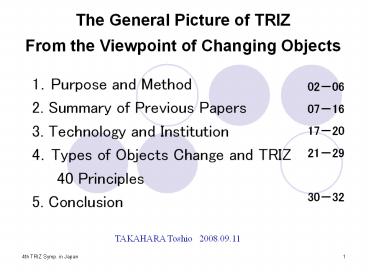
The General Picture of TRIZ From the Viewpoint
of Changing Objects
- 1.Purpose and Method
- 2. Summary of Previous Papers
- 3. Technology and Institution
- 4.Types of Objects Change and TRIZ
- 40 Principles
- 5. Conclusion
02-06 07-16 17-20 21-29 30-32
TAKAHARA Toshio 2008.09.11
2
1. Purpose and Method1.1 Purpose
- Change Objects
- An important thing is only to make a right change
on a right object in some area - 1.Application Area
- 2. Object World
- Especially Thing to be operated in Object
- 3.Method to change
- Formal Theory for these requirements in every
application area (I dont touch existing contents
of TRIZ)
3
1.2 Purpose and Total Picture of Study
Change Object Enumerate what can be
changed Enumerate the way of change
Basic Concepts
Granularity and Density, Attributes
Objects
Objects Change
Object World
How to Express Object World
Method of Resolving Differences (Intentional
change of Object World)
Application Area (Personal, Technology,
Institution)
4
1.3.Key of Method Type
- A classification into minimum (if possible) kinds
of elements of something as Types, in which - 1. we can deal with the same kind in the same
way and the different kind differently, (Unified
Way) - 2. by the combination of element we could
reconstruct the original one uniquely in Object
World or kind of element cover all Objects change
and application area. (Exhaustiveness) - ? Unified and Systematic Theory to change Object
5
1.4 Method Relation between Types
Types of Objects Change to be obtained not Types
of Object
In 2003- 2005 A weak point of TRIZ
Basic Concepts And Types
In 2007, 2008
Object,
Attributes and Object Structure
Objects
In 2003- 2005 A weak point of TRIZ
Objects Change
Object World
Types of Object Transformation and Operation
gtTypes of Solution
In 2007
Types of Purposes
Types of Area Types of Institution
In the future
Application Area (Personal, Technology,
Institution)
Method of Resolving Differences (Intentional
change of Object World)
6
1.5 Method Flow of Types
Recognition of the real world and Differences
2.1 Object
Types of Purposes Make a new function, Problem
solving, Idealization (more plus, less minus)
2.2 Object Structure
Specify relation between purpose, situation and
types of Objects change
In 2007 Under one attribute and one Object In
2008 Under two attributes and two Objects
2.3 Types of Objects Change to be obtained
Change Object Specify something to be changed in
Object and method of Operation and Transformation
of Object
Types of Solution (in the Future)
2.4 Types of Operation and Transformation of
Object
Solution
7
2. Summary of Previous Papers2.1. Object,
Granularity, Attributes
- Kinds of Objects Types of Object World
- Kinds of Objects which is something to be
recognized - 1.Matter System Object
- 2. Idea System Object
- 21.Information of individual or common notion
which is taken by physical entity - 22.My idea
- 3.Movement or ActionProcess Object
- GranularitySize, magnitude or scope in space
and/ or time of something - Density Density of inner structure, Degree of
abstraction of something
8
2.2. Structure of Object
Principle D
- Four granularities of Attribute in Object
- Attribute 1 is everything that concretely
describe Object - Attribute 1 Attribute 2 (Content) in narrow
sense Inner Structure (Form) - Attribute 2 in narrow sense Attribute 3
difficult to change in most narrow sense State
easy to change - Latent attributes
- (Attributes, Value)
Function a
Principle U/ P
Function b
Function n
Object
Attribute a
Attribute b
Attribute n
Inner structure
Elements
Number of Elements
Relation between elements
9
2.3. Types of Objects Change within one
Attribute and one Object
- 1.Generate or delete Object
- 2.Generate or delete attributes
- 3.Change attributes of Object
- 1) No change of attributes
- 2) Change attributes of Object not qualitatively
- 3) Change attributes of Object qualitatively
- To generate Object or attributes is to bring in
to the stage of Object World. To delete Object or
attributes is to bring out from the stage of
Object World.
10
2.4. Types of Object Operation and Transformation
2.4.1. Types of Object Transformation 1
- Object Transformation Principle D
- Change of inner structure consisting of elements
and the relation between them can change plural
attributes of Object, generate new Object and
delete Object itself from inside. - (an expansion of the law of the mutual
transformation of quantitative and qualitative
changes) - Basically Principle U,P change attributes 2 from
outside
11
2.4.2 Types of Object Transformation 2
Object 2
Object 1
Movement
Object Transformation Principle U Object 1and
movement can change attributes of Object 2 or
Object 2 itself.
Object 2
Movement
Object 1
Object Transformation Principle P Object 1 and
Object 2 can change attributes of movement or
movement itself.
12
2.4.3. Types of Object Operation
- Object Operation AWe can operate existing single
Object or Object in Object 1- Process Object-
Object 2 model. - Object Operation R We can bring in, bring out
or replace Object or its element of existing
single Object or Object in Object 1- Process
Object- Object 2 model freely regardless they
are existing or not.
13
2.4.4. Relation between Types of Object
Operation, Transformation and Objects Change
within One Object
Types of Object Operation
Types of Object Transformation
Types of Objects Change
Delete or generate Object, attributes
Change number of Object, attributes 0- 1, 1- 0
Principle D Change inner structure of Object
Operation A Act on existing Object
Principle P Object1 and Object2 change Process
Object
Qualitatively Change attributes of Object
Person
Change 1 attribute of Object
Operation R Bring in, bring out or replace
Object
Principle U Object1 and Process Object change
Object2
Not qualitatively Change attributes of Object
14
2.5.1. How to Express 1Example of Picture Frame
Person
Nail
Picture frame held by a person
Hanged Picture frame with Torque
Hang Frame on nail
Hang Frame on nail
And/ or
frame and string
With no qualitative change
Person
Nail
Hang Frame on nail
Picture frame held by a person
Hanged Picture frame with Torque
frame and string
15
2.5.2. How to Express 2Example of Burning
With qualitative change or replace
And/ or
Oxygen
State before burning
Burn
State after burning
Burn
Flammable material with carbon
Ash
CO2
Oxygen
Person
10g
5g
Burn
X t
Y t
Activity
Flammable material with carbon
Ash
CO2
CO2
16
2.5.3. How to Express Detailed Picture Frame
Nail
Torque A caused by gap between gravity center and
nail
A-(B-C-)gt0
Person
Picture frame held by a person
Frame slant
Frame hanged horizontally
Slanted frame
Hang Frame on nail horizontally
Friction B between nail and string
Friction B-
frame and string
Friction C- between wall and frame
Friction C between wall and frame
Touch
Person
wall
17
3.1. Technology and Institution
- TechnologyThings between Person and Nature
- InstitutionCommon Idea between Person and
Community - 1. Person and Thing take Common Idea
- Institution of Exchange (e.g. language,
money) - 2. Person takes Common Idea
- Common Subject (e.g. thought, philosophy,
religion, moral) - System Institution (e.g. nation, corporation,
family) - Social Institution (e.g. law, politics,
economics)
18
3.2.Example of Institution Birth of Commodity
and Money K. Marx Capital Chap.1
Add (and segment) attribute by Principle U
Bring in Exchange by Operation R
Useful thing
Use-value
Add attribute by exchange
Person
Use-value
Unintentional movement
Exchangeable
Transformation of attributes in succeeding
exchange processes
Person
Useful thing
Use-value
Exchange-value
Segmentation of Object into Commodity and Money
Person
Commodity
Money
Bring in Money by Operation R
19
3.3. Change and Contradiction
- Change is an assemblage of
- intentional change (Resolving Differences)
- unintentional change
- autonomous change contradiction
- Technology is conformed mainly to the law of
movement of matter without purpose - Institution is conformed to the law of movement
of community to realize purposes grasped at
granularity as autonomous
20
3.4. Technology and Institution
- In Both Technology and Institution
- Change Objects by cause- effect relation, and
use results and knowledge of contradiction - Institution
- We have only necessary conditions which are to
- continue to verify input and output of action,
- continue to ask for method to realize change
and common subject itself and - continue to act for change for the purpose.
21
4. Types of Objects Change and TRIZ 4.1.1
Preparation Two Viewpoint
- 3 Granularities of change
- A1. Change of number of Objects
- A2. Change of number of attributes
- A3. Change of attributes
- 3 Types of Means of Changing Object gt Types of
solution / 40 Principles - B1. By Basic Principles
- B2. Resolving Contradiction
- B3. Simple Change of Attributes
22
4.1.2 Types of Objects Change and TRIZ
Preparation Types of Contradiction
- 3 Types of Opposites
- 2 attributes in each Object, 2 attributes in 1
Object, 2 values in 1 attribute - 3 Types of Contradictions
- A. Allow contradiction to go on type
(Develop a form in which opposites can exist
side by side ) - Type 1 Mutually exclusive conditions of two
values in one attribute lead to movement (PC) - Type Y
- B. Improvement of attributes of contradiction
type - Type X PC
- Type 2 Meet two values of requirements of two
attributes simultaneously (TC) - Type 3 Transformation of two attributes
- C. Improvement of attributes of opposites
type - Type 4 Segmentation of Object
23
4.1.3 Types of Changed Objects and TRIZ
Preparation Types of Resolving Contradiction
A. Allow contradiction to go on type
B. Improvement of attributes of contradiction
type
C. Improvement of attributes of opposites type
24
4.2.1 Rearrange Existing 40 Principles 1numbers
of Principles the number of Principle31, 32,
37 are not included
- Structure Principles Super Groups
- a) Basic Principles Group 61, 2, 5, 6, 24, 34
- b) Dynamic Principles Group 18(3, 4, 6, 9, 10,
11, 13, 14, 15, 16, 17, 18, 19, 20, 21, 23, 35,
40) - c) Structure Principles Group 7(1, 2, 5, 7, 13,
24, 40) - d) Replace Principles Groups 9
- Replace Element Principles Group (26, 27,
28) - Replace Environment Principles Group (29,
38, 39) - Replace by Attributes Change Principles
Group (14, 30, 40)
25
4.2.2 Rearrange Existing 40 Principles 2
- Function and Attributes Principles Super Groups 1
- e) Plus Principles Groups 18
- Basic Plus Principles Group (1, 24, 35)
- Function Plus Principles Group (6, 9, 10,
11, 15, 16, 17, 18, 19, 20, 21, 23, 25, 36) - Attributes Plus Principles Group (17, 35, 40)
- f) Minus Principles Groups 12
- Basic Minus Principles Group (2, 5, 34, 35)
- Function Minus Principles Group (16)
- Replace Minus Principles Group (26, 27, 28,
29, 30, 31, 33) - Attributes Minus Principles Group (33, 35)
26
4.2.3 Rearrange Existing 40 Principles 3
- Function and Attributes Principles Super Groups 2
- g) Equalize Principles Groups 9
- Equalize Problem Solving Principles Group
(8, 11, 12, 34) - Equalize Movement Principles Group (9,
10, 16, 23, 34) - Equalize Attributes Principles Group (33)
- h) Anti Principles Groups 8
- Basic Anti Principles Group (13)
- Anti Function Principles Group (13)
- Anti Attributes Principles Group (4, 13,
39) - Anti- Anti Function Principles Group (8,
9, 16, 34) - Anti- Anti Meaning of Function Principles
Group (22)
27
4.3.1. Types of Changed Objects within Two
Attributes and Objects and TRIZ
0 Object, 0 attribute
Generate or delete Object
1. Not qualitatively or 2.Qualitatively change
one attribute of one Object. 3. Handling
physical contradiction
1 Object, 1 attribute
Segment, add, delete or merge attributes
1 Object, 2 attributes
1. Qualitatively transform two attributes. 2.
Handling technical contradiction
Segment, delete or merge Objects
1. Qualitatively transform two attributes. 2.
Handling technical contradiction
2 Objects, 2 attributes
28
4.3.2. Types of Objects Change within Two
Attributes and Objects and TRIZ 1
Types of Objects Change Types of Objects Change Means to realize in TRIZ
1) Change number of Object 0/ 1, 1/ 0 11) Generate Object Principle 24. Intermediary
1) Change number of Object 0/ 1, 1/ 0 12) Delete Object Principle 34. Discarding
2) Handling one attribute 213) One value dont change 211)221)231) Mutually exclusive conditions of two opposites lead to movement Physical Contradiction in TRIZ Type 1
2) Handling one attribute 213) One value dont change 212)222)232) Two opposites can be separated Separation of opposites in TRIZ Type X
2) Handling one attribute 213) One value dont change 223) Not qualitative change of attributes Many Principles in TRIZ
2) Handling one attribute 213) One value dont change 23) Qualitative change of attributes 233) 2331) Delete attributes Principle 34. Discarding
2) Handling one attribute 213) One value dont change 2332) Transformation of attribute to the other attributes (Transformation of attribute to be studied)
3) Change number of attributes 1/ 2, 2/ 1 31) One attribute to two attributes 311) Add attribute Principle 6. Universality Principle 25. Self-service, others
3) Change number of attributes 1/ 2, 2/ 1 312) Segmentation of attribute Principle 1. Segmentation
3) Change number of attributes 1/ 2, 2/ 1 32) Two attributes to one attribute 321) Delete one of the two Principle 2. Taking out Principle 34. Discarding
3) Change number of attributes 1/ 2, 2/ 1 322) Two merge into one Principle 5. Merging
29
4.3.3. Types of Changed Object within Two
Attributes and Objects and TRIZ 2
4) Handling two attributes 41) No change of attributes Type Y
4) Handling two attributes 42) Not qualitative change of attributes Meet two values of requirements simultaneously Technical Contradiction in TRIZ Type 2
4) Handling two attributes 43) Qualitative change of two attributes to the other two attributes (Transformation of two attribute to be studied) Type 3
5) Change number of Object 1/ 2, 2/ 1 51) One to two Principle 1. Segmentation Type 4
5) Change number of Object 1/ 2, 2/ 1 52) Two to one 521) One of the two extinguishes Principle 34. Discarding
5) Change number of Object 1/ 2, 2/ 1 522) Two merge into one Principle 5. Merging, Delete contradiction by merging opponents type Z
30
5.1 Summary
Object
Basic Concepts And Types
In 2007, 2008
Types of Objects Change to be obtained
Attributes and Object Structure
Objects
A weak point of TRIZ
Objects Change
Object World
Object Transformation and Operation gtTypes of
Solution
In 2007
Types of Purposes
Types of Area Types of Institution
In the future
Application Area (Personal, Technology,
Institution)
Method of Resolving Differences (Intentional
change of Object World)
31
5.2 Conclusion
- Types of Objects change within two attributes and
two Objects - TRIZ is an assemblage of process elements
- attributes change
- solving physical contradiction and
technical contradiction - segmentation and merging of attributes
- segmentation and merging of Objects
- We can apply TRIZ to institutional area with some
modification
32
5.3. Further Study Needed
- Transformation of attribute to the other
attribute - How inner structure of Object decide attributes,
Structure of contradiction in Institution - Solution to decide
- 1) how types of purposes and situation decide
types of Objects change (position in 4.3.1 -
4.3.3) and - 2) how types of changed Object select Operation
R, Principle U, P and D and decide how to use
them ?Types of Solution - 40 Principles in the area of Institution as
Types of Solution
Recommended

