

U'S' Modeling Contributions to the IPCC Fourth Assessment Report AR4 PowerPoint PPT Presentation
1 / 18
Title: U'S' Modeling Contributions to the IPCC Fourth Assessment Report AR4
1
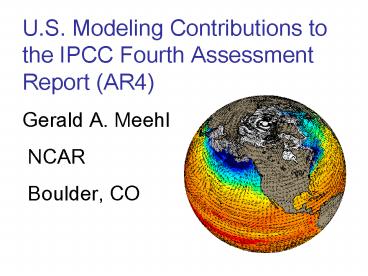
U.S. Modeling Contributions to the IPCC Fourth
Assessment Report (AR4) Gerald A. Meehl NCAR
Boulder, CO
2
The IPCC AR4 has motivated the formulation of the
largest international global coupled climate
model experiment and multi-model analysis effort
ever attempted, and is being coordinated by the
WCRP/CLIVAR Working Group on Coupled Models
(WGCM) Climate Simulation Panel Seventeen
modeling groups from 10 countries around the
world are participating with 23 models
considerable resources have been devoted to this
project PCMDI has taken on the considerable
task of collecting, archiving and making
available the model data 27 TeraBytes of model
data archived so far
3
Three global coupled climate modeling groups from
the U.S. have made major contributions to the
AR4 1) Running the extensive set of model
experiments with multi-member ensembles 2)
Publishing scientific results from the
experiments GFDL (NOAA) GISS (NASA) NCAR-CCSM
(NSF-DOE) The Climate Model Evaluation Project
(CMEP) has also supported analyses of the U.S.
model data for IPCC
4
Participating AOGCMs (23 models from 17
institutions in 10 countries)
x x x x x x x
5
Ensemble members
x x x x x x x
6
Climate change commitment in the NCAR CCSM3 and
PCM At any point in time, we are committed to
additional warming and sea level rise from the
radiative forcing already in the system.
Warming stabilizes after several decades, but
sea level from thermal expansion continues to
rise for centuries. (Meehl et al., 2005 How
much more warming and sea level rise? Science,
307, 17691772)
7
Ocean Heat Uptake in GISS model
(Hansen, J. and co-authors, 2005 Earth's Energy
Imbalance Confirmation and Implications.
Science, 308 1431-1435)
8
Summer Drying in GFDL model
(Findell, K. L., and T. L. Delworth, 2005 A
modeling study of dynamic and thermodynamic
mechanisms for summer drying in response to
global warming. Geophysical Research Letters, 32,
L16702, doi 10.1029/2005GL023414.)
9
(No Transcript)
10
21 AOGCMs, 2080-99 compared to 1980-99, SRES A1B,
common 5 lat-lon grid
-
b) - c)
d)
(Furrer et al., 2005)
11
Results from analyses of the multi-model dataset
were presented by 125 scientists at a workshop
convened by US CLIVAR and hosted by IPRC (Univ.
of Hawaii) March 1-4, 2005, and are feeding
directly into the AR4 assessment process Over 200
papers have been submitted to peer-reviewed
journals with results from multi-model analyses
for assessment in the IPCC AR4 This is more than
double the most optimistic estimate for
participation To date, there are over 400
analysis projects registered at PCMDI, with about
three more being added each week
12
U.S. CLIVAR Climate Model Evaluation Project
(CMEP)
- US CLIVAR recommended that NSF, NOAA, NASA, and
DOE have a program to evaluate US coupled climate
model simulations of 19th and 20th century - 61 proposals submitted - 19 funded
- List of awards and abstract found at
www.usclivar.org/science.html - CMEP IPCC AR4 Workshop hosted by the
International Pacific Research Center (IPRC) at
the Univ. of Hawaiiabout 150 participants
13
CMEP results NAO Variability
(S. Nigam)
CMEP Results
- NAO variability is tracked using the leading EOF
of 850mb heights in the Atlantic sector - Models are able to generate the salient features
of the NAO pattern. The observed pattern exhibits
no Pacific connections, but the GFDL pattern
does. The southern cell is eastward shifted in
CCSM3 - Robust surface temperature signals are produced
over northeastern North America and northern
Europe and Asia in all models. Distribution of
the warming signal over US is more varied, though - Precipitation anomalies over the Atlantic,
reflecting meridional stormtrack displacement,
are generally well captured in all models.
Positive rainfall anomalies are placed a bit too
eastward in CCSM3 and a bit too westward in the
GISS C4x3 model. - NAO related zonal-mean zonal wind anomalies,
having a dipole structure in the midlatitudes,
are realistically modeled in the GFDL, CCSM3 and
PCM runs they serve to broaden the jet in all
cases connections to the lower stratosphere are
also well modeled (Nigam)
14
CCSP 1.1
Monthly
Tropics 20N-20S
1979-99
(Santer et al., 2005, Science) obs and 49
realizations from 19 AOGCMs
15
- Conclusions
- 1. The U.S. modeling centers (GFDL, GISS, and
NCAR-CCSM) have all made significant
contributions in terms of running the model
experiments and analyzing results from their
models for publication and assessment in the AR4 - PCMDI has taken on the formidable task of
collecting, archiving and making available the
multi-model data 27 terabytes archived, over 400
registered analysts, more than 200 papers
submitted - CMEP has provided funding for 19 U.S. projects to
analyze the output from the U.S. models - The model data have been used and will continue
to be used in support of the CCSP reports and
further CMEP analyses (recommended by US CLIVAR)
16
IPCC AR4 ENSO Events
OBS
CMEP Results
CCSM
GFDL
GISS
A. Solomon
A.Capotondi
17
(No Transcript)
18
Simple Indices of Climate Variability and
Change(D. Karoly)
CMEP Results
There is very good agreement between the time
variations of observed global-mean temperature
and the ensemble-mean from the model simulations
that included all forcings increasing greenhouse
gases and sulphate aerosols, as well as major
volcanic eruptions and changes in total solar
irradiance. The modeled cooling after volcanic
eruptions appears to be too large.
Recommended

