

New Room Temperature Solid-State Qubits for Future Quantum Computers PowerPoint PPT Presentation
1 / 1
Title: New Room Temperature Solid-State Qubits for Future Quantum Computers
1
New Room Temperature Solid-State Qubits for
Future Quantum Computers
S. Nellutla, K.-Y. Choi, M. Pati, J. van Tol, I.
Chiorescu and N. S. Dalal NHMFL, Dept. of
Chemistry and Biochemistry and Dept. of Physics,
FSU
Current semiconductor computer technology
is slowly reaching its limits of performance. The
new magic term for future alternatives is
quantum computing, where we enter the
fascinating realm of quantum mechanics, and of
quantized properties of materials.
In a classical computer information is
stored in bits, and can have the value of 0 or 1.
In a quantum computer on the other hand, quantum
bits (qubits) are the elementary units and they
are described using a set of two quantum
wavefunctions, 0gt and 1gt. Due to its quantum
nature, a qubit can exist in any superposition of
0gt and 1gt and thus can have an infinite number
of possible states instead of just 1 or 0.
Coherence, the ability to maintain such
superpositions, is the name of the game for
scientists in this field. Quantum signatures
which are easily recognizable in atomic systems
in gaseous state are significantly harder to be
obtained in solid state systems because the
interactions with the environment can change the
state of the qubit, leading to the wrong answer.
In this study we introduce a new solid state
material in which qubit interaction with their
local environment, mostly neighboring nuclear
spins, can be suppressed to such an extent that
quantum superpositions are detectable even at
room temperature. Starting from solution, single
crystals of K3NbO8 doped with Cr5 have been
obtained. Cr atoms carry a spin with projection
1/2 defining the two qubit states. Rabi
oscillations are observed for the first time in a
spin system based on transition metal oxides up
to room temperature. At liquid helium temperature
the phase coherence relaxation time T2 reaches
10 µs and, with a Rabi frequency of 20 MHz,
yields a single qubit figure of merit of about
500. This shows that a diluted ensemble of Cr5
doped K3NbO8 is a potential candidate for
solid-state quantum information processing.
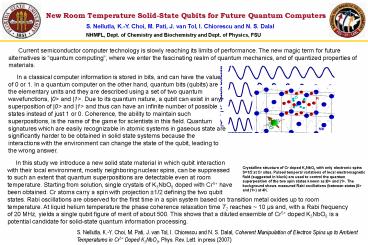
Crystalline structure of Cr doped K3NbO8 with
only electronic spins S1/2 at Cr sites. Pulsed
temporal variations of local electromagnetic
field (suggested in black) are used to control
the quantum superposition of the two spin states
known as 0gt and 1gt. The background shows
measured Rabi oscillations (between states 0gt
and 1gt) at 4K.
S. Nellutla, K.-Y. Choi, M. Pati, J. van Tol, I.
Chiorescu and N. S. Dalal, Coherent Manipulation
of Electron Spins up to Ambient Temperatures in
Cr5 Doped K3NbO8, Phys. Rev. Lett. in press
(2007)
Recommended

