

Which way will a spinning baseball curve (relative to freefall)? PowerPoint PPT Presentation
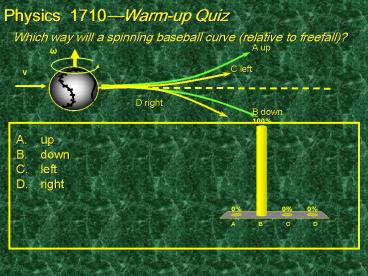
Title: Which way will a spinning baseball curve (relative to freefall)?
1
Which way will a spinning baseball curve
(relative to freefall)?
Physics 1710Warm-up Quiz
0
A up
?
C left
v
D right
B down
- up
- down
- left
- right
41 42 43 44 45 46 47 48 49 50 51 52 53 54 55 56 57 58 59 60
61 62 63 64 65 66 67 68 69 70 71 72 73 74 75 76 77 78 79 80
2
Physics 1710Chapter 15 SHO
- Bernoullis Effect
- P Po - ½ ? vrelative 2
?
v
P Po - ½ ? (v R?)2
C left
v
P Po - ½ ? (v - R?)2
3
Physics 1710Chapter 15 SHO
- 1' Lecture
- Simple Harmonic Motion is sinusoidal.
- The period is the reciprocal of the frequency.
- For a mass m on a spring of spring constant k,
the period T 2pv(m/k) - For Damped SHO, the frequency is decreased and
the amplitude decays exponentially.
4
Physics 1710Chapter 15 SHO
- Existential Physics Questions
- What happens when you stretch a spring?
- What happens if you stretch the spring twice as
much? Or three times as much?
5
Physics 1710Chapter 15 SHO
F
x
6
Physics 1710Chapter 15 SHO
x F 0 0
F
.1 m -1 N
.2 m -2 N
.3 m -3 N
x
F/x - 10 N/m
7
Physics 1710Chapter 15 SHO
- Hookes Law
- When you stretch or compress a spring, the
force (F) produced is proportional to the
displacement (x) and in the direction to restore
the system (-) to the original position. - F - k x
8
Physics 1710Chapter 15 SHO
- Spring Constant k
- The restoring force produced by a spring is
proportional to the negative of its extension (or
compression). - F - k x (Hookes Law)
- F restoring force
- k spring constant
- x extension, the stretch or squeeze (if
negative).
What is the restoring force of a spring with k
25. N/m when it is stretch by 10 cm?
F - (25. N/m )(0.10 m) -2.5 N
9
Physics 1710Chapter 15 SHO
Mass on a Spring
Spring ?
Mass ?
Force
10
Physics 1710Chapter 15 SHO
F
x
F/x - 10 N/m
F/x - 25. N/m -k
F/x - 12.5 N/m
11
Physics 1710Chapter 15 SHO
What determines the frequency of the oscillation
of a simple harmonic oscillator?
x
The stronger the force (k), the more rapid is the
oscillation. The greater the mass (m) the slower
is the oscillation.
12
Physics 1710Chapter 15 SHO
- Mass on a Spring (Quantitative)
- Fx - kx
- F ma m(d 2x/dt 2)
- So d 2x/dt 2 - (k/m) x (The Helmholtz
equation)
Solution? Try x Xo cos(?t f) d 2(Xo cos(?t
f))/dt 2 - (k/m) Xo cos(?t f)? - Xo ?2
cos(?t f) - (k/m) Xo cos(?t f) iff ?2
k/m ? ? v (k/m) 2p f 2p/T
13
Physics 1710Chapter 15 SHO
- Peregrination in Existential Physics
14
Physics 1710Chapter 15 SHO
- Peregrination in Existential Physics
Cosine of the angle
15
Physics 1710Chapter 15 SHO
- Mass on a Spring (Quantitative)
- d 2x/dt 2 - (k/m) x
- Implies that x Xo cos(?t f)
- and ? v (k/m) 2p f 2p/T
- or T 2p v (m/k)
What is the period T of a mass of 0.5 kg on a
spring with spring constant k 25. N/m?
16
What is the period T of a mass of 0.5 kg on a
spring with spring constant k 25. N/m?
Physics 1710Chapter 15 SHO
- 7.1 sec
- 44. sec
- 0.14 sec
- 0.89 sec
- None of the above
1 2 3 4 5 6 7 8 9 10 11 12 13 14 15 16 17 18 19 20
21 22 23 24 25 26 27 28 29 30 31 32 33 34 35 36 37 38 39 40
17
Physics 1710Chapter 15 SHO
Lets Do Physics! Lets Do Physics! Lets Do
Physics!
Lets Do Physics! Yeah!
18
Physics 1710Chapter 14 Fluid Dynamics
- What will happen to the period if I double the
mass?
Peer Instruction Time
19
What will happen to the period if I double the
mass?
Physics 1710Chapter 15 SHO
- It will stay the same.
- It will increase by 2X
- It will increase by v2X
- It will decrease by ½X
- It will decrease by 1/v2X
1 2 3 4 5 6 7 8 9 10 11 12 13 14 15 16 17 18 19 20
21 22 23 24 25 26 27 28 29 30 31 32 33 34 35 36 37 38 39 40
20
Physics 1710Chapter 15 SHO
Lets Do Physics! Lets Do Physics! Lets Do
Physics!
Lets Do Physics! Yeah!
21
Physics 1710Chapter 15 SHO
- What is the velocity in Simple Harmonic Motion?
- x Xo cos(?t f)
- v dx/dt - ? Xo sin (?t f) - ? Xo cos
(?t f p/2) - N.B. In general in Xo cos(?tf)
- Xo is called the amplitude.
- ? v(k/m) 2p f 2p/T is the angular
frequency. - f is the phase.
22
Physics 1710Chapter 15 SHO
- What is the Kinetic and Potential Energy ?
- x Xo cos(?t f)
- v dx/dt - ? Xo sin(?t f) - ? Xo cos(?t
f p/2) - K ½ mv2 ½ m ?2Xo2 sin2 (?t f) K ½ k Xo2
sin2 (?t f) , since ?2 k/m - U ½ k x2 ½ k Xo2 sin2(?t f)
- Total E KU ½ k Xo2 cos2(?t f) sin2(?t
f) - E ½ k Xo2
23
Physics 1710Chapter 15 SHO
- Damping
What if there is a viscous drag Fdamping -b
v? Then md 2x/dt 2 - k x b dx/dt Try x
Xo e ½ (b/m)t cos(?t f) dx/dt ( ½ b/m) Xo
e ½ (b/m)t cos(?t f) - ?Xo e ½ b/m
sin(?t f) d 2x/dt 2 (½ b/m)2 Xo e ½ (b/m)t
cos(?t f) 2( ½ b/m) (- ?)Xo e ½ (b/m)t
sin(?t f) - ?2 Xo e ½ (b/m)t cos(?t f)
(½ b/m)2 - ?2 x b/m (dx/dt), okay for ?
24
Physics 1710Chapter 15 SHO
- Damping
x Xo e ½ (b/m)t cos(?t f) for ? vk/m (½
b/m)2
Energy E ½ kXo2 e (b/m)t
25
Physics 1710Chapter 15 SHO
- Summary
- Simple Harmonic Motion is sinusoidal. x
Xo cos(?t f) - The period is the reciprocal of the
frequency. T 1/ f - For a mass m on a spring of spring constant k,
the period T 2pv(m/k) - For Damped SHO, the frequency is decreased and
the amplitude decays exponentially. - x Xo e ½ (b/m)t cos(?t f)with ? vk/m ½
b/m
Recommended

